The International Monetary Fund has trimmed its outlook for the global economy in 2026, warning that an escalating conflict with Iran, elevated oil prices and tightening financial conditions have darkened a forecast that only months ago appeared to be stabilizing. The revised projections, discussed at length during the Qatar Economic Forum's UNGA Special Edition in New York, set the tone for a week of diplomacy and data that will culminate in the Fund's full World Economic Outlook in October.
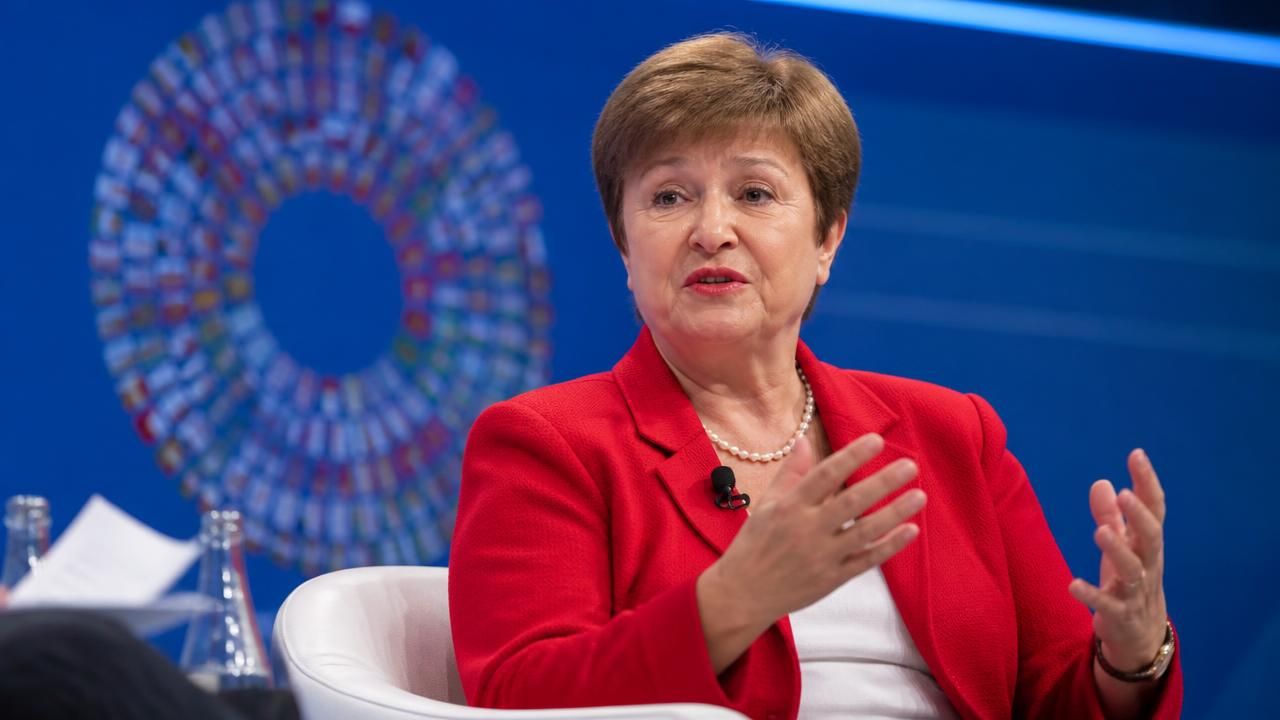
IMF Managing Director Kristalina Georgieva used a wide-ranging conversation with Bloomberg's Romaine Bostick to frame the moment as one of "remarkable resilience under remarkable strain" — an economy still expanding, but expanding against a backdrop of war, energy volatility and political uncertainty.
A Downgrade, Not a Collapse
The headline numbers tell a story of moderation rather than collapse. Reporting from MSN and other outlets put global growth on track to reach roughly 3% in 2026 — a level consistent with the post-pandemic norm, but one that has been shaved down as geopolitical risks intensified. SteelOrbis characterized the revision bluntly: the Fund has cut its global growth outlook for 2026 as geopolitical risks intensify.
The Wall Street Journal framed the same decision far more dramatically, reporting that the IMF had effectively scrapped its outlook for the global economy as the Iran conflict drags on and, separately, that it had cut its 2026 forecast. The divergence in framing is instructive. Where the Journal emphasized disruption to the forecasting exercise itself, other outlets stressed continuity — that a 3% trajectory remains intact, if fragile.
The more alarming thread came from finance.Yahoo's coverage, which reported that the IMF has warned of a potential global recession should high oil prices persist. That warning reflects a familiar transmission channel: a sustained energy shock raises input costs, squeezes household budgets, forces central banks to keep policy tighter for longer, and erodes the fiscal space governments need to cushion the blow.
The AI Buffer
Offsetting that pressure, at least partially, is an investment boom in artificial intelligence. As MSN reported, the AI boom is helping offset the oil shock, but the global economy still faces risks. Capital expenditure on data centers, semiconductors and model development has become a meaningful contributor to growth in the United States and parts of Asia, functioning as a private-sector stimulus at a moment when public balance sheets are constrained.
Economists caution that this buffer is narrow. AI-driven investment is concentrated in a handful of firms and regions, and its spillovers to employment and productivity remain contested. If energy prices stay elevated and the AI cycle cools simultaneously, the cushion could thin quickly.
India Emerges as the Bright Spot
Against that backdrop, India has become the Fund's most reliable growth engine. IMF Deputy Managing Director Nigel Clarke said India remains a key driver for global growth — a message he carried directly into meetings with Indian Finance Minister Nirmala Sitharaman.
"India remains a key driver for global growth." — IMF Deputy Managing Director Nigel Clarke
Sitharaman's discussions with Clarke, reported across MSN, Rediff Moneynews and Fortune India, covered India-IMF ties, the global economic outlook, trade and India's growth trajectory. The Finance Minister also held talks with IMF and World Bank leadership on growth and development, according to Financial Express — a signal that New Delhi is positioning itself as a bridge between advanced and emerging economies at a time of fragmentation.
One technical but consequential item on the agenda: the IMF said a new statistical series could improve India's GDP estimates, with a fresh forecast due in the October World Economic Outlook. Accurate measurement matters disproportionately for India, where nominal growth, deflators and informal-sector activity have long complicated comparisons and occasionally fueled disputes over the credibility of official data.
Why the India Channel Matters
- Scale: India is among the few large economies still expanding fast enough to move the global aggregate.
- Demand: Domestic consumption and infrastructure investment offer an alternative source of demand as Chinese growth moderates.
- Policy: India's fiscal and monetary authorities retain more room to maneuver than many peers.
- Data: Improved statistical methodology could sharpen both markets' and the Fund's read on emerging-market momentum.
How the Story Was Framed
The coverage split along predictable lines. Bloomberg emphasized the institutional voice — Georgieva explaining the outlook in her own words at a marquee forum. The Wall Street Journal led with rupture, using language of scrapped forecasts and conflict. Indian outlets — Business Standard, MSN, Rediff and Fortune India — foregrounded the bilateral dimension, treating the Sitharaman-Clarke and Sitharaman-Georgieva meetings as the story's center of gravity. Trade-focused outlets such as SteelOrbis reduced it to the revision itself.
Read together, the accounts describe a single reality with different emphases: a global economy that is slowing but not stalling, buffeted by war and energy costs, partly cushioned by a technology investment cycle, and increasingly dependent on a small number of large emerging economies — India chief among them.
What to Watch
Three variables will determine whether the IMF's cautious optimism holds. First, the trajectory of the Iran conflict and its effect on crude prices. Second, whether central banks can ease policy without reigniting inflation. Third, whether the AI capital cycle proves durable or merely a cyclical sugar high.
The Fund's October World Economic Outlook — including its revised India estimates — will be the next hard data point. Until then, the message from New York is one of guarded resilience: growth is still coming, but the margin for error has narrowed.