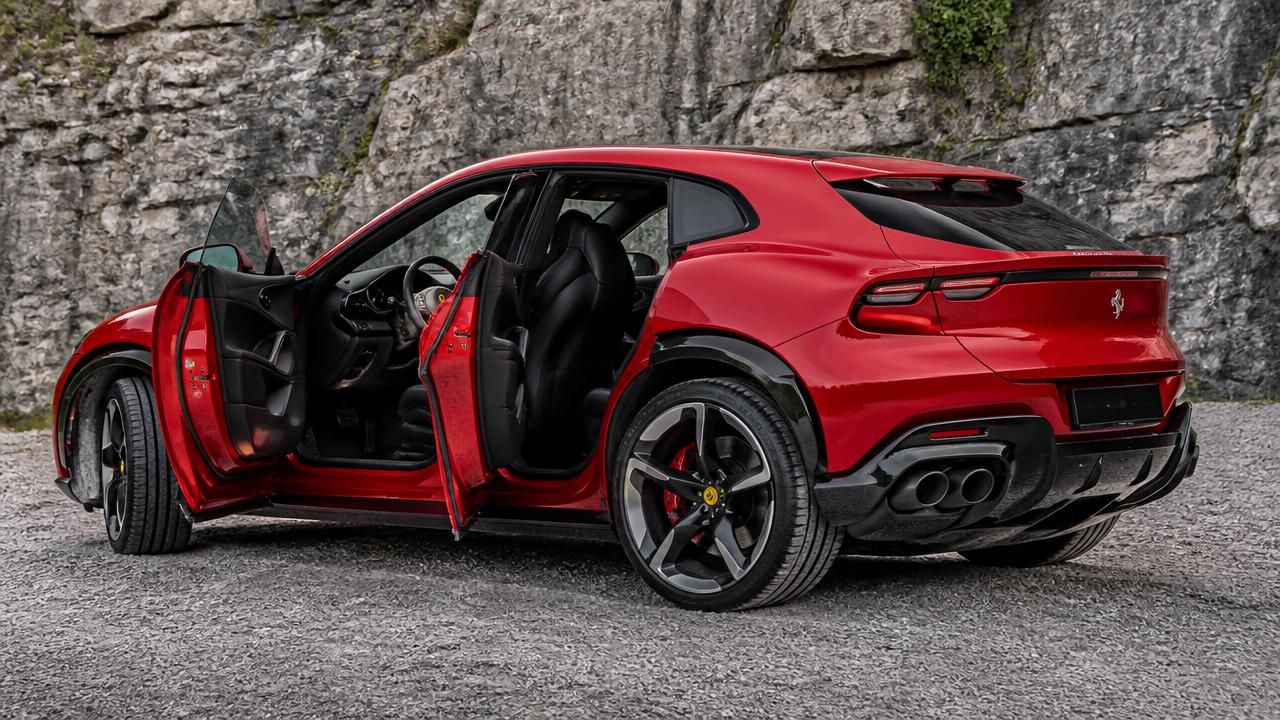
For decades, Ferrari has sold two-seat sports cars as the core of its identity while quietly catering to buyers who wanted to bring someone else along. That accommodation began in the 1960s with the 250 GT 2+2, whose second row was strictly for occasional use—a formula that held all the way through the 612 in the early 2000s. The Purosangue, the marque's first genuine five-door, is where that lineage finally grows up. Yet the most heated argument surrounding the car isn't about its horsepower. It's about what to call it.
A Long Road to Four Real Seats
Ferrari's path to a practical four-seater was gradual. The all-wheel-drive FF, introduced in 2011, was the company's first true four-seater, and it adopted the distinctive "Breadvan" shooting-brake silhouette. It was still a three-door, however, and slightly better at carrying cargo than humans in the rear. The GTC4Lusso that followed kept that three-door layout and much the same compromise: sleek, fast, and awkward for anyone climbing into the back.
The Purosangue rewrites that equation. Rear passengers get their own pair of doors—rear-hinged units that swing open to provide direct access to a pair of rear bucket seats. A rear hatch remains, so the vehicle is technically a five-door. But as Ars Technica's review makes clear, practicality comes with asterisks: there is an immovable firewall separating the cargo area from the passenger cabin, and the rear seats do not fold flat.
The upshot is that a big-box-store run is, in the reviewer's words, "possible, but you're probably going to want a roof rack if you plan to go skiing, cycling, or anything else that requires bulky equipment."
What the Purosangue Actually Is
Underneath the long hood sits the engine that defines the car's character: a 6.5-liter naturally aspirated V12—an increasingly rare configuration in a market racing toward electrification and forced induction. Ferrari's decision to keep the V12 naturally aspirated in its newest, most family-oriented model is a statement of intent, positioning the Purosangue less as a luxury hauler and more as a grand tourer with a stretched cabin.
- Layout: Four seats, rear-hinged rear doors, rear hatch, no folding rear bench
- Powertrain: 6.5-liter naturally aspirated V12
- Ferrari's own label: FUV—Ferrari Utility Vehicle
- Positioning: A high-riding four-seater that Ferrari insists is not a sport utility vehicle
The nomenclature matters to Maranello for reasons that are as much cultural as technical. Ferrari has spent years watching rivals—Porsche with the Cayenne, Lamborghini with the Urus, Aston Martin with the DBX, Rolls-Royce with the Cullinan—expand into the utility segment and reap enormous profits. Ferrari wants the volume and the margin without conceding that it has built the thing enthusiasts once swore it never would.
The Nomenclature Wars
That tension is exactly what Ars Technica's review seizes on, and it is the sharpest framing any outlet has applied to the car. The publication notes that it is "probably accurate that Ferrari says the Purosangue is not an SUV but an FUV—a Ferrari Utility Vehicle," a formulation that simultaneously reports the company's claim and gently signals how much of it is marketing.
It's also probably accurate that Ferrari says the Purosangue is not an SUV but an FUV—a Ferrari Utility Vehicle.
Enthusiast and trade outlets have largely followed the same script, though with different emphases. Automotive shopping and aggregation destinations—Autoblog among them, where the 2026 Purosangue sits as a model-listing page behind a JavaScript and ad-blocker notice—treat the car as a catalog entry: trim, price, specs, availability. General-interest portals such as MSN surface the same material to a mainstream audience with little editorial framing at all. The result is a story told in two registers: a technical, skeptical enthusiast critique on one side, and a spec-sheet commodity on the other.
The Ten-Car Footnote
Scarcity is the other thread running through coverage. Carscoops ran a headline declaring that "Only 10 Of These Ferrari SUVs Exist And Every One Is American"—a framing that leans on the SUV word Ferrari rejects, while pointing to an ultra-limited, US-market configuration. The detail is a reminder of how Ferrari manages demand: production of the Purosangue has been deliberately capped so that it never dominates the brand's output, preserving the exclusivity that underpins resale values and the waiting list alike.
For American buyers, that scarcity is not incidental. The United States is Ferrari's largest market, and limited-run, market-specific builds are a well-worn tool for rewarding the brand's most loyal—and most lucrative—customers.
Why It Matters
The Purosangue is a test case for an entire tier of the auto industry. Ultra-luxury performance brands have discovered that high-riding four-doors pay for the low-volume halo cars enthusiasts actually worship. Ferrari's resistance to the S-word is not just semantics; it is an attempt to capture the utility segment's revenue without diluting the myth that supports its pricing power.
Whether that balancing act holds will be judged less by reviewers than by the order book. Early signals suggest demand far exceeds the supply Ferrari intends to build—the classic condition for a car that will be argued about for years. And the argument, as the coverage so far demonstrates, will be conducted largely over one question: is it an SUV, an FUV, or simply a Ferrari doing what Ferraris have always done—bending categories to fit the customers it wants to keep?