For most of the past century, Tyrannosaurus rex was pictured as a sluggish, tail-dragging reptile that had to warm up in the sun before it could go anywhere. Later research dismantled that image, replacing it with the active, bird-like animal popularized by Jurassic Park. But whether T. rex actually used warm blood to power all that activity remained an open question — until now, perhaps.
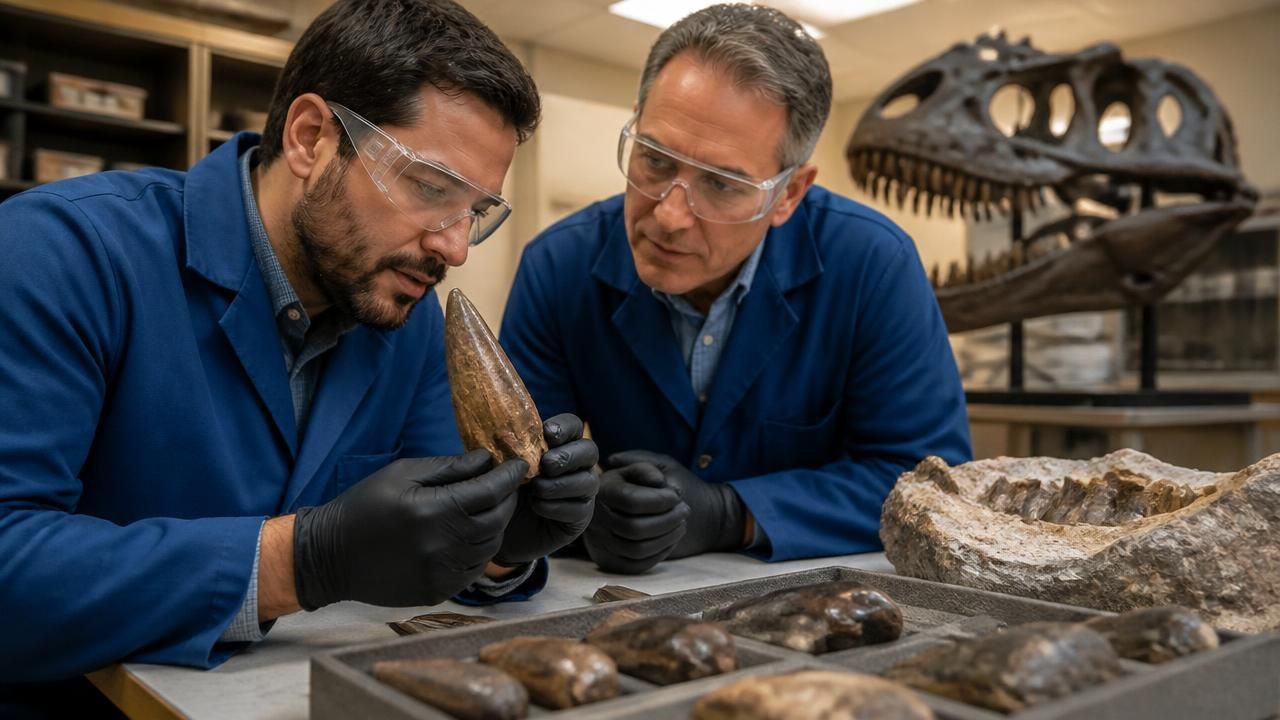
A team of researchers led by Randon J. Flores and Robert A. Eagle, geochemists at the University of California, Los Angeles, has measured the dinosaur's body temperature by analyzing its teeth. Their dental thermometer read about 36° Celsius — roughly the body temperature of a modern elephant, and close to the roughly 37°C that humans maintain. The fossil at the center of the work is about 66 million years old.
A thermometer made of tooth enamel
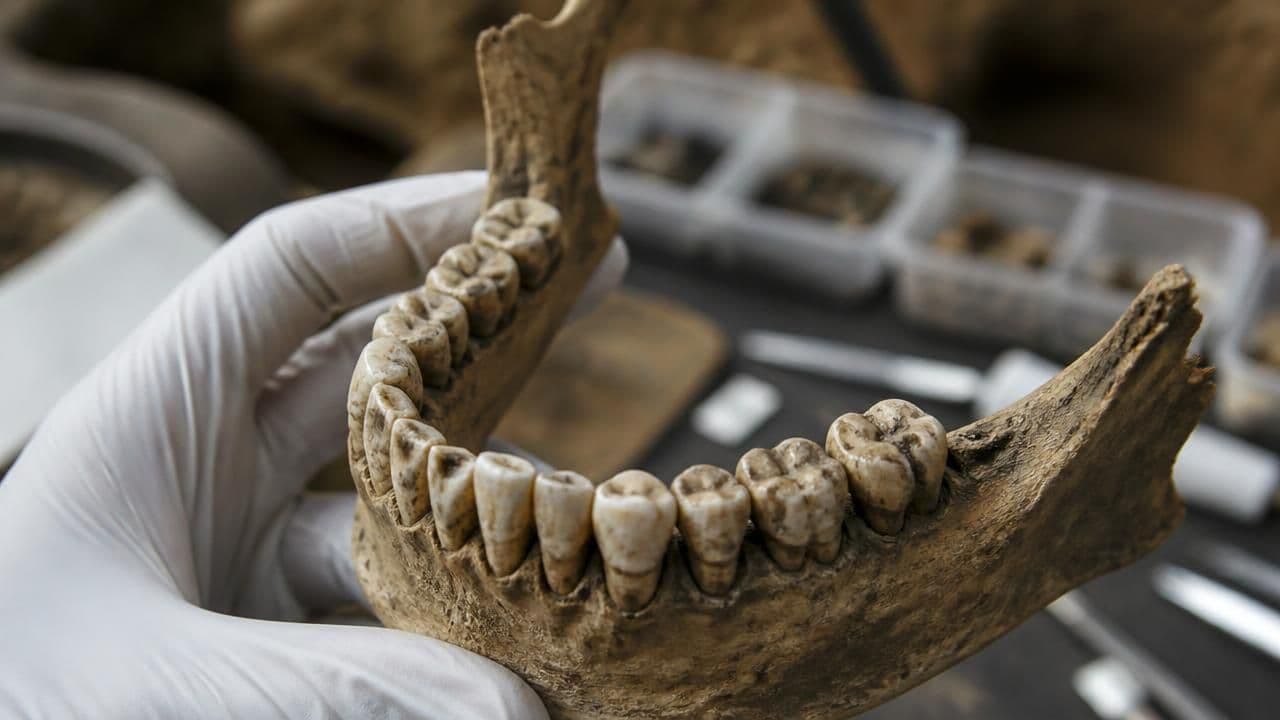
The technique, broadly known as isotope thermometry, exploits a chemical quirk of tooth enamel. As an animal grows, the mineral in its teeth locks in atoms of carbon and oxygen. The way heavier isotopes pair up — or "clump" together — in that crystal lattice depends on temperature, not on the chemistry of the water the animal drank. Because enamel is the hardest tissue in the vertebrate body and survives fossilization exceptionally well, it preserves a durable record of the heat at which it formed.
That makes teeth a rare direct window into dinosaur physiology. Enamel forms at body temperature, so a measurement of its formation temperature is effectively a measurement of the animal's internal thermostat — no sunbathing required.
A debate that wouldn't die
Paleontologists have long argued about dinosaur metabolism using indirect evidence: bone microstructure, growth rates, and the latitudes at which fossils turn up. Some studies concluded that many dinosaurs were endotherms, generating their own heat the way birds and mammals do. Others argued that each lineage may have evolved its own thermal strategy, and that some dinosaurs sat somewhere in the middle — a state researchers have termed "mesothermy."
Those proxy methods were suggestive but never decisive, which is what gives a direct temperature reading its weight. The roughly 36°C result pushes T. rex firmly toward the warm-blooded end of the spectrum, aligning the most famous dinosaur with the birds that descend from its branch of the family tree.
The researchers' conclusion, in essence: the tyrant lizard king's body ran hot — not at reptile temperatures that track the outside air, but at a stable, internally regulated level comparable to a large mammal's.
What a warm T. rex means
- Energetics: Endothermy is expensive. A warm-bodied predator must eat far more often than a cold-blooded one of similar size, which implies T. rex was a high-consumption hunter or scavenger roaming large territories.
- Growth and development: Warmth accelerates development, consistent with evidence that tyrannosaurs grew rapidly as juveniles and reached enormous sizes in their teens.
- Ecology: Warm-blooded predators can stay active across seasons and latitudes, reshaping models of Late Cretaceous food webs.
- Evolution: A warm T. rex strengthens the case that endothermy was widespread among theropods, not an innovation unique to birds.
Caveats and open questions
A single genus, and in many such studies a single specimen or a small sample, cannot settle the metabolism of an entire clade. Temperature estimates can be influenced by the conditions under which a fossil formed, and teeth preserve a localized, not a whole-body, signal. Nor does a warm body temperature guarantee full endothermy as mammals practice it: an animal could run hot through a combination of size, activity, and partial internal regulation.
The next steps will be comparative. If the same technique is applied across a range of dinosaurs — small theropods, ornithischians, sauropods — researchers can map which lineages ran hot and which did not, and when in evolutionary time those strategies appeared.
How the story is being framed
Coverage of the finding has emphasized different angles. Ars Technica framed it as the latest chapter in a century-long reversal, from the tail-dragging sluggard to the bird-like animal of modern paleontology, and placed the new measurement within the long-running dispute over indirect evidence. Aggregator headlines on MSN took a more visceral route, telling readers that scientists had finally taken T. rex's temperature and that it ran "almost as warm as you," or simply that its teeth show it was warm-blooded. ScienceDaily led with the arresting image of a 66-million-year-old tooth revealing a dinosaur "nearly as warm as a human."
Different as the framings are, they converge on one headline fact: the most feared predator of the Mesozoic was not a cold, plodding lizard waiting for the sun. It was, in the most literal sense, hot-blooded.