As millions of Americans prepare to turn their clocks back this weekend, a new study is injecting a safety warning into the long-running debate over daylight saving time: making DST permanent could send schoolchildren to class in darkness far more often, with measurable risks for pedestrians.
The University of Washington research, reported by ScienceDaily and highlighted by SciTechDaily, CNN, USA Today, the Spokesman-Review and other outlets, estimates that permanent daylight saving time could force American children to make at least 2 billion additional school commutes in darkness. It also finds that fatal crashes involving school-aged pedestrians were roughly twice as likely during dark mornings as after sunrise. The study links those risks to both traffic exposure and disruption of children's biological clocks.
A safety trade-off hidden in the clock debate
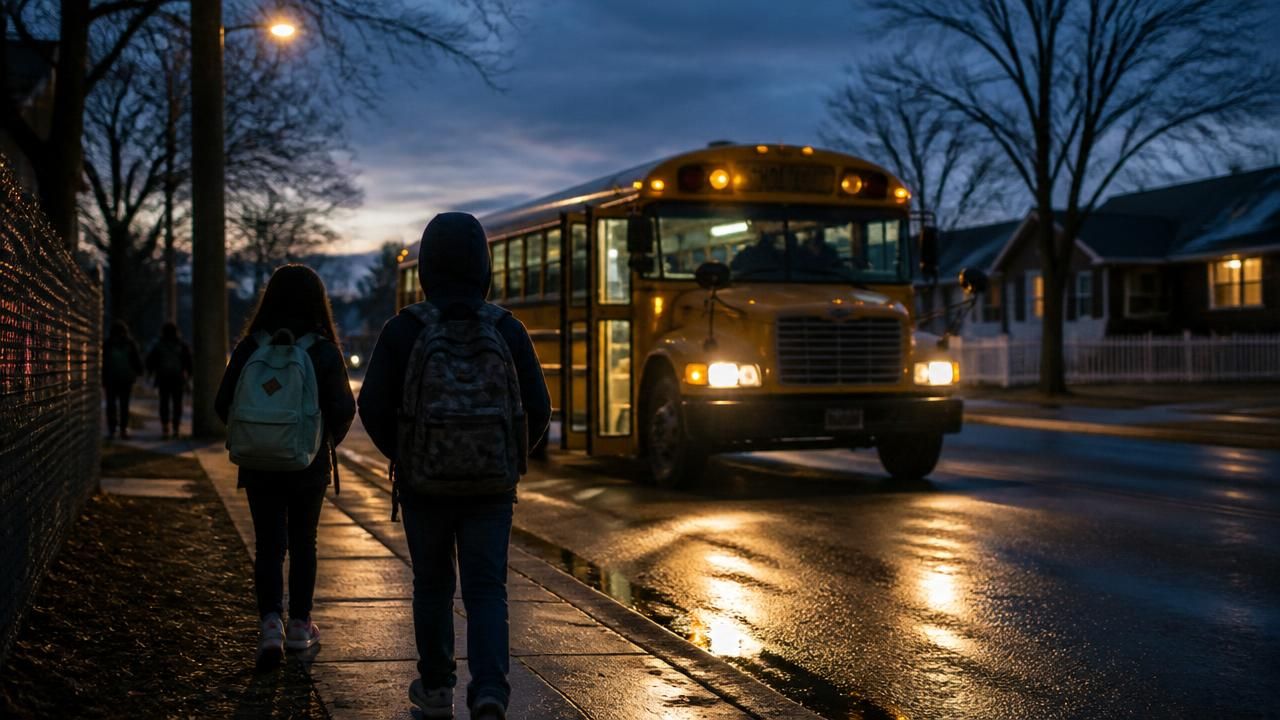
Daylight saving time is usually sold as a way to add evening light, and permanent DST has broad intuitive appeal: later sunsets, more afternoon recreation and an end to the twice-yearly clock change. But the same shift pushes sunrise later in winter. Under permanent DST, children in many parts of the country would wait for buses, walk to school or bike in pre-dawn darkness for more of the school year. The study's estimate that at least 2 billion additional school commutes would occur in darkness is an attempt to quantify that trade-off. It is not a prediction of 2 billion crashes, but a measure of exposure to risk.
Fatal crashes involving school-aged pedestrians were roughly twice as likely during dark mornings as after sunrise, according to the study.
That finding is especially relevant because morning commutes are compulsory. A child cannot choose to skip school because it is dark. The study warns that the risk is compounded by circadian disruption: shifting clocks can misalign sleep-wake cycles, making children less alert and less able to navigate traffic safely. CNN framed the issue around schoolchildren's lives and published an expert explainer, underscoring that the debate is not merely about clock preference but about exposure to traffic during low-light hours.
How outlets framed the findings
Coverage across outlets diverged in emphasis. ScienceDaily and SciTechDaily led with the dark-commute angle, warning that permanent DST could send millions of kids to school in the dark. CNN emphasized the risk to schoolchildren and explained the safety case. The Spokesman-Review and MSN coverage tied the research to the familiar fatigue of time changes, while USA Today's headline warned that scientists see problems with permanent DST. IndyStar, meanwhile, framed the broader fight as a science-versus-politics dilemma, capturing the tension between research findings and the political appeal of later sunsets.
That split reflects a deeper tension. Permanent DST has many champions among lawmakers, business groups and people who prefer brighter evenings. But the new research suggests that the policy's benefits are not evenly distributed. While adults may enjoy more afternoon light, children and early-morning commuters would bear more of the cost in dark winter mornings. The end of daylight saving time this Sunday is a reminder of the stakes: falling back brings earlier sunrises, which can make morning commutes safer for children, but it also brings earlier sunsets and the familiar fatigue of a one-hour shift.
The health and political context
The debate is not new. The United States experimented with year-round daylight saving time in 1974, during an energy crisis, but reversed course after public complaints, especially about dark winter mornings. Lawmakers have since repeatedly proposed making DST permanent, often citing energy savings, economic activity or lifestyle benefits. Scientists have been more cautious, noting that clock changes disturb sleep and that permanent DST would create darker mornings in winter.
The study does not argue for abolishing DST altogether. Rather, it suggests that any move to permanent DST must account for school start times, bus schedules, pedestrian infrastructure and public health. A one-hour shift may sound trivial, but it changes when children wake, when they travel and how much daylight they encounter. The new evidence suggests that the debate should not be framed only around evening light or the annoyance of changing clocks. The morning side of the ledger, especially for children, deserves equal weight.
What would make a difference
- Later school start times could reduce the number of children traveling in darkness, though many districts face budget and transportation constraints.
- Safer walking and biking routes, better lighting and crossing guards could lower pedestrian risk on dark mornings.
- Policymakers could pair permanent DST with targeted safety measures rather than treating it as a simple clock-setting reform.
- Public health officials could monitor sleep and injury data after any change, since the effects may vary by latitude and school district.
For now, the study adds a public-safety dimension to a policy debate that has often been dominated by convenience and politics. As the country again weighs permanent daylight saving time, the warning is clear: brighter evenings may come at a cost that is paid early in the morning, and often by children.