Fear is supposed to sharpen the mind, drawing a clean line between what is dangerous and what is safe. A surprising new body of research suggests the opposite may be true: under threat, the brain appears to blur that line rather than brighten it — and that blurring may lie at the heart of anxiety disorders and post-traumatic stress disorder.
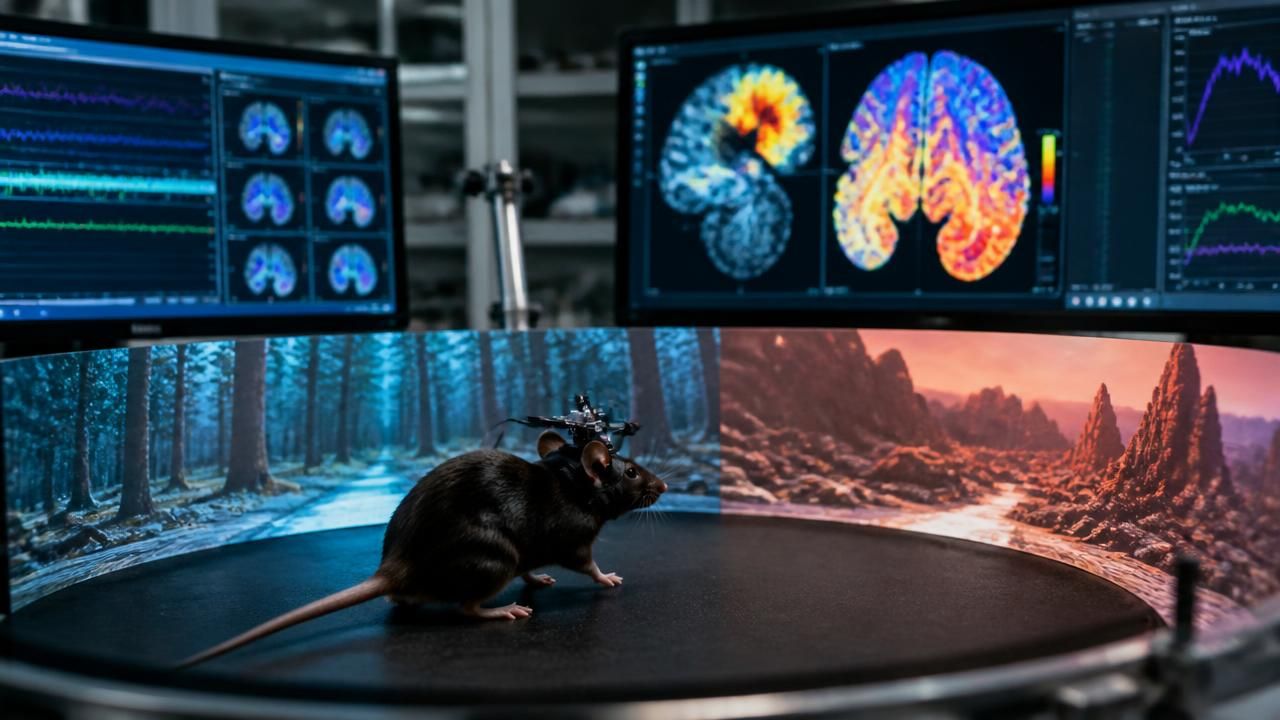
In experiments reported by Science Daily, researchers watched brain activity in mice navigating augmented-reality environments designed to simulate both threatening and harmless spaces. Rather than tightening the boundary between the two, the animals' neural representations of danger and safety began to overlap. The finding reframes a long-standing assumption in neuroscience: that fear learning works like a filing system, keeping 'safe' and 'unsafe' folders strictly apart.
Inside the experiment: overlapping maps of danger
The augmented-reality setup is central to the work. By letting mice move through virtual environments while researchers monitor their neural activity, scientists can hold physical variables constant and manipulate only the cues that predict threat — a level of precision impossible in a conventional maze. What they observed was a creeping convergence: the patterns of activity associated with a frightening context and a benign one drifted closer together rather than diverging.
The behavioral consequence, the researchers suggest, is speed. If the brain treats a gray area as a potential threat, an animal reacts faster when danger does materialize. Science Daily describes this as a survival strategy that sacrifices specificity for readiness — a biological version of 'better safe than sorry.'
Why an imprecise memory can be a good memory
From an evolutionary standpoint, the calculus is easy to defend. Missing a real predator is fatal; mistaking a rustling bush for one merely costs energy. A nervous system tuned to generalize is a nervous system that rarely gets caught off guard.
Memories of threatening and harmless environments began to overlap — a 'better safe than sorry' mechanism that may allow faster responses to danger.
The cost, however, is borne by the animal in the long run. A brain that cannot reliably distinguish safe from unsafe is a brain that remains on alert in places where vigilance brings no benefit. That is, clinically, a familiar description: the persistent, context-inappropriate fear that defines PTSD, and the intrusive worry that characterizes many anxiety disorders.
When adaptive fear becomes pathological
The translational implication is the story's most consequential element. People with PTSD frequently report intense fear responses in objectively safe settings — a doorway, a smell, a tone of voice — and clinicians have long struggled to explain why extinction learning, the process by which the brain learns that a cue no longer predicts harm, fails to stick in these patients. A mechanism that actively merges threat and safety representations would offer a tidy explanation: the safety signal is never encoded as distinct in the first place.
Researchers quoted in the coverage describe the work via Newswise as an effort to understand how the brain learns to predict what to fear based on past experience — framing fear learning as a predictive, not merely reactive, process. That distinction matters for treatment. If the brain is constantly forecasting threat, then therapies that target the forecast — cognitive reappraisal, exposure protocols, and potentially pharmacological adjuncts to extinction learning — may need to be designed differently than those aimed at the fear response itself.
A parallel thread: sex differences in fear memory
Separately, News-Medical reports a finding that complicates any single-mechanism account of trauma: the female brain appears to form fear memories through a distinct molecular process. The headline alone signals a significant shift, aligning with a broader recognition in neuroscience that fear circuitry is not sexually neutral. Women are roughly twice as likely as men to develop PTSD, a disparity long attributed to social and exposure factors but increasingly traced to biological differences in how fear is consolidated and retrieved.
The same outlet reports that a grant has been awarded to investigate the molecular memories behind exaggerated fear — research aimed at identifying the cellular machinery that preserves a traumatic association long after the event. Combined with the sex-difference work, this points toward a future in which fear-related disorders are treated not as a single condition but as a family of mechanistically distinct ones, each with its own molecular signature.
How the outlets frame it
Coverage of the discovery diverges in emphasis. Science Daily leads with the counterintuitive neuroscience — the blurring of danger and safety — and treats anxiety and PTSD as downstream implications. Newswise frames the same work around predictive learning, positioning the study within a broader cognitive-science conversation about how past experience shapes expectation. News-Medical, by contrast, foregrounds the funding and pharmacological angles, treating the study as one piece of a translational pipeline. The Nature Portfolio's ongoing collection on the neurobiological mechanisms of PTSD situates all of it within a mature research field encompassing HPA-axis dysregulation, fear-extinction deficits, and epigenetic regulation of memory.
Caveats and what comes next
The obvious limitation is the species gap. Mouse neural maps are not human neural maps, and augmented reality for rodents, however elegant, cannot capture the narrative and contextual layers that shape human trauma. Researchers will need to test whether the overlap phenomenon appears in human imaging studies, and whether its magnitude correlates with symptom severity.
- Replication: Independent labs must confirm the danger-safety overlap in other models and paradigms.
- Translation: Human neuroimaging could test whether overgeneralization predicts anxiety or PTSD diagnosis.
- Intervention: If overlap is causal, drugs or training that restore separation between threat and safety representations become plausible targets.
- Stratification: Sex-specific molecular pathways suggest treatments may eventually be tailored by biology, not just by diagnosis.
For now, the work offers something rarer than a therapy: a revised picture of what fear is for. The brain, it seems, does not file the world into safe and dangerous so much as hedge — and in some people, that hedge never stops running.