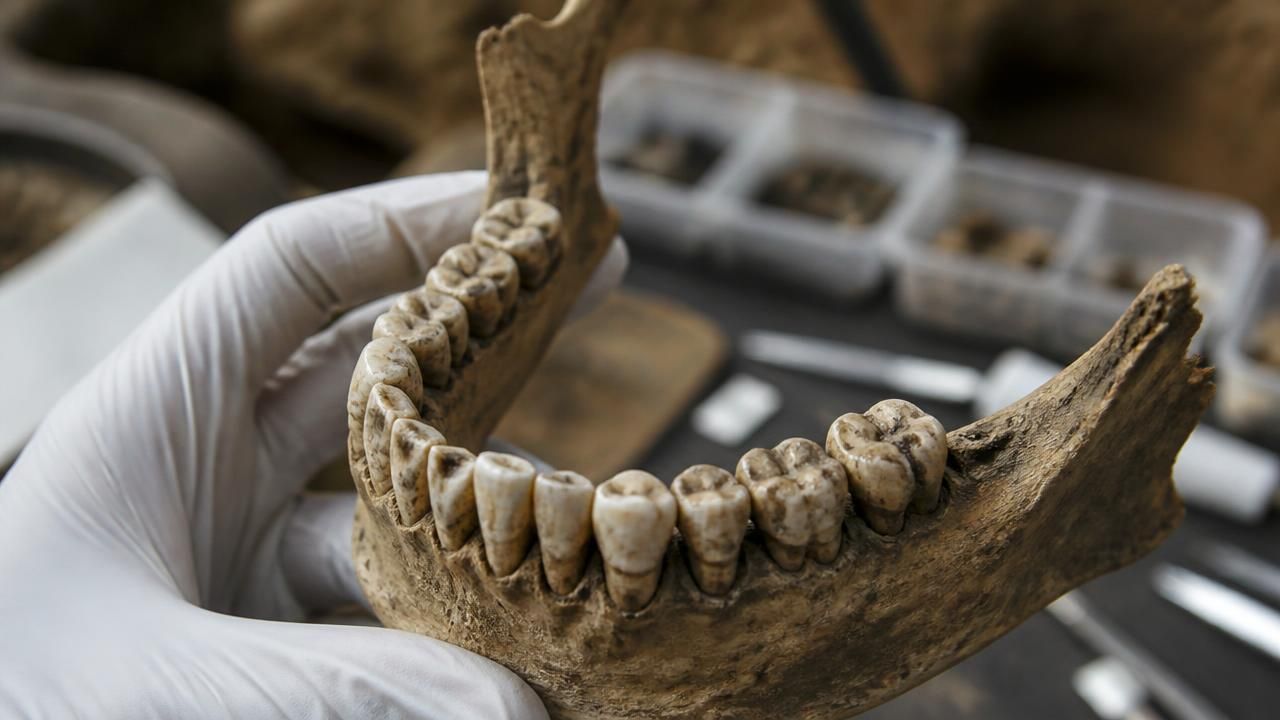
Researchers studying prehistoric human remains say they have identified the earliest known evidence that people deliberately consumed a mind-altering plant: the areca nut, better known as betel nut, a stimulant that remains one of the most widely used psychoactive substances on Earth.
The work, reported by teams examining teeth from Indonesia and Southeast Asia, describes two distinct kinds of evidence — deep, polished grooves worn into molars, and chemical residues locked inside hardened dental plaque — left behind by people who chewed the seed thousands of years before the invention of farming. The story has been covered by NPR, The New York Times, CNN, Popular Mechanics, ScienceDaily, Phys.org, Ancient Origins and others, though the headlines have not agreed on a number: several outlets reported a 25,000-year-old habit, while others emphasized 4,000-year-old chemical traces.
The find
At the center of the coverage is a set of ancient human remains recovered in Indonesia. The teeth show unusual wear patterns — distinctive grooves and staining consistent with the habitual chewing of a fibrous, mildly abrasive seed held against the tooth row for long periods. NPR described betel nut as a top mind-affecting substance, noting that its use is popular across parts of Asia despite the health risks it carries.
Popular Mechanics framed the discovery bluntly: bizarre grooves in ancient teeth had revealed the world's oldest drug habit. ScienceDaily emphasized where the evidence was hiding — in plaque — while CNN and Phys.org highlighted the chemical signature that makes the case unusually direct.
What the teeth actually show
Two separate lines of analysis are at work, and the difference explains much of the confusion in the coverage:
- Physical wear. Habitual chewing leaves mechanical marks — grooves, flattening and characteristic staining — that archaeologists can read even when no organic residue survives. This evidence supports the deeper, Ice Age timeline.
- Biomolecular residue. Calcified dental plaque, or calculus, traps microscopic plant remains and alkaloid compounds. Chemical detection of areca-derived substances in ancient teeth provides the earliest direct proof of consumption, but only where preservation allows.
The active compounds are alkaloids, principally arecoline, which acts on nicotinic receptors in the brain to produce a mild stimulant effect — a buzz, in the vernacular of nearly every report on the subject.
Two timelines, one story
The divergence between the 25,000-year and 4,000-year framings is not a contradiction so much as a difference of method and emphasis. Reports on MSN and IFLScience led with the older date, describing a 25,000-year-old Indonesian hunter-gatherer with a betel nut habit — characterized as the earliest evidence yet of drug use in humans. Ars Technica and Yahoo, drawing on the residue work, framed the finding as betel nuts giving people a buzz for millennia, with the earliest chemical traces appearing in Southeast Asian teeth roughly 4,000 years ago.
Anthropologically, both claims matter. If psychoactive plant use stretches back into the Pleistocene, it predates agriculture, pottery and writing by tens of thousands of years — meaning the pursuit of altered mental states is not a byproduct of settled civilization but a strand of hunter-gatherer life. The Daily Mail leaned into that angle, casting the individual as the world's oldest drug user.
The evidence suggests that deliberately altering consciousness is not a recent human invention, but a practice embedded in everyday life long before the first farms were planted.
The health ledger
Modern coverage of the discovery inevitably circles back to the present. Betel quid — the seed wrapped with lime and often tobacco leaf — is chewed by hundreds of millions of people, concentrated in South and Southeast Asia, Taiwan, Papua New Guinea and diaspora communities worldwide.
A separate review highlighted in the coverage links betel nut dependence to cancer, heart disease and metabolic risks. Health authorities have classified betel quid containing tobacco as a Group 1 carcinogen. Documented harms include:
- Oral and esophageal cancers
- Oral submucous fibrosis, a progressive stiffening of the mouth lining
- Cardiovascular and metabolic complications
- Dependence and withdrawal symptoms
That double identity — a plant that has accompanied humans for millennia and a substance now recognized as a serious public-health threat — is the tension running beneath the archaeological headlines.
Why it matters
The discovery reshapes a familiar question. Rather than asking when humans first used drugs, researchers are increasingly asking why the practice is so old, so widespread and so persistent. Dental calculus, long dismissed as grime, has emerged as a biomolecular archive capable of answering that question.
What remains unresolved is how routine the habit was. A single set of grooved teeth can demonstrate an individual's behavior; only broader sampling across sites and centuries will show whether betel nut was a daily staple, a ritual substance or an occasional indulgence for Ice Age communities whose lives are otherwise largely invisible to us.