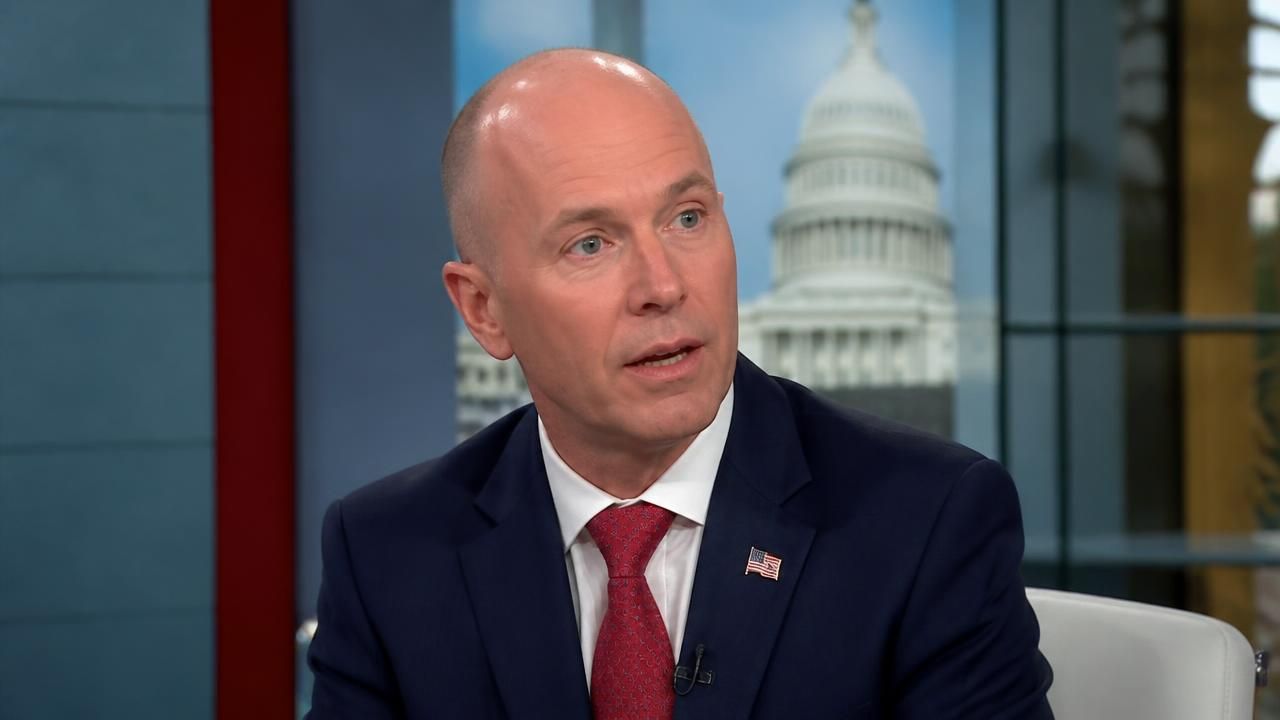
Utah Gov. Spencer Cox is betting that Americans are exhausted — not by politics itself, but by the way they practice it. In his new book, Off Ramp, and across a run of national interviews, the Republican governor argues the country does not need less conflict. It needs better conflict: substantive disagreement stripped of the contempt he says is corroding personal relationships, deepening polarization and, at its most extreme, feeding political violence.
Cox carried that message onto Bloomberg’s This Weekend and to CBS’s Face the Nation with Margaret Brennan, where he sat for a wide-ranging interview broadcast Sept. 13, 2026. He delivered a version of it at Vanderbilt University, warning against political contempt and recalling how Utahns came together after the killing of conservative activist Charlie Kirk. And it forms the spine of a book that asks readers to rebuild local ties — and, as one headline bluntly put it, to put down their phones.
Americans need, in Cox’s framing, “more substantive disagreement” — without the contempt he says is fueling polarization, damaged relationships and political violence.
A diagnosis, then a prescription
The title of Cox’s book is itself the argument. An “off ramp” is what a driver takes when the highway ahead is jammed or dangerous — an exit that does not mean abandoning the journey, only changing the route. Cox’s version of that exit has two lanes: a cultural one and an institutional one.
Culturally, he urges Americans to rebuild the dense, unglamorous networks of local life — school boards, congregations, volunteer shifts, neighborhood friendships — that he argues once absorbed disagreement without breaking into open hostility. Politically, he contends that policymakers need deeper subject-matter expertise to confront emerging challenges, and he singles out artificial intelligence as the sharpest example. The problems arriving fastest, in his account, are technical enough that partisan instinct is a poor substitute for genuine competence.
From the screen to the sidewalk
Different outlets have framed Cox’s project in strikingly different registers. Bloomberg, which hosted him on This Weekend, treated the book as a governing philosophy — a plea for healthier political conflict and stronger local connections, paired with a warning that AI demands expertise that legislatures currently lack. Its coverage foregrounded the statesman’s argument about political violence and the contempt that precedes it.
Politico took a more personal angle, headlining its treatment of Cox’s message by declaring that “America Is Losing Its Mind” and that “this governor wants you to put down your phone.” That framing shifts the emphasis from Capitol Hill to the living room, casting the book less as a policy manifesto than as a self-help intervention for a distracted, doomscrolling electorate. The same underlying claim — that mediated, performative outrage has replaced face-to-face argument — lands very differently depending on which end of the telescope you use.
Cox’s appearance on Face the Nation placed him in the Sunday-show tradition of governors using national airtime to audition a broader message, and he used it to connect the book’s themes to the practical work of governing a state.
Vanderbilt, Kirk and the memory of unity
Speaking at Vanderbilt University, Cox returned to one of the book’s emotional anchors: the aftermath of Charlie Kirk’s killing. In Cox’s telling, that moment produced something rare — a pause in the partisan reflex, an instinct toward mourning rather than scoring points. Tennessee coverage of the speech emphasized that recollection, positioning Cox as a narrator of unity in a period when unity has been scarce and short-lived.
The invocation is delicate. Kirk was a polarizing figure, and the grief that followed his death was not universally shared or expressed. Cox’s rhetorical move is to treat the episode not as a political event but as a case study in what communities do when the usual scripts are suspended — and to ask why that suspension cannot last.
The 2028 question
Not everyone reads the book as pure civic reflection. In Maryland, the Baltimore Sun reported that analysts see the emerging debate between Gov. Wes Moore and Cox as a story about 2028 — a pair of ambitious governors, one a Democrat from Annapolis and one a Republican from Salt Lake City, sketching rival visions on the same national stage. (Portions of that report circulated through regional editions, with some readers encountering access restrictions — a reminder of how unevenly even a national story is distributed.)
The framing is instructive. Cox’s anti-contempt message, delivered through a book tour and Sunday-show bookings, is simultaneously a governing agenda, a personal brand and a possible opening argument for a national campaign. That ambiguity is not unusual — most political books carry it — but it complicates the reception of a text that asks readers to tune out the horse race.
Why the message lands now
Cox is not the first governor to write about polarization. What distinguishes Off Ramp is its insistence that the solutions are simultaneously intimate and technocratic: call your neighbor, and also staff your regulatory agencies with people who understand model weights and compute policy.
Whether that combination travels nationally is an open question. Contempt is cheap to produce and profitable to distribute, and the incentives arrayed against Cox’s off ramp are formidable. But his bet — that a critical mass of Americans is looking for an exit rather than a fight — is now on the record. The next two years will test whether anyone takes it.