For more than a century, Albert Einstein's general theory of relativity has survived every experiment physicists could throw at it. Now, a wave of new work is pushing the theory into territory it was never designed to be tested in: the quantum world. The latest advance, reported by Science Daily, describes a new method for creating a controlled beam of muonium — an exotic atom made of an electron bound to a muon, the electron's heavier, second-generation cousin — that could let researchers ask whether gravity treats matter differently depending on its generation.
The result caps a busy stretch of quantum-gravity headlines. In recent days, outlets ranging from Yahoo and MSN to Discover Magazine, Knowridge and the Jewish News Syndicate (JNS) have all reported variations on the same theme: Einstein's equivalence principle — the idea that all objects fall the same way regardless of their composition — is being interrogated with atoms, quantum wave packets and, increasingly, gravitational waves. Each outlet frames the stakes slightly differently, but the underlying question is identical: does general relativity remain exact, or does something new begin to leak in at the quantum frontier?
The Muonium Beam: A New Kind of Antimatter Probe
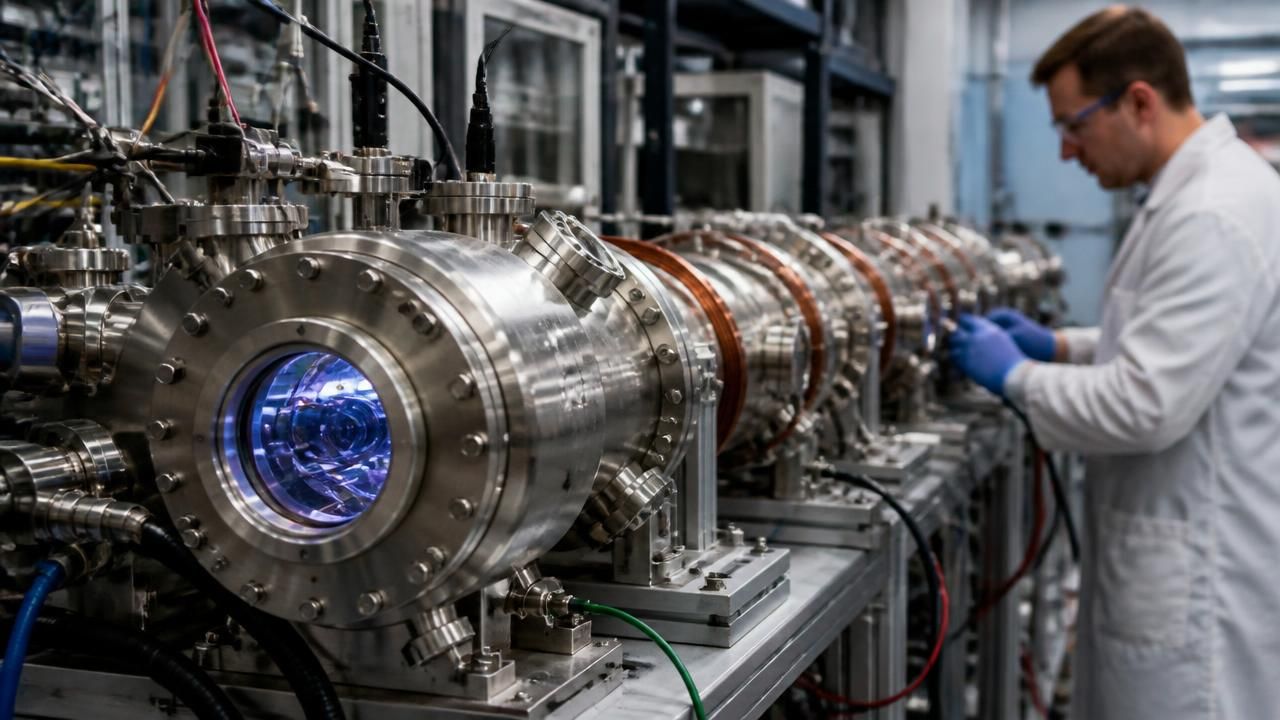
Muonium is a short-lived curiosity: a positively charged muon and an electron orbiting each other for around two microseconds before the muon decays. Producing it in a controlled, collimated beam — rather than as a scattered spray — has long been the stumbling block. According to the Science Daily report, scientists have now found a way to do precisely that, opening the door to interferometry experiments in which muonium atoms are dropped, split and recombined to measure how gravity pulls on them.
Why muonium? Because the muon is effectively a second-generation electron, roughly 200 times heavier. If gravity's strength depends on some property beyond mass-energy — a hypothetical "fifth force" that couples differently to different particle families — muonium would be the ideal place to spot it. MSN's headline writers leaned into the drama, describing the apparatus as a "mad-scientist antimatter beam," while others framed it more soberly as a "cold beam of exotic atoms" or a "novel particle beam" that could "challenge Einstein's theory of gravity."
Any unexpected difference would be a major surprise, and could potentially point toward new physics, including a hypothetical fifth force.
The Quantum Drumbeat: Falling Objects and Wave Packets
In parallel, a separate line of experiments has been testing the equivalence principle with genuinely quantum objects. Science Daily reported that researchers had, for the first time, observed Einstein's gravity operating in the quantum world — an experiment picked up and reframed by Knowridge as "scientists see Einstein's gravity at work in the quantum world." Discover Magazine's headline described the same result as the equivalence principle "passing a quantum test," a notably more cautious reading that emphasizes confirmation rather than revolution.
Yahoo's coverage underlined the historical dimension: a falling quantum object had passed a century-old test of Einstein's gravity, a nod to the legendary Eötvös and Galileo experiments that falsified early alternatives to Newtonian gravity. The modern twist is that the falling object is no longer a cannonball or a bronze cylinder but a delocalized quantum wave packet, held in a superposition of positions and released under free fall.
JNS added a further strand to the story, reporting that an Israeli research team's falling-atom experiment points toward a new generation of tests at the quantum-gravity frontier. That work is significant because quantum objects sit on the boundary of the two theories that modern physics cannot yet reconcile: general relativity, which describes gravity as curved spacetime, and quantum mechanics, which governs everything else. If a quantum system were found to violate the equivalence principle — if its different internal energy states fell at different rates — it would signal a crack in one of the founding assumptions of general relativity.
Black Holes as Laboratories
The tests are not confined to tabletop laboratories. Yahoo also reported on proposals to use the "ringing" of black holes — the gravitational-wave signal emitted as a newly merged black hole settles into its final state — as possibly the toughest test yet of Einstein's theory. Such ringdown measurements probe gravity in the most extreme regime available to astronomers: spacetime curvature so violent that any deviation from general relativity should be greatly amplified.
Together, these approaches form a triangulation strategy. Precision atomic experiments hunt for small, local deviations; black hole observations look for large, distant ones. A signal in either would be transformative; agreement across both would tighten the constraints on alternative theories of gravity sharply.
How the Story Is Being Framed
The coverage reveals a telling split in tone. Science-focused outlets such as Science Daily, Knowridge and Discover Magazine emphasize methodological advance and confirmation: Einstein's theory, once again, appears to hold. Broader aggregators — MSN among them — favor the language of challenge and upheaval, with headlines about relativity being "shaken," "challenged" or tested by "mad-scientist" apparatus.
The tension is not dishonest; it reflects genuine scientific uncertainty about what lies beyond the Standard Model and general relativity. Establishing that the equivalence principle holds for second-generation particles, for quantum wave packets and for merging black holes would not be a null result — it would be an extraordinary sharpening of the boundary within which any future theory of quantum gravity must operate.
What Comes Next
- Muonium interferometry: turning the new beam into a working free-fall interferometer, with the muon's short lifetime the central technical hurdle.
- Quantum equivalence principle tests: extending falling-atom experiments to more massive, more delocalized objects, where deviations are more likely to surface.
- Gravitational-wave ringdown: using next-generation detectors to extract black hole quasinormal modes with enough precision to distinguish general relativity from its rivals.
None of these experiments will overthrow Einstein overnight. But each narrows the space in which a fifth force or a quantum correction to gravity could hide — and, in the process, moves physics closer to the day when the theory that has defined a century of cosmology must finally answer to the quantum world it never described.