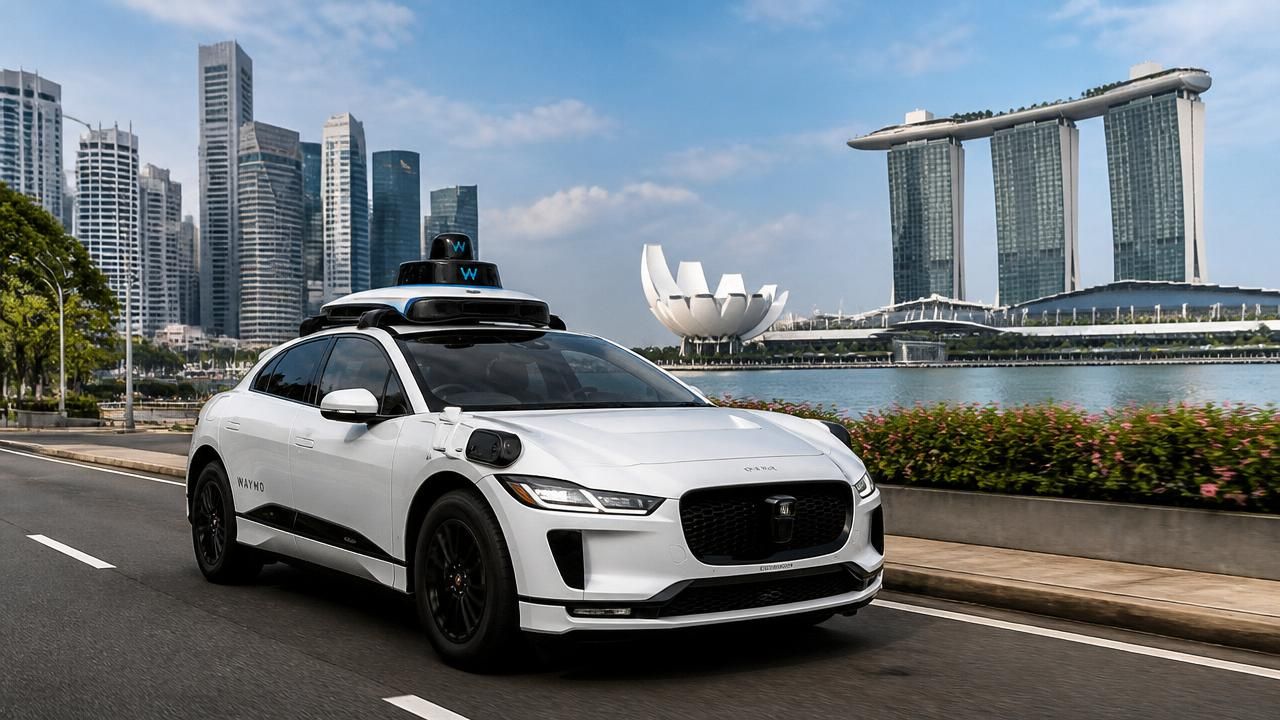
Waymo will begin offering fully autonomous, paid ride-hailing in Singapore in 2028, the Alphabet-owned company said, setting up what would be its first commercial robotaxi operation outside the United States and a high-stakes test of whether its driverless technology can translate to a radically different urban environment.
The announcement, reported in near-identical terms by The Verge, MSN and the financial newswire MarketScreener, marks the most concrete step yet in Waymo's long-telegraphed international ambitions. The company has spent years expanding across American cities — San Francisco, Phoenix, Los Angeles, Austin and Atlanta among them — while rivals in China have moved aggressively into overseas markets.
The plan: map first, drivers later
Under the timeline laid out by the company, Waymo vehicles will begin arriving in Singapore in "the coming months." That initial phase will be dedicated to mapping the city-state's streets and building the digital infrastructure the system depends on. In 2027, Waymo intends to begin autonomous testing with human safety drivers behind the wheel — the standard intermediate step before removing the fallback operator entirely.
Only then does the company expect to reach its goal of full driverless service.
Waymo says it is "working toward offering fully autonomous ride-hailing to the public" by 2028.
The sequencing is deliberate. Waymo's playbook in every new market has been to accumulate local driving data under supervision before exposing passengers to an unmonitored vehicle. Singapore's compact geography — roughly 730 square kilometers, with dense, well-maintained roads and predictable traffic patterns — makes it an unusually attractive candidate for that process, even as its tropical downpours, humidity and heavy pedestrian traffic present sensor challenges that Waymo's desert and California deployments have not fully stress-tested.
Singapore's regulatory gate
Nothing about the 2028 target is guaranteed. Waymo must secure approval from Singapore's Land Transport Authority before it can accept a single paying passenger, and the city-state requires every autonomous vehicle to undergo a formal safety assessment, typically conducted at a designated testing facility before public-road deployment.
Singapore has quietly assembled one of the world's more developed AV governance regimes. The LTA has run regulatory sandboxes for years, and the CETRAN test centre at Nanyang Technological University has served as the country's primary proving ground for autonomous systems. Authorities have also been moving toward a formal licensing framework for driverless services, positioning the city-state as a jurisdiction that wants the technology — but on its own terms.
That posture cuts both ways for Waymo. It means a slower, more expensive entry than operating in permissive U.S. states. It also means regulatory clarity, a single national authority, and a government that has historically been willing to partner with operators it deems safe.
The Ojai factor
While The Verge and financial outlets focused on the expansion announcement itself, Forbes approached the story from the passenger seat, publishing a first-hand account of rides in Waymo's Ojai vehicle that it framed as a window into the robotaxi future. The vehicle — the newest hardware platform in Waymo's fleet, and the model pictured operating in San Francisco — has become the company's calling card as it courts new markets.
The product-experience angle matters commercially. Waymo's expansion case rests not just on technical feasibility but on whether riders find the service comfortable, reliable and unremarkable enough to use routinely. Every new city is, in effect, a referendum on that question.
Why Singapore, and why now
Singapore fits Waymo's commercial calculus on several fronts. It is wealthy, densely populated and tech-forward, with a government that has spent a decade preparing for autonomous transport. Driver labor is relatively expensive, strengthening the economics of replacing it. And unlike the U.S., the city-state drives on the left — a genuine engineering consideration for a fleet built around left-hand-drive vehicles and American traffic conventions.
Competitive pressure is another factor. Chinese operators including WeRide and Pony.ai have already conducted trials in Singapore, and Baidu's Apollo Go has expanded internationally. Waymo's decision to plant a flag in Southeast Asia signals that it does not intend to cede the global market to lower-cost Chinese competitors.
The financial stakes are considerable. Waymo has raised billions from outside investors, and its reported valuation has climbed sharply as its U.S. ride volumes have grown. Overseas expansion is the central plank of the growth story that valuation depends on — and Singapore is its proof of concept.
How the story was framed
- The Verge led with the international-expansion narrative and the regulatory mechanics: vehicles first, safety drivers next, passengers last, subject to LTA sign-off.
- MSN emphasized the commercial milestone, framing the news around paid robotaxi rides beginning in 2028.
- MarketScreener, aimed at investors, treated it as a corporate development headline — a growth signal for Alphabet shareholders rather than a technology story.
- Forbes sidestepped the announcement cycle entirely, using the Ojai ride experience to ask what the robotaxi era will actually feel like for passengers.
Taken together, the coverage captures three different stories inside one: a regulatory story, an investor story and a consumer story.
What to watch
The near-term signals will be procedural. Watch for the first vehicles to clear customs and begin mapping runs, for the LTA to confirm the terms of Waymo's testing permit, and for whether the 2027 supervised trials stay on schedule. Any slip in that chain pushes the 2028 passenger target further out.
The longer-term question is whether Singapore becomes a template or an exception. If Waymo can operate profitably in a left-hand-drive, tropical, heavily regulated city-state, the case for rapid further international expansion becomes far easier to make. If it stalls, the company's global ambitions may remain, for now, an American story with a single Asian footnote.