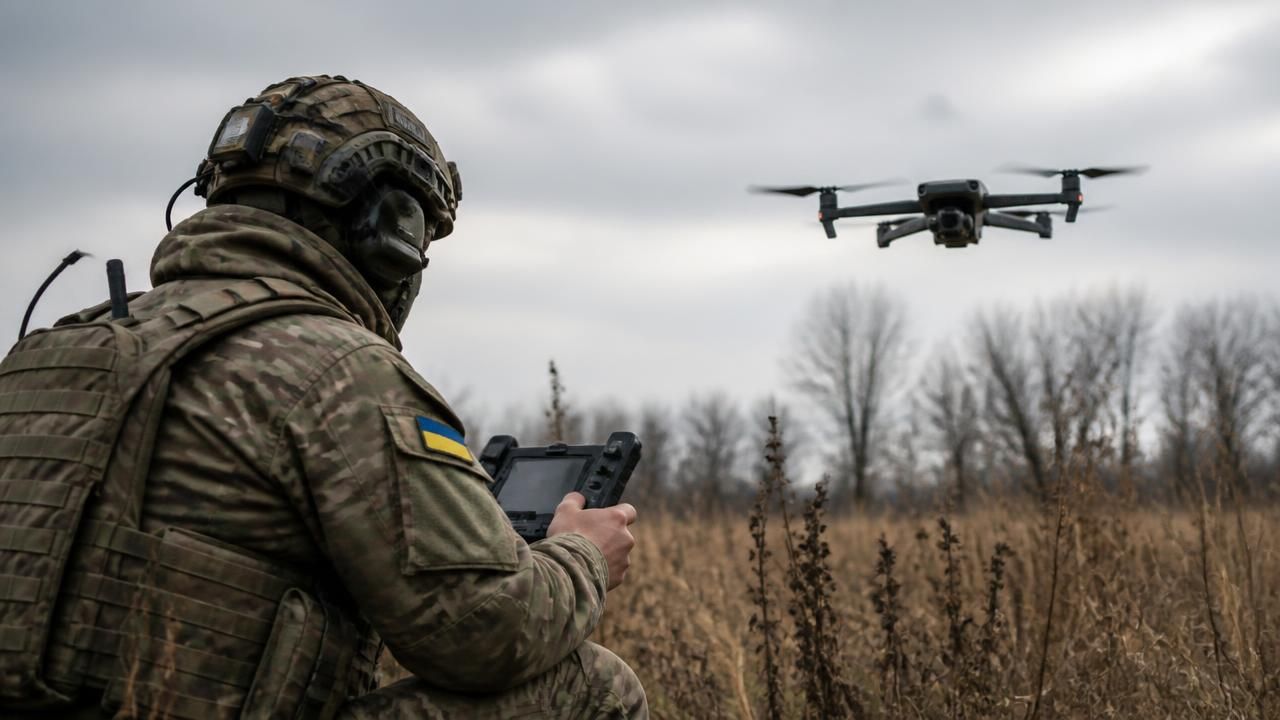
A Swedish software company founded by researchers from Uppsala University is helping NATO militaries put machine-learning target detection directly onto small drones — a technical shift that, according to analysts and battlefield observers, is quietly pushing warfare toward machines that can find and, increasingly, select their own targets.
The development, detailed by Ars Technica and framed by the Financial Times as evidence that "the era of AI warfare has arrived," is the latest sign that Russia's war in Ukraine has become a live laboratory for artificial intelligence, with both Kyiv and Moscow racing to field systems that operate faster than a human operator can react.
From truck telematics to the battlefield edge
Scaleout Systems, founded in 2018 in Sweden, initially built tools for training and deploying machine-learning models on the modest hardware found inside commercial trucks and other vehicles. The premise was "edge" computing: rather than shipping sensor data to a distant data center, the company's software squeezed useful models onto whatever processors were already on board.
Then Russia launched its full-scale invasion of Ukraine in February 2022, and the company's trajectory changed. According to Ars Technica, Scaleout pivoted toward defense applications, joining the ranks of NATO-backed firms working to move AI-driven target detection and selection onto drones conducting surveillance and attack missions.
"With the war in Ukraine and a shifting world, we realized that this technology can be very important to operationalize edge data and sensor data for machine learning to make sure that NATO allies have found that strategic advantage." — Andreas Hellander, cofounder and CEO of Scaleout Systems
What 'AI on the edge' actually means
- Detection versus selection. The technology spans a spectrum, from flagging objects in a camera feed for a human operator to ranking and choosing among them — a distinction that matters enormously under international humanitarian law.
- Latency and jamming. Small drones in Ukraine frequently lose their radio links to electronic warfare. On-board models keep working when the connection does not.
- Compute constraints. The models must run on grams of silicon and watts of power, which is why Scaleout's origin in vehicle-grade hardware may prove as relevant as any weapons expertise.
Ukraine as proving ground
The sharpest framing of where this is heading came from a Ukrainian drone specialist, whose assessment circulated via MSN: that the next evolution of attack drones — the Shahed family of loitering munitions being the reference point — will see AI choosing their own targets.
Shahed-136 drones, supplied to Russia by Iran, have been used in massed strikes against Ukrainian cities and infrastructure. Their current versions are typically pre-programmed with coordinates; adding autonomous target selection would compress the kill chain to milliseconds and remove the human from the final decision in any meaningful sense.
Moscow's autonomous turn
A second MSN report stated that Russia has deployed autonomous AI drones in the Ukraine war — a claim consistent with a broader pattern in which both sides have layered increasingly capable machine vision onto cheap, expendable airframes. Independent verification of fully autonomous lethal engagement remains difficult, however. Open-source researchers caution that "autonomous" is often used loosely to describe automated navigation, terminal homing, or automated target recognition rather than true machine decision-making about whom to kill.
How the outlets frame it differently
The coverage splits along revealing lines. Ars Technica anchors the story in a single company and its engineering journey, treating Scaleout's pivot as an emblem of how European industry recalibrates around defense. The Financial Times zooms out, casting the moment as a threshold event — a new era in which AI is not an accessory to war but a participant.
The two MSN-syndicated items narrow the lens to the battlefield itself, with headlines that emphasize Ukrainian expertise and Russian deployment. Their framing is more operational and adversarial: what is happening right now in the skies over Donetsk and Zaporizhzhia, rather than what the technology portends for NATO procurement over the next decade.
The unanswered questions
None of the accounts resolves the central governance problem. International talks on lethal autonomous weapons systems have been under way for more than a decade without producing a binding treaty. Human rights organizations and some states argue for "meaningful human control" over the use of force; major military powers, including the United States and Russia, have resisted hard limits.
Technical risks compound the legal ones: false positives, spoofing, and the difficulty of attributing accountability when a machine misidentifies a target. There is also a strategic dimension — once autonomous targeting becomes cheap and widely available, the capability will diffuse far beyond state arsenals.
What to watch
Expect continued silence from manufacturers on exact deployment details, more declaratory claims from both militaries, and a growing gap between what is provable from open-source imagery and what is asserted by industry and governments. The decisive test may be less about whether the technology works than about who is willing to say, on the record, where they have drawn the line on letting it decide.