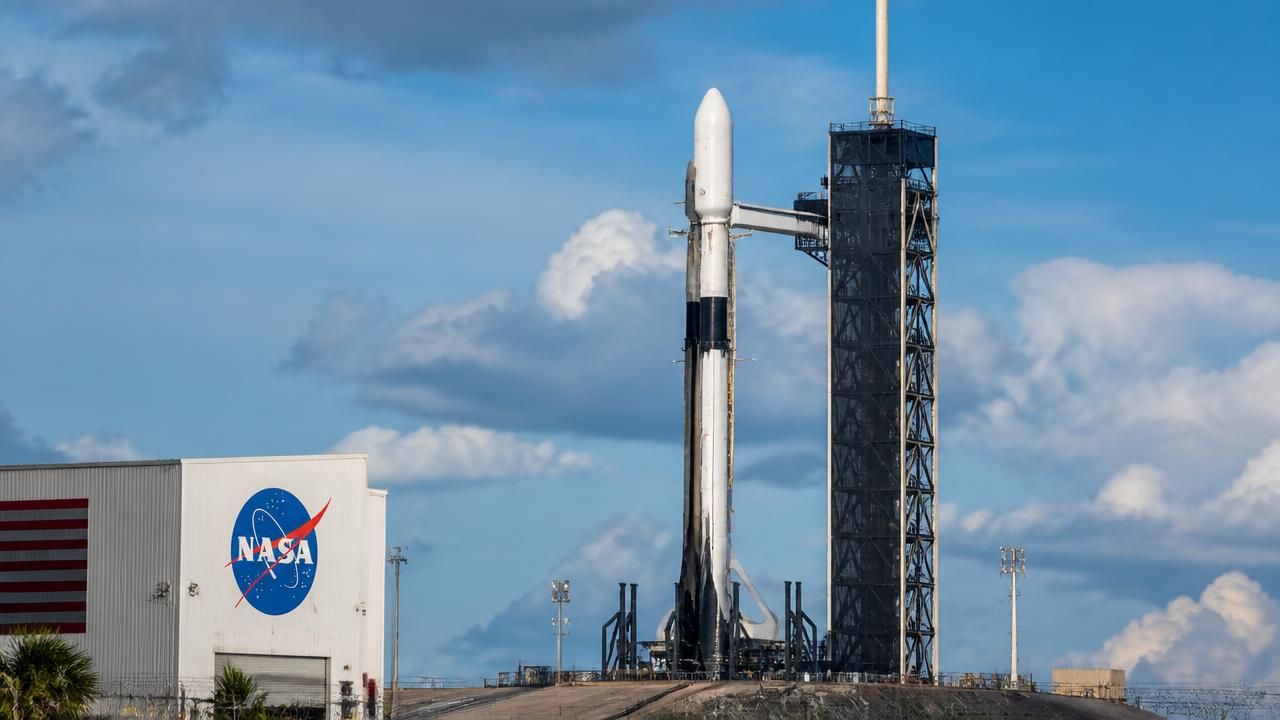
NASA has selected SpaceX to launch its StarBurst mission, a small satellite designed to investigate neutron star mergers and the origins of short gamma-ray bursts. The launch is scheduled no earlier than 2028 aboard a Falcon 9 rocket from Space Launch Complex 40 at Cape Canaveral Space Force Station in Florida, as part of a Bandwagon rideshare mission.
The award is a firm-fixed-price task order under NASA’s VADR (Venture-Class Acquisition of Dedicated and Rideshare) launch services contract, an indefinite-delivery/indefinite-quantity vehicle with a 10-year ordering period and a maximum total value of $1 billion across all contracts. The selection underscores NASA’s continuing bet on rideshare launches to hold down costs for smaller astrophysics missions.
A Wide-Field Hunter of Cosmic Explosions
StarBurst’s instrument will monitor the entire portion of the sky not blocked by Earth, scanning for brief, powerful explosions known as gamma-ray bursts. It will focus on the initial high-energy emission from short gamma-ray bursts, which occur when dense stellar remnants called neutron stars merge. These mergers are among the most violent events in the universe, producing ripples in spacetime that gravitational-wave observatories can detect and electromagnetic radiation that telescopes can study.
StarBurst will launch aboard a Bandwagon rideshare mission on a Falcon 9 rocket from Space Launch Complex 40 at Cape Canaveral Space Force Station in Florida no earlier than 2028.
By combining StarBurst’s observations with gravitational-wave measurements and follow-up observations from other telescopes, researchers will study these events through multiple types of signals—an approach known as multimessenger astronomy. The mission is part of NASA’s Astrophysics Pioneers Program, which supports lower-cost investigations using small spacecraft and other platforms.
Why Short Gamma-Ray Bursts Matter
Short gamma-ray bursts last only fractions of a second, but they release enormous energy. Astronomers believe they are powered by the merger of two neutron stars or a neutron star and a black hole. Such events are also thought to forge heavy elements like gold and platinum, seeding the cosmos with material that eventually becomes planets and people. Catching the prompt gamma-ray flash is difficult because it fades quickly and can be missed if observatories are not pointed in the right direction.
StarBurst is designed to help solve that problem by watching a huge swath of sky continuously. If it detects a burst, ground- and space-based observatories can be alerted to follow up across the electromagnetic spectrum. At the same time, gravitational-wave detectors such as LIGO, Virgo, and KAGRA can provide independent confirmation of a neutron star merger. The combined data can reveal the physics of the merger, the nature of the resulting object, and the environment around it.
Contract Details and Launch Plans
The launch will use a Falcon 9 rocket as part of SpaceX’s Bandwagon rideshare program, which offers relatively low-cost rides to orbit for small satellites. NASA’s VADR contract is designed to streamline acquisitions for venture-class missions, allowing the agency to tap commercial launch services without building a new contract for each mission. The StarBurst task order is firm-fixed-price, meaning SpaceX will deliver the launch service for a set price.
NASA’s Launch Services Program Office will manage the launch. The agency has not announced a specific launch date beyond “no earlier than 2028.” That timeline gives mission planners time to finish building and testing the satellite, integrate it with the rideshare stack, and coordinate with other payloads on the Bandwagon mission.
How Different Outlets Framed the Story
Coverage of the award varied by audience. NASA’s own announcement emphasized the science objectives, the VADR contract mechanism, and the technical details of the launch. Financial and business outlets, including Yahoo Finance and MSN, led with SpaceX’s selection as a commercial win. One MSN headline described StarBurst as a gamma-ray sensor that “could unlock one of the universe’s biggest mysteries,” framing the mission in accessible, discovery-driven terms.
Another financial headline reported that the ticker SPCX edged higher in after-hours trading after the NASA selection. SpaceX is privately held and does not trade on public markets, so any move in a ticker with similar letters likely reflects broader investor sentiment around space-related securities rather than direct ownership of SpaceX. The contrast illustrates how the same contract can be read simultaneously as a scientific milestone and as a market signal about the commercial space economy.
The Bigger Picture
StarBurst is one of a new generation of small, focused astrophysics missions that aim to do big science on modest budgets. The Astrophysics Pioneers Program has supported concepts that might otherwise struggle to win funding in a field dominated by large observatories. By pairing a wide-field gamma-ray detector with gravitational-wave observatories, StarBurst could help cement multimessenger astronomy as a routine way of studying the universe.
The mission also reflects NASA’s growing reliance on commercial rideshare launches. Falcon 9 has become a workhorse for both dedicated and rideshare missions, and VADR gives NASA a flexible way to buy those services. If StarBurst succeeds, it could pave the way for more small satellites designed to catch fleeting cosmic events in coordination with global observatories.
For now, the 2028 launch date leaves several years of development. Researchers will be watching closely, because every short gamma-ray burst captured alongside a gravitational-wave signal offers a rare chance to test theories of matter at extreme densities, the behavior of gravity, and the origin of the heaviest elements. The mystery that StarBurst is chasing is not just one of the universe’s biggest—it is one of its most fundamental.