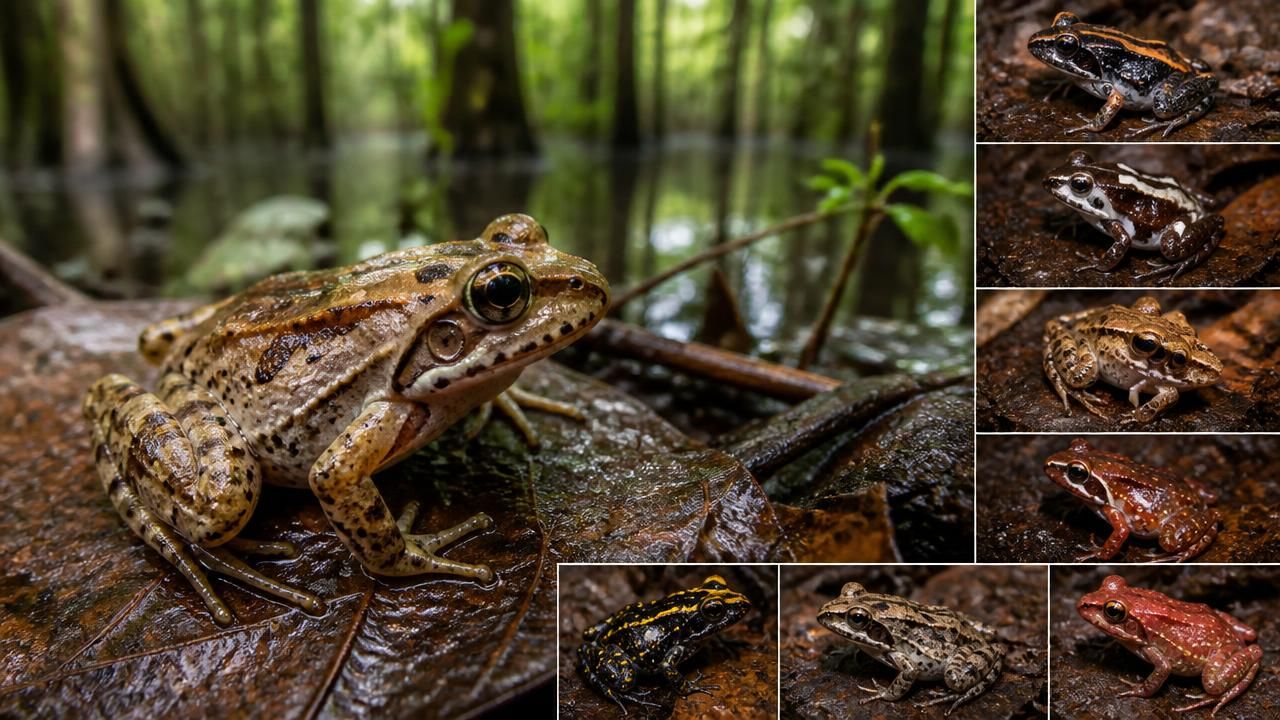
Two discoveries announced from opposite sides of the planet have converged on a single, uncomfortable conclusion: scientists are still finding frogs that nobody knew existed, and many of them are running out of time.
In the flooded forests of the western Amazon, researchers have described a new species, Adenomera varcena, that is nearly indistinguishable from its closest relatives by sight alone. Thousands of kilometers away, on the forest floor of northern Madagascar, a separate team has described seven new species of diamond frog, a genus of tiny, leaf-litter-dwelling amphibians that spend most of their lives out of view.
Together, the papers amount to more than a taxonomic footnote. They are a reminder that the tropics remain a frontier for discovery, and that species can vanish before they are ever named.
A Call in the Flooded Forest
The Amazonian frog was found in the seasonally inundated forests of the western Amazon, an ecosystem that floods for months each year and that has long confounded surveyors. Adenomera varcena belongs to a genus of small, ground-dwelling, foam-nesting frogs whose members look so similar that field biologists have historically lumped them together.
What gave the species away was not its appearance but its voice. Each Adenomera lineage produces a distinctive advertisement call, and the new species' call did not match any known recording. Genetic analysis subsequently confirmed that the population was reproductively isolated from its lookalikes — the classic signature of a cryptic species, one hidden behind morphological similarity.
The discovery highlights how much Amazonian biodiversity remains hidden, even as habitat loss and climate change threaten these poorly understood species.
That framing, advanced by the researchers and amplified by ScienceDaily's coverage, places the frog squarely within a broader argument: the Amazon's species inventory is far from complete, and the window for completing it is narrowing.
Seven Frogs Beneath Madagascar's Leaf Litter
The Madagascar findings are striking for their sheer number. Seven new diamond frogs — small, mostly brown and cryptically patterned members of the microhylid genus Rhombophryne — were identified from the island's forest floor, where they live among fallen leaves and are rarely encountered by anyone not specifically looking for them.
Diamond frogs are among the least-studied vertebrates in Madagascar. Many are known from a single mountain, a single valley, or in some cases a single specimen. Their calls are often faint, their breeding behavior is poorly documented, and their ranges can be measured in hectares rather than kilometers. That combination — extreme microendemism plus minimal survey effort — makes them especially vulnerable to being described and imperiled at the same time.
ScienceDaily's headline framed the Madagascar work around concealment: the frogs were, quite literally, "hiding beneath Madagascar's forest floor." Aggregators, by contrast, led with the number. The distinction matters, because "seven new species" reads as a triumph of discovery, while "seven new species on vanishing forest floor" reads as a warning.
One Pattern, Two Continents
The two stories share more than a subject. Both involve cryptic taxa that were separated from known relatives using a combination of molecular data and bioacoustics — DNA to establish lineage boundaries, sound to confirm that populations were not interbreeding even where they overlapped. And both describe animals whose habitat is under acute pressure.
The western Amazon faces road building, agricultural conversion, oil and gas exploration, and increasingly severe drought and fire seasons linked to climate change. Madagascar has lost a large share of its original forest cover to slash-and-burn agriculture and charcoal production, fragmenting what remains into isolated patches. For a frog that lives in a single drainage or on one ridgeline, fragmentation is not a gradual inconvenience. It is extinction, deferred.
There is also a methodological lesson. Amphibians are the most threatened class of vertebrates on Earth, with roughly two in five species considered at risk, and yet new species continue to surface at a steady pace. That paradox reflects how under-sampled the tropics are, particularly for small, nocturnal, acoustically active animals that field teams can only detect by being in the right place at the right time — often during a rainstorm.
Why It Matters Beyond the Frogs
- Ecological role: Small frogs are mid-level predators of insects and prey for snakes, birds, and mammals, linking leaf litter to the wider food web.
- Indicator value: Amphibians have permeable skin and complex life cycles, making them sensitive early-warning systems for water quality and climate shifts.
- Medical and scientific potential: Frog skin compounds have yielded important pharmacological leads, and each lost lineage closes a door on unknown chemistry.
- Conservation triage: Microendemic species cannot be protected by broad landscape measures alone; they require site-specific safeguards.
Neither team is suggesting that the discoveries are cause for complacency. If anything, the message is that naming a species is the beginning of the work, not the end. A formal description gives a species a legal identity, a data point in global assessments, and a claim on conservation funding — but it does not slow the chainsaw or the bulldozer.
What the two papers do offer is a sharper picture of what is at stake. In the flooded forests of the Amazon and the leaf litter of Madagascar, the animals least likely to be seen are also the ones most likely to disappear unnoticed. Every new name added to the list is a small victory. Every name never written is a loss nobody will be able to measure.