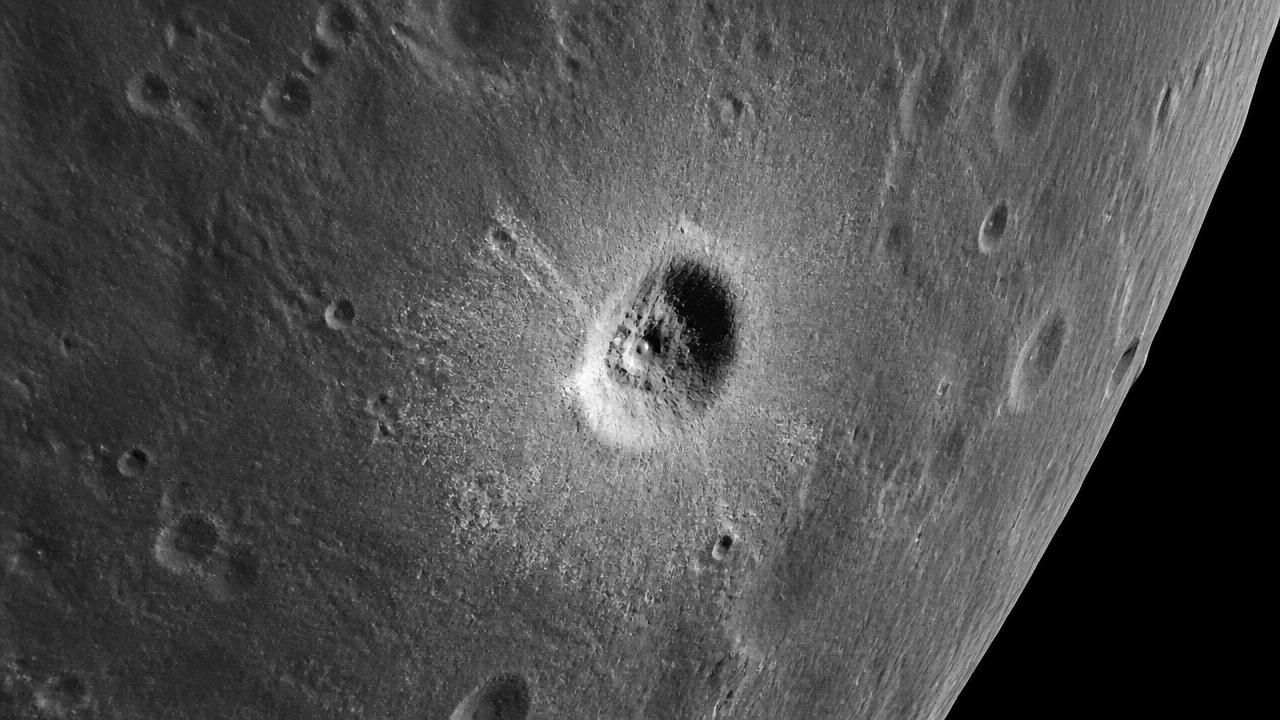
NASA’s Lunar Reconnaissance Orbiter has spotted the largest newly formed impact crater ever found in the solar system, a 728-foot-wide scar on the Moon’s eastern edge that scientists say was carved by a building-sized object in 2024. The discovery, reported in a pair of papers in the journal Science Advances, offers a rare window into how often the Moon is struck and what those collisions mean for future explorers.
The crater, now officially named McGetchin after pioneering lunar scientist Tom McGetchin, formed sometime between April 11 and May 22, 2024. Scientists estimate the impactor—likely a comet or asteroid—was the size of a three- to six-story building. The collision excavated a hole wide enough to stretch across two football fields and deep enough to fit three yellow school buses stacked vertically. An impact of this magnitude is expected on the Moon only about once per century, or even less frequently, the researchers said.
Discovery from a Routine Check
The finding began with a routine data-quality check. Robert Wagner, an image-processing specialist with Intuitive Machines who works with data from NASA’s Lunar Reconnaissance Orbiter Camera, or LROC, was scanning a giant Moon map on his computer screen when an unusually large bright spot circled by a dark halo caught his eye. The feature implied that surface material in that area had been recently shaken up.
“I just stopped, dropped everything, and started looking into what that spot was,” Wagner said.
By comparing before-and-after images of the Moon, Wagner realized he had discovered something extraordinary. The white spot was not the crater itself but material flung out of it. The dark halo was the disturbed surface around the fresh impact. Images from LRO’s Wide-Angle Camera taken in spring 2011 showed no such feature; images from summer 2025 revealed the fresh scar. The area shown in the comparison images is about 38 miles wide.
A Once-in-a-Century Event
The McGetchin crater is remarkable not only for its size but for its timing. With no atmosphere to slow incoming objects or burn them up, the Moon is constantly exposed to space rocks that strike at high speed. Most are small, producing tiny craters or disturbing only a thin layer of dust. But the McGetchin impactor was large enough to punch through the surface and throw debris far across the surrounding landscape.
- Crater width: 728 feet, roughly the length of two football fields.
- Crater depth: 141 feet, equivalent to three vertically stacked school buses.
- Impactor size: possibly the size of a three- to six-story building.
- Formation window: between April 11 and May 22, 2024.
- Frequency: an impact of this magnitude occurs on the Moon about once per century or longer.
The event is a reminder that the Moon is not a static, dead world. It is a dynamic landscape shaped by impacts, radiation, and extreme temperature swings. NASA’s Lunar Reconnaissance Orbiter has been circling the Moon for more than 17 years, using its seven instruments to map the topography, surface composition, temperature, and radiation environment. During that time, the spacecraft’s team has identified at least 1,000 new impact craters and flagged more than 100,000 surface changes caused by collisions or the debris thrown out afterward.
Why It Matters for Future Exploration
The discovery comes as NASA and its international and commercial partners advance plans for a sustained human presence on the Moon. Those plans include expanded scientific research, resource extraction, and commercial activity. Understanding the rate and size of lunar impacts is critical for designing habitats, equipment, and safety protocols. A crater-forming event of this scale would be catastrophic for a surface outpost if it occurred nearby.
Researchers say the discovery highlights the value of NASA’s Moon orbiter data in studying a dynamic landscape as the agency advances a sustained human presence and expanded scientific and commercial activity on the Moon. The McGetchin crater also provides a natural laboratory for studying impact processes, ejecta distribution, and the effects of space weathering on freshly exposed material.
The Value of Before-and-After Images
The LROC system has been instrumental in finding new craters by comparing images of the same areas over time. The McGetchin discovery relied on exactly that approach: a 2011 baseline image and a 2025 image that revealed the bright ejecta and dark halo. Without long-term orbital monitoring, the crater might have gone unnoticed or been mistaken for an older feature.
Scientists named the crater after Tom McGetchin, a pioneering lunar scientist whose work helped shape modern understanding of planetary surfaces. The name McGetchin now joins a growing catalog of lunar features, but this one is unique: it is the largest newly formed crater ever confirmed in the solar system.
For now, LRO continues to circle the Moon, adding to a record that spans more than 17 years. Each new image helps scientists refine estimates of impact rates, assess hazards, and understand how the Moon’s surface changes over time. As humans prepare to return, that record will be more important than ever.