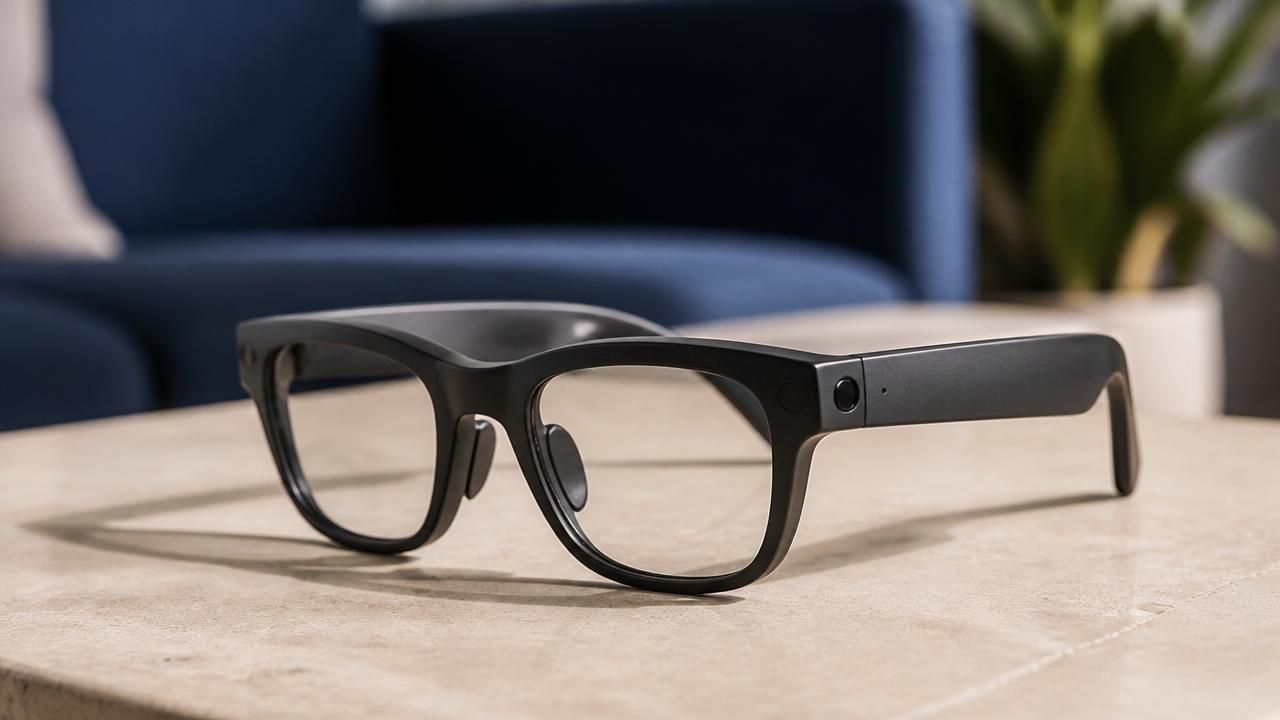
Meta is reportedly preparing to unveil a pair of smart glasses with no camera at all — a striking reversal for a company whose flagship wearable has become a running case study in how quickly a hit gadget can curdle into a privacy controversy. According to a report from The Information, the camera-free frames, developed under the codename Luna, could be shown as soon as next week at Meta Connect, the company’s annual hardware showcase.
Meta has not confirmed the report, and the company has a long history of prototyping devices that never reach store shelves. But the reported design choices suggest the project is aimed squarely at a problem Meta has struggled to solve with software updates and public-relations campaigns: convincing a skeptical public that a camera strapped to your face is not a threat to everyone standing in front of you.
A camera subtracted, not added
Where the current Ray-Ban Meta line leans on a camera for photo and video capture, Luna reportedly replaces optics with acoustics. The Information’s report describes six microphones arrayed around the frame, paired with speakers tucked into the temples. The hardware is designed to let wearers talk to Meta AI — and to a new AI agent reportedly called Muse — while listening to audio through open-ear speakers.
The removal of the camera is not just a gesture toward privacy advocates; it is also an industrial-design decision. Without a camera module and its associated components, the glasses’ arms can be made thinner and the frame as a whole can sit closer to a conventional pair of eyeglasses. That matters commercially. One of the most persistent complaints about camera-equipped smart glasses is that they announce themselves as technology — a look that invites stares, questions and, in some venues, outright bans.
Stripping the camera out has apparently made it possible to make the glasses’ arms smaller, and closer to ordinary frames.
The backlash that shaped the design
Meta’s camera glasses have been dogged by objections almost since launch. Wearers have been confronted in bars, restaurants and gyms; some schools, museums and performance venues have restricted them. The most damaging episode came in 2024, when two Harvard students demonstrated a system that paired the glasses’ camera with facial-recognition software to identify strangers in real time — a stunt that turned an abstract privacy debate into a visceral one.
Meta’s answer at the time was procedural rather than architectural: a capture LED that cannot easily be disabled, tamper detection, and updates that made the indicator harder to defeat. Critics pointed out that a light only helps if people around the wearer notice it — and that any indicator can eventually be circumvented. A pair of glasses with no camera to point at anyone sidesteps the argument entirely.
An audio-first bet on AI wearables
The strategic logic extends beyond damage control. Audio-only glasses are cheaper to build, lighter to wear and easier to justify to regulators than imaging devices. They also slot neatly into Meta’s larger ambition of making AI assistants ambient — something you speak to throughout the day rather than open on a phone.
The competition is moving in the same direction. Apple, Google and Samsung are all pursuing head-worn computing through various form factors, and Amazon has spent years pushing camera-free audio frames. Meta’s advantage is its EssilorLuxottica partnership, which gives it access to Ray-Ban and Oakley distribution, retail shelf space and genuine fashion credibility — the piece most technology companies get wrong.
Meta also appears to be hedging. The company has simultaneously pursued a more ambitious, feature-dense track with display-equipped glasses that include cameras and a neural input band, aimed at early adopters willing to pay a premium. Luna, by contrast, reads as a mainstream product: a pair of glasses that happens to have an assistant inside, rather than a computer that happens to sit on your nose.
How the story is being framed
The coverage itself reveals how differently the same product decision can be read. The Verge led with the cultural angle, describing the device as a less pervy pair of smart glasses — a blunt acknowledgment that the camera, not the computing, was the reputational problem. The Information, which broke the story, framed it as a corporate response to mounting privacy concerns. PCMag treated it as straightforward product-cycle news, pegged to the coming Connect keynote. Digital Trends cast it as an attempt to win back user trust.
Each framing is defensible. A camera-free device is simultaneously a design choice, a legal strategy, a marketing reset and a bet that voice — not vision — is the interface people will actually tolerate wearing all day.
What to watch
- Whether Luna appears at all. Meta Connect is a venue for demonstrations as much as launches, and reported products sometimes slip by a cycle.
- Pricing and battery life. Audio-first glasses could undercut camera models significantly, but always-listening microphones are power-hungry.
- What Muse actually does. A new agent name implies new capabilities beyond the existing Meta AI assistant.
- Whether Meta keeps both tracks. If Luna sells, the company could face pressure to make camera-free the default — a difficult admission about its flagship.
For now, the most telling detail is what Meta appears willing to give up. In an industry that has spent a decade adding sensors, the company is reportedly betting that subtraction is the feature customers have been waiting for.