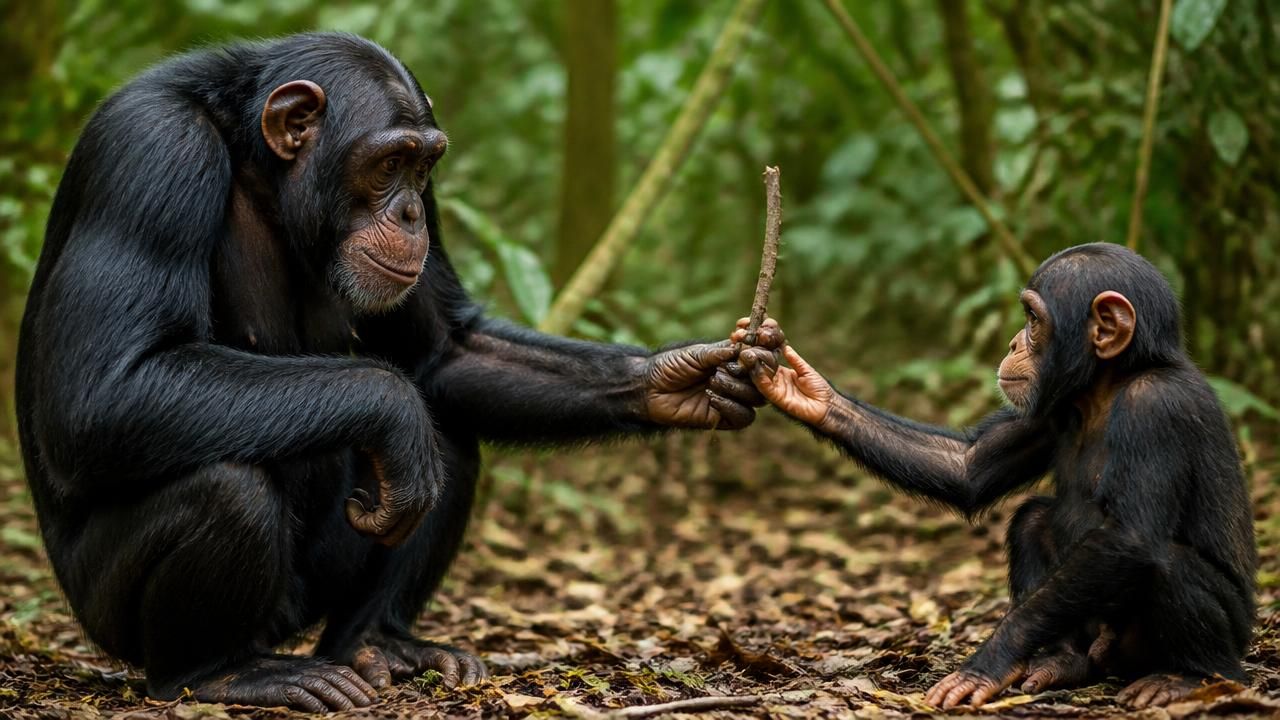
The classroom has no walls, the teachers keep no lesson plans, and the pupils are covered in fur. A newly published paper in the journal Frontiers in Psychology describes how adult chimpanzees deliberately model the use of tools for their offspring and then hand the implements over so the youngsters can imitate the same motions — a sequence researchers argue qualifies as a genuine form of teaching.
The finding adds weight to a decades-old shift in primatology: the recognition that tool use, once considered a defining hallmark of humanity, is a shared inheritance among our closest living relatives, and that some of it is passed down culturally rather than instinctively.
Passing the twig, not just the technique
According to the study, the transmission happens through what the authors call food or tool transfer. An experienced adult — frequently a mother — demonstrates the technique, then gives the tool or the food it has yielded to a younger chimpanzee, creating an opportunity for supervised practice rather than simple observation.
“Receiving food and tools from experienced individuals, which we call food or tool transfer, may help chimpanzees learn to use technology to extract foods that are difficult to access,” said co-author Andreu Sánchez-Megías, a graduate student at the University of Barcelona and the Jane Goodall Institute Spain in Senegal. “Tool transfers thus appear to be a form of teaching, together with observation and supervised practice. It appears that mothers are the main models and teachers for young chimpanzees in this manner.”
That combination — demonstration, handover, and imitation — is what distinguishes the behavior from passive social learning. The young chimp is not merely watching an adult succeed; it is being equipped, quite literally, to try the task itself.
Decades in the making
The new paper sits at the end of a long line of observations. Charles Darwin noted chimpanzees using stones to crack nuts as early as 1871. The decisive breakthrough came in 1960, when the primatologist Jane Goodall watched a chimpanzee named David Greybeard bend a twig, strip away its leaves, and use the bare stem to spoon termites out of a mound and into his mouth.
When Goodall's mentor, Louis Leakey, learned of the behavior, he delivered what remains the field's most quoted line:
“Now we must redefine ‘tool,' redefine ‘man,' or accept chimpanzees as humans.”
Since then, researchers have catalogued a remarkably varied chimpanzee toolkit: leaf sponges used to soak up water and honey, sticks for dipping into ant and termite nests, rocks for cracking nuts, and leaves used as wipes or seats. Different communities use different sets of tools, a pattern that mirrors the regional variation anthropologists once treated as exclusively human culture.
One discovery, several framings
The way the story has been reported reveals how differently newsrooms weight the same research. Ars Technica, which has a long-running interest in animal cognition, led on the mechanism of transmission — the deliberate modeling and the handover of tools — and on the mothers-as-teachers angle. Discover Wildlife emphasized the method of discovery, highlighting remote cameras catching chimpanzees in the act of instructing youngsters. Two MSN aggregations distilled the finding into a single, utilitarian headline: chimpanzees give youngsters the tools to learn tricky techniques, and demonstrate tool use to teach offspring.
A phys.org headline took a different tack altogether, foregrounding the inventiveness of the young animals themselves — the idea that juveniles not only absorb adult designs but refine and improvise on them. That framing points to a live debate in the field: whether chimpanzee tool traditions are strictly conservative, copied faithfully across generations, or whether the younger generation acts as a source of innovation that keeps the culture changing.
The two readings are not contradictory. Social learning supplies a template; youthful experimentation can extend it. Mothers appear to do most of the instruction, but the pupils are not simply blank slates.
Why it matters
- Cumulative culture: Tool transfer suggests chimpanzees can build on knowledge rather than rediscovering it in each generation.
- Comparative cognition: The study sharpens the criteria scientists use to define teaching across species.
- Conservation: Tool traditions vary by community and are learned, not innate — meaning that if a population collapses, an entire repertoire of skills can vanish with it.
- Method: Remote cameras and long-term field observation are proving as important as laboratory experiments in animal behavior research.
The broader implication is uncomfortable for anyone attached to a sharp line between human and animal. Tool use alone no longer separates us; neither does culture, and perhaps not even teaching. What remains distinctive is the scale and cumulative depth of human technology, not its existence.
For the chimpanzees of West Africa, the takeaway is more immediate. Every twig stripped of its leaves and handed to a waiting youngster represents knowledge stored in a community rather than a genome — and, like the forests those communities depend on, it can be lost.