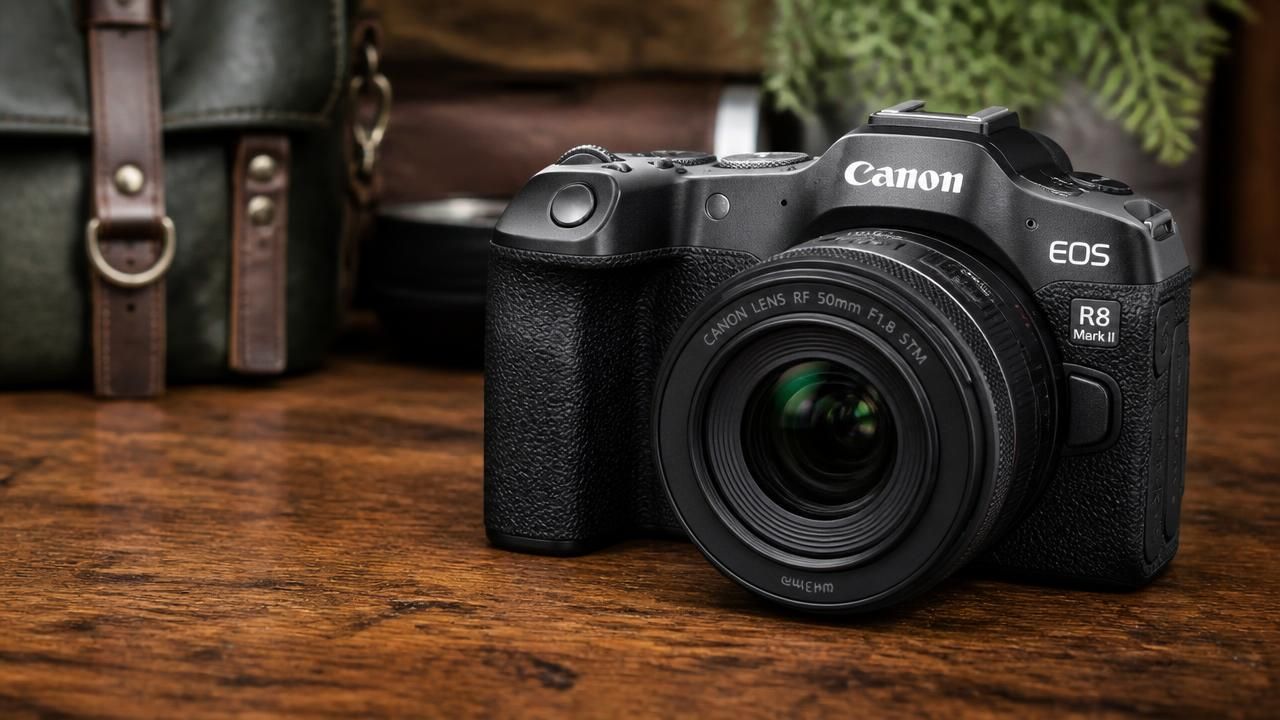
Canon has announced the EOS R8 Mark II, a second-generation entry-level full-frame mirrorless camera that wraps modern internals in a 1980s-inspired retro body — and, more importantly for photographers, finally adds the in-body image stabilization (IBIS) that was the most conspicuous omission from the original R8.
The camera is expected to go on sale in late October for $1,899, positioning it below last year's EOS R6 Mark III in both price and heft. At roughly 1.2 pounds, the Mark II is slightly heavier than its predecessor — a direct consequence of the stabilization hardware — but remains Canon's lightest full-frame body and undercuts the R6 Mark III on cost.
A throwback shell over a familiar formula
Where the 2023 R8 borrowed its shape from the full-frame R6 Mark II, the new model takes a sharp design turn. Reviewers uniformly describe the body as retro or "1980s-inspired," with Canon clearly chasing the nostalgia-driven success that rivals such as Nikon, Fujifilm and OM System have mined in recent years.
PCMag, which tested what it called Canon's first retro camera, argued the approach is more than cosmetic. The outlet concluded that "throwback gear doesn't have to be a gimmick" — a notable endorsement for a manufacturer that has historically favored conservative, ergonomics-first industrial design.
Digital Camera World was even more direct in its hands-on coverage, framing the launch as a marriage of "1980s camera inspiration" and "modern mirrorless performance."
The two fixes that mattered most
When the original R8 launched in 2023, it was pitched as a smaller, cheaper and more accessible alternative to the R6 Mark II for shooters who wanted to step up to full frame. The compromises that made that price possible became the camera's defining criticisms: no IBIS, a modest battery, and a control layout that frustrated enthusiasts.
"Forget the 1980s-inspired design — the new Canon EOS R8 Mark II fixes the two biggest features missing from the original camera." — Digital Camera World
Independent reviewers reached similar conclusions. One published verdict described the Mark II as a camera that "finally grows up," while another acknowledged the design may not be to everyone's taste but welcomed it as a fix for the author's biggest complaints about the original.
The stabilization addition also shifts the Mark II's competitive math. IBIS has become table stakes in the sub-$2,000 full-frame segment, where Sony and Nikon both offer stabilized bodies, and its absence was the single most cited reason shoppers stepped up to the R6 line instead.
The sensor question mark
Not every early signal has been positive. Notebookcheck reported that the R8 II is "said to feature" a disappointing sensor, suggesting the camera may carry over the original's 24-megapixel full-frame chip rather than adopting newer silicon. That claim surfaced amid a wave of pre-launch speculation, and Imaging Resource documented leaked photos and specifications circulating ahead of the official reveal — material that typically mixes accurate details with wishful thinking.
If the sensor is indeed carried over, it would echo Canon's broader strategy of segmenting its lineup by processing power, autofocus algorithms and stabilization rather than by pixel count or dynamic-range improvements. The practical difference may be modest for most buyers, but it gives critics an easy talking point.
The most balanced early review — headlined simply "new design, major fixes but frustrations remain" — captures the mood: meaningful progress, not a clean sweep.
Retailers and reviewers mobilize
The launch has triggered the usual ecosystem of retail activations. B&H Photo is hosting a livestream panel and first-look video for the R8 II, while coverage has spread across Yahoo Finance's syndicated feeds and MSN's aggregated review pages — a sign of how thoroughly camera launches now bleed into general-interest commerce coverage.
Timing matters. Imaging Resource also flagged that the original R8 is discounted by $100 in Amazon's early Black Friday promotions, meaning Canon's outgoing model and its replacement will compete on shelves during the same holiday window.
Why it matters
The entry-level full-frame segment has become the industry's most strategically important battleground. Smartphone computational photography has crushed the compact camera market, pushing manufacturers to defend the bottom rung of interchangeable-lens systems with aggressive pricing and feature trickle-down.
By adding IBIS and a distinctive design without breaching the $2,000 threshold, Canon is attempting to make the case that full frame is no longer aspirational — it's the default starting point. Whether the Mark II's sensor and remaining ergonomic compromises undercut that pitch will become clear once full reviews and retail units land in late October.
For now, the consensus from those who have handled it is that Canon has corrected its most obvious mistake. The open question is whether it has done enough to hold the line against increasingly capable rivals at the same price.