Two years after Jonathan Haidt's The Anxious Generation turned teenage screen time into a global policy cause, the fight over children and social media has entered a harder, more consequential phase. Bans are on the books. Lawsuits are being settled for sums that would have seemed implausible a decade ago. Senators are summoning executives to hearings. And yet the question at the center of it all — whether social media is actually harming kids, and by how much — remains genuinely contested.
The result is a rare paradox in tech policy: governments and courts are moving faster than the science they cite, while clinicians warn that the science may be measuring the wrong things entirely.
A movement goes global
What began as a parent-and-policymaker backlash has hardened into law. Australia's nationwide teen social media restrictions — which Haidt has been credited with helping inspire — were the first major test of blanket age-based prohibition. In June 2026, the United Kingdom followed, declaring an under-16 social media ban framed explicitly as child protection, though as CNBC reported, experts immediately flagged enforcement as the weak point: age-verification systems can be gamed, VPNs are trivial to install, and privacy advocates warn that identity checks for minors carry their own risks.
The New York Times describes a movement that has now taken hold globally, moving from voluntary parental controls toward statutory restrictions. The open questions are no longer about whether governments will act, but about what happens when they do.
The courts become the pressure point
Legislation is only one front. Reuters and Yahoo News have both maintained running factboxes on the sprawling litigation over claims that social platforms harm children — a tangle of state attorneys general, school districts, and individual families that has already produced internal documents and forced design practices into the public record.
The headline moment came when Meta agreed to a historic $16.7 billion settlement over claims its platforms harmed children, as reported by the New York Post. A settlement of that scale functions as both a financial shock and a template: other platforms now face an established price for similar claims, even though a settlement is not an admission of wrongdoing.
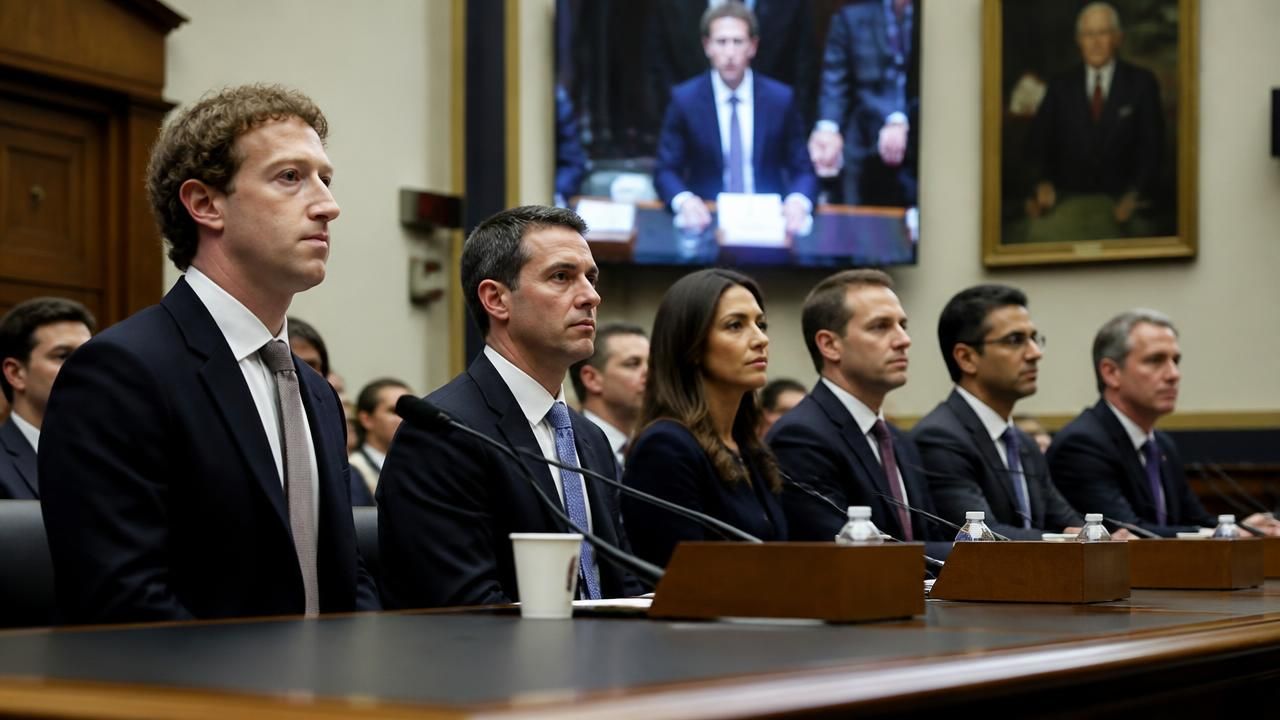
Political pressure has run in parallel. The Arkansas Democrat-Gazette reported senators bluntly telling social media executives to stop hurting kids — a hearing that reflected how bipartisan the posture has become, even if the remedies remain disputed.
“What if social media isn't hurting kids?”
That framing, from The Verge, captures the dissent that has quietly strengthened as the crackdown has accelerated.
The science is not settled
Haidt's thesis — that smartphones and social platforms are largely to blame for a decline in teen mental health dating to roughly 2010 — became the intellectual backbone of the backlash. His name surfaces unprompted among officials who say the book opened their eyes, and he has joined bereaved parents suing tech companies.
But a growing number of researchers argue the causal story is far shakier than the policy momentum implies. The critiques are consistent: correlations between heavy use and poor mental health are modest; effects are small and often fail to survive controls for pre-existing conditions; and the 2010 inflection point coincides with other plausible drivers, from the pandemic and its aftermath to academic pressure, sleep loss, economic precarity, and changes in how distress is reported and measured. Reverse causality cuts both ways — distressed teens may gravitate toward heavy use rather than be created by it.
None of that means platforms are harmless. It means the certainty in political speeches outruns the certainty in the journals, and that a ban may be treating a symptom while design incentive structures go untouched.
What clinicians say the data misses
The most pointed counterargument to the skeptics comes from the consulting room rather than the dataset. Writing in The Guardian, psychoanalyst Robin Kirman argues that social media is damaging children's inner lives in ways we don't fully understand — attention, solitude, boredom, fantasy, and the slow work of self-formation are not easily captured by survey scales or effect sizes.
This is a subtle claim: the absence of a clean measurable harm is not proof of absence. A generation that rarely experiences unstructured, unobserved time may bear costs that show up decades later, in capacities no regression model is built to detect. It is an argument for humility — in both directions.
What actually helps, beyond time limits
Forbes' framing is a useful corrective to the binary: keeping kids safe online is more than time limits. Practical guidance that recurs across researchers and clinicians includes:
- Design-level change over willpower: default settings, infinite-scroll and autoplay limits, and age-appropriate feeds matter more than a stopwatch.
- Digital literacy as a taught skill: recognizing engagement-optimized content and algorithmic manipulation.
- Sleep protection: device-free bedrooms remain one of the best-evidenced interventions.
- Co-use and conversation: parental involvement outperforms surveillance.
- School policy: consistent phone rules reduce the social cost of opting out.
What to watch next
Three things will define the next phase. First, enforcement: Britain and Australia must prove age verification can work without creating a privacy and surveillance regime for minors. Second, litigation: more settlements — or a trial that forces the underlying evidence into open court — could reshape platform design faster than legislation. Third, the equity question: tighter restrictions risk cutting off LGBTQ+ and isolated teens for whom online communities are a lifeline, a concern that has dogged every ban proposal.
The uncomfortable truth running through all ten of these threads is that both sides are partly right. Something changed in adolescent mental health, and screens are somewhere in the story. But a story is not a mechanism, and a ban is not a cure.