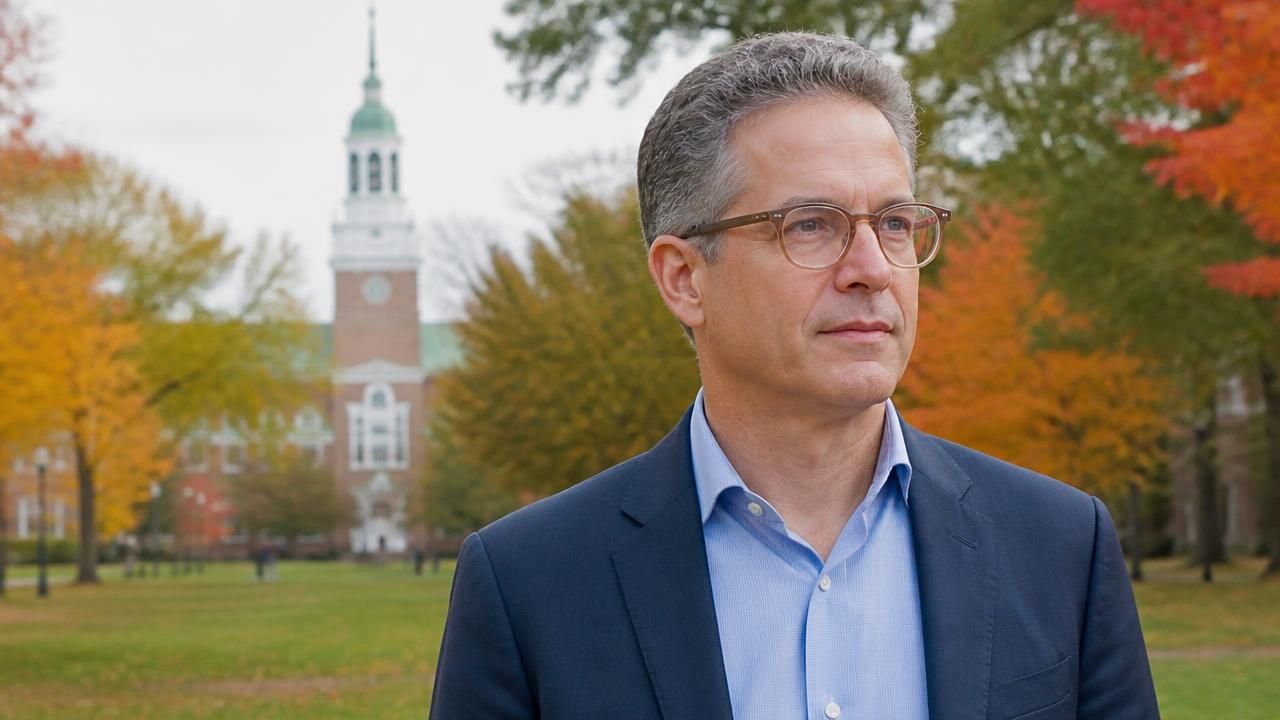
Santiago Schnell, Dartmouth College's provost, has resigned after an advisory committee concluded that he failed to disclose significant use of artificial intelligence in an academic paper and in a nationally published op-ed — an op-ed, as it happens, about universities' struggle to police AI cheating. The resignation, confirmed this week, closes a unusually public arc for a senior academic administrator and has reignited a campus and national debate about who sets the rules for AI use in scholarship, and whether those who write the rules are willing to live by them.
The timeline is what gives the story its resonance. On August 9, 2026, Schnell published an essay in The Washington Post titled "Universities are fighting AI cheating. But there's a deeper problem." In it, he argued that detection tools and honor codes address symptoms rather than the underlying transformation of how knowledge is produced. Less than a semester later, the same subject matter became the subject of an institutional review of his own work.
What the committee found
According to reporting by Ars Technica, the advisory committee reviewed Schnell's writings and found that he had not disclosed substantial AI assistance in an academic paper and in the Post op-ed, despite publisher requirements that such use be disclosed. The committee's access to Dartmouth's enterprise Claude account — a business-tier deployment of Anthropic's assistant — proved central to its findings. The logs showed Schnell using the model for a range of tasks well beyond casual drafting: revising and tightening papers, locating and fixing bugs in code, and editing or generating figures for publication.
The investigation was complicated by what the report describes as "insufficient cooperation." Schnell surrendered his Dartmouth-issued laptop but declined to hand over logs from personal LLM accounts tied to the writings under review, and he did not agree to meet with the committee. The result is an inquiry that relied heavily on institutional records rather than on the subject's own account — an outcome that leaves open questions about the full extent of the AI assistance involved.
"Universities are fighting AI cheating. But there's a deeper problem." — the title of Schnell's August 2026 Washington Post op-ed, published months before his resignation.
The students' charge: hypocrisy
The story landed differently depending on where readers encountered it. Outlets such as MSN and Yahoo framed it in blunt, tabloid-adjacent terms — "busted," "exposed," a provost caught using AI for his own writing — with headlines emphasizing that students had called for his dismissal. The New York Times, by contrast, situated the resignation within a broader pattern: college leaders adopting AI tools enthusiastically in their own administrative and scholarly work while their institutions impose strict limits on students. That framing — "College Leaders Are Using A.I. Students Call It Hypocrisy" — turns an individual accountability story into a structural one about asymmetric rules.
For undergraduates already subject to AI detectors of dubious reliability, the optics were difficult to escape. Many students have faced disciplinary proceedings based on probabilistic flags from detection software that experts widely regard as unreliable, particularly for non-native English speakers. That a senior administrator could use a large language model extensively — for prose, code, and figures — without disclosure, and only face consequences after journalistic and internal scrutiny, sharpened the sense of a double standard.
Why disclosure, not detection, is the fault line
The Schnell case exposes a policy vacuum that many universities have papered over with tools rather than rules. Three tensions stand out:
- Detection versus disclosure. Institutions have invested in AI-detection software while leaving disclosure regimes vague, inconsistently enforced, and largely aimed at students rather than faculty.
- Publisher rules versus institutional norms. Journals and newspapers increasingly require authors to declare generative AI assistance. Those requirements mean little when compliance is self-reported and unverifiable.
- Personal versus institutional accounts. The committee could examine Dartmouth's enterprise Claude logs but not Schnell's private accounts. As AI use migrates to personal subscriptions, institutional oversight weakens.
At the same time, the case raises legitimate questions about proportionality. Schnell's documented uses — revising prose, debugging code, preparing figures — are activities many researchers now regard as ordinary productivity work rather than misconduct. The transgression, as the committee framed it, was not the use of AI but the failure to disclose it. That distinction matters: it suggests the offense is one of transparency, and it points toward the fix.
The road ahead for Dartmouth and its peers
Dartmouth now faces the practical work of replacing a provost and, more consequentially, rebuilding trust with faculty and students. The resignation is likely to accelerate calls for explicit, uniform disclosure standards covering administrators, faculty, and students alike — and for policies detailed enough to distinguish copy-editing from figure generation.
The national lesson is similar. As AI becomes embedded in research and writing, institutions cannot credibly enforce rules they do not follow at the top. Schnell's op-ed warned that universities were fighting the wrong battle. The circumstances of his departure have made that argument for him — at considerable personal cost, and to the discomfort of the institutions now forced to answer for it.