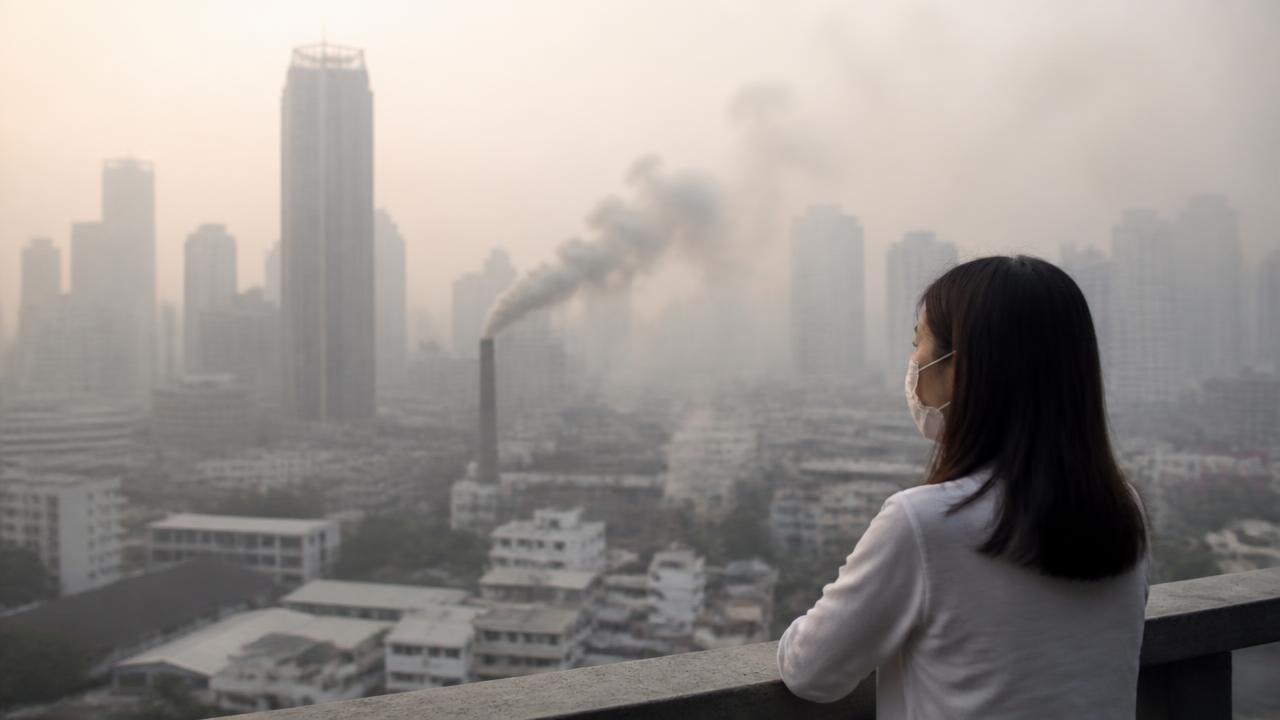
Long-term exposure to common air pollutants is associated with a significantly elevated risk of suicide and suicidal behaviour, according to a new international review that adds to a growing body of evidence linking environmental degradation to the global mental health crisis.
The research, led by scientists at Queen's University Belfast, synthesised findings from 29 separate studies to examine whether air, noise, light and water pollution could influence deaths by suicide and the spectrum of suicidal behaviours. While environmental pollution has long been linked to poorer physical and mental health, its specific role in suicide risk had remained comparatively under-examined — a gap the new analysis seeks to close.
What the research found
The review points most strongly at two pollutants: fine particulate matter (PM2.5) — microscopic particles small enough to penetrate deep into the lungs and bloodstream — and nitrogen dioxide (NO2), a gas produced largely by vehicle engines and the combustion of fossil fuels. Both were associated with heightened danger of suicidal thoughts and death by suicide.
The finding is notable because PM2.5 and NO2 are among the most ubiquitous pollutants in the modern environment. The World Health Organization estimates that roughly 99 per cent of the global population breathes air that fails to meet its health-based guidelines, making the exposure — and any associated mental health risk — effectively universal.
Environmental pollution is known to be associated with poorer mental health, but its role in suicide risk is less well understood. This analysis suggests that the smallest particles and traffic-related gases may carry a measurable psychological toll.
The heat factor
The Belfast review does not stand alone. Separate lines of research converging on the same period have found that short-term heat stress and air pollution together are linked to increased suicide risk, with several outlets framing the story around the compound effect of hotter temperatures and dirtier air. The message from that strand of work is that temperature and pollution appear to interact rather than act independently: when it is hot and polluted, suicide numbers climb.
That framing matters for climate policy. As heatwaves become more frequent and intense under global warming, and as wildfire smoke and ozone formation — both temperature-sensitive — worsen air quality, the two exposures increasingly overlap in time and place. Cities that are already struggling with traffic emissions face a double burden during summer months.
A broader assault on the brain
The suicide findings sit within a wider body of research suggesting that polluted air does not merely harm the lungs and heart. Reporting on the same body of science has highlighted that everyday air pollution is linked to poorer brain function, affecting attention, memory and cognitive performance in otherwise healthy people.
Separately, clinical research from healthcare systems has found that heavy air pollution is linked to worse outcomes after surgery, including higher rates of complications in patients recovering from operations. Taken together, the evidence describes an environmental exposure that affects cognition, clinical recovery and mental health — not just respiratory disease.
Why the brain may be vulnerable
Scientists have proposed several mechanisms. Ultrafine particles can cross the blood-brain barrier and trigger neuroinflammation and oxidative stress. Pollution is also thought to disrupt the body's stress-response systems and may affect neurotransmitter function. Chronic low-level inflammation, which has been linked to depression, is another plausible pathway.
Researchers caution, however, that these are hypotheses rather than established causal chains. The studies analysed are largely observational, meaning they can show correlation but not prove that polluted air directly causes suicidal behaviour.
How different outlets framed the story
Coverage of the research varied markedly in emphasis. The Guardian foregrounded the scientific process, describing the Queen's University Belfast team's systematic examination of 29 studies across multiple pollution types. Health and lifestyle outlets leaned toward the human-interest angle, asking whether rising heat and air pollution are driving suicide risk and presenting the answer as concerning. Other aggregators reduced the story to a single punchy line — "When it's hot and polluted, suicide numbers climb."
Clinical and academic press releases pushed the compound-exposure framing further, stressing short-term heat stress alongside pollution. Meanwhile, adjacent coverage used the moment to surface related findings on cognition and post-surgical recovery, broadening the story from a single risk factor to a systemic public health problem.
Limitations and the need for caution
Several caveats temper the conclusions:
- Association, not causation. Observational studies cannot rule out confounding factors such as socioeconomic deprivation, pre-existing mental illness, or access to healthcare.
- Exposure measurement. Many studies estimate pollution exposure at a regional or city level rather than at an individual's doorstep, which can blur the signal.
- Publication and geographic bias. Reviews of this kind often over-represent research from high-income countries with robust air-quality monitoring.
- Suicide is multifactorial. Economic stress, social isolation, trauma and genetic vulnerability all play powerful roles.
Even so, researchers argue that the consistency of findings across studies is difficult to dismiss — and that if an environmental exposure this widespread has even a modest effect on suicide risk, the population-level consequences would be substantial.
Implications for policy and public health
More than 720,000 people die by suicide each year, according to WHO estimates, and suicide remains a leading cause of death among young people worldwide. Outdoor air pollution is linked to roughly 4.2 million premature deaths annually, with household pollution responsible for millions more.
If the association holds, the implications are far-reaching. Air quality regulation, traffic management, cleaner energy and urban greening would become not just cardiopulmonary interventions but mental health interventions — levers that sit outside the traditional remit of psychiatry. Heat action plans, increasingly common in European and Asian cities, might similarly need to account for psychological as well as physical risk.
The research also underscores an equity dimension: poorer communities tend to live closer to major roads, industrial sites and heat islands, meaning the burden of both pollution and rising temperatures falls disproportionately on those with the fewest resources to adapt.
What comes next
Scientists behind the review are calling for longitudinal studies that track individuals over time, incorporate biomarkers of exposure, and control more carefully for social and economic variables. A clearer picture of who is most vulnerable — and at what concentrations harm begins — will be essential for setting guidelines and targeting interventions.
For now, the message emerging from multiple disciplines is a sobering one: the air we breathe and the heat we endure may be shaping our minds as well as our bodies, and the two forces are becoming harder to separate.