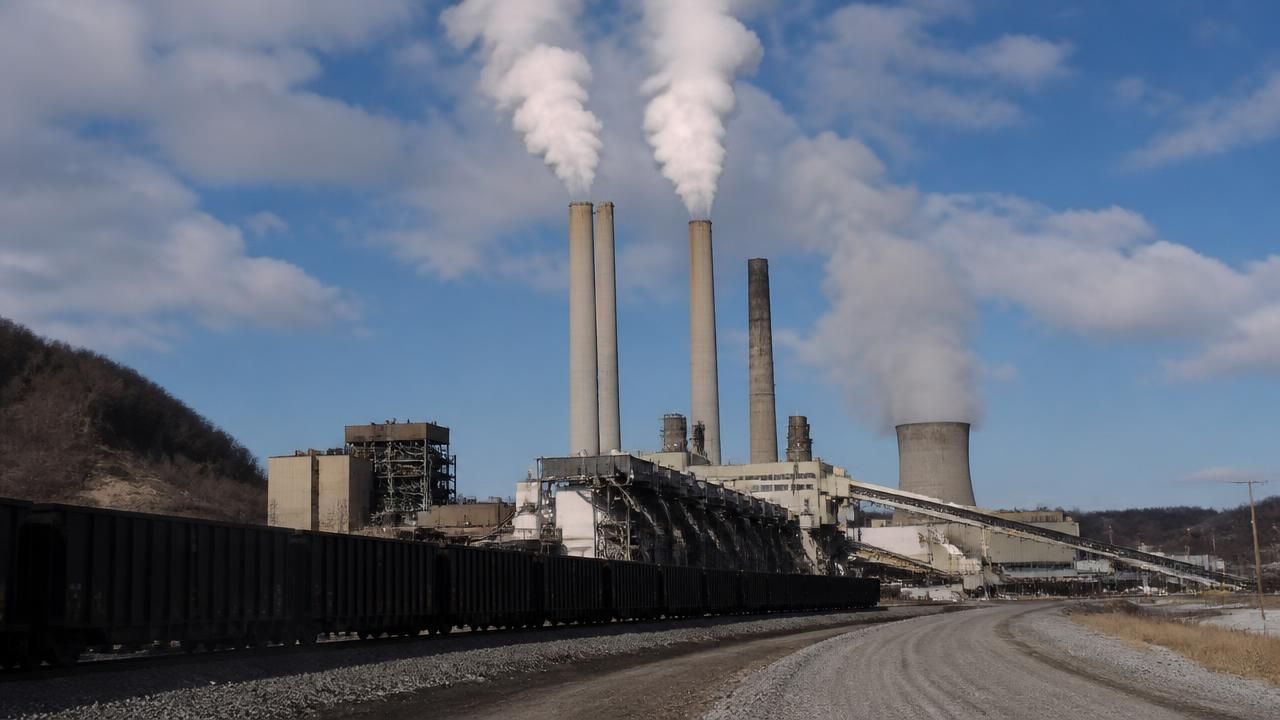
The Trump administration has repealed the federal rule limiting planet-warming greenhouse gas emissions from the nation's fossil fuel power plants, wiping out one of the most consequential climate regulations on the books and setting up a fresh legal and political battle over how — or whether — Washington can regulate carbon dioxide from the electricity sector.
The move, announced by the Environmental Protection Agency, eliminates the Biden-era standards that required existing coal-fired plants and new natural-gas plants to cut their greenhouse gas emissions by roughly 90 percent by 2032, either by capturing carbon, co-firing with cleaner fuels or shutting down. Environmental groups quickly warned the decision would harm both the climate and public health, while supporters cast it as relief for an industry squeezed by what they describe as unworkable mandates.
The coverage reflected the divide almost immediately. Headlines from different outlets described the same action in strikingly different terms:
"Trump's EPA repeals pollution limits on fossil fuel power plants" — NPR
"Trump guts climate rules for coal and gas power plants" — The Hill
"E.P.A. Erases Limits on Climate Pollution From Power Plants" — The New York Times
"EPA Repeals Biden-Era Carbon Rules for Power Plants" — NTD
Where outlets like NPR, The Hill and The New York Times emphasized pollution, climate and public health, others — including NTD and the Financial Times — framed the change in more neutral, procedural language as the repeal of an emissions rule. Business-focused coverage stressed regulatory relief and energy costs; scientific and environmental outlets stressed the atmospheric consequences.
What the rule did — and what disappears with it
The regulation, finalized in 2024, rested on the Clean Air Act's authority to limit emissions from existing stationary sources. It was the third attempt in a decade to regulate carbon from power plants, following the Obama administration's Clean Power Plan, which was stayed by the Supreme Court in 2016 and later replaced, and the Trump administration's first-term Affordable Clean Energy rule, which a federal court struck down. A 2022 Supreme Court decision, West Virginia v. EPA, narrowed the agency's latitude under the law, and the Biden rule was written to survive that ruling by focusing on plant-by-plant controls rather than sweeping grid-wide shifts.
Electricity generation accounts for roughly a quarter of U.S. greenhouse gas emissions. Because coal and gas plants can operate for decades, analysts note that rules governing their emissions are among the most durable tools available to federal regulators — and their removal correspondingly consequential.
- Existing coal plants would have faced the strictest requirements starting in the 2030s.
- New baseload gas plants would have been required to capture most of their carbon dioxide.
- Compliance timelines gave operators years to choose between retrofits, fuel switching and retirement.
Which states are most exposed
The repeal lands hardest in coal-dependent states. Mapping of the U.S. coal fleet consistently places West Virginia, Wyoming, Kentucky, Pennsylvania, Indiana, Texas, Illinois, Ohio, Missouri and North Dakota near the top for operating capacity. Utilities in those states had been weighing retirement dates and compliance investments against the 2024 rule; with the requirement gone, some aging units may now run longer, and planned closures could be deferred.
That dynamic cuts both ways. Plant operators say extended life for existing units supports grid reliability and avoids the cost of premature replacement. Critics counter that keeping older, higher-emitting plants online locks in pollution that disproportionately affects nearby communities and delays the cheaper renewable and storage projects already queued for interconnection.
The administration's rationale
The EPA has argued that the Biden rule exceeded the agency's statutory authority, imposed costs that would be passed to ratepayers and endangered the reliability of the electric grid as demand rises from data centers, electrification and manufacturing. Officials have also pointed to the Supreme Court's skepticism of broad agency power over the energy mix as vindication for the repeal, and have tied the timing of the announcement to a broader deregulatory push.
Environmental organizations reject that framing, saying the repeal ignores both the agency's own prior analysis — which projected billions of dollars in net benefits from avoided climate damage and improved air quality — and the mounting public health toll of particulate and ozone-forming pollution from fossil combustion.
Where this goes next
The repeal is all but certain to be challenged in court by states, environmental groups and public health advocates, who are expected to argue that the EPA cannot abandon its obligation to regulate a pollutant it has formally determined to endanger public health and welfare — the finding that underpins all federal greenhouse gas regulation and that the administration has separately signaled it may revisit.
Any legal fight will unfold against a changed judicial landscape. The Supreme Court's 2024 decision ending Chevron deference gives courts far less reason to defer to an agency's reading of ambiguous statutes, meaning both the repeal and any future replacement rule will be litigated on the text of the Clean Air Act itself.
Internationally, the decision sharpens the contrast between the United States and major economies that are expanding renewables and carbon markets, and it complicates Washington's posture in global climate negotiations. Domestically, the practical effect will vary by region and utility: some companies had already committed to coal retirements for economic reasons, while others now have a fresh argument for extending the life of existing plants.
What is unambiguous is the direction of travel. For the first time since the Supreme Court's 2007 ruling that greenhouse gases are pollutants under the Clean Air Act, the federal government is stepping back from regulating carbon dioxide from power plants — a retreat whose consequences for emissions, electricity prices, grid reliability and public health will be measured for years.