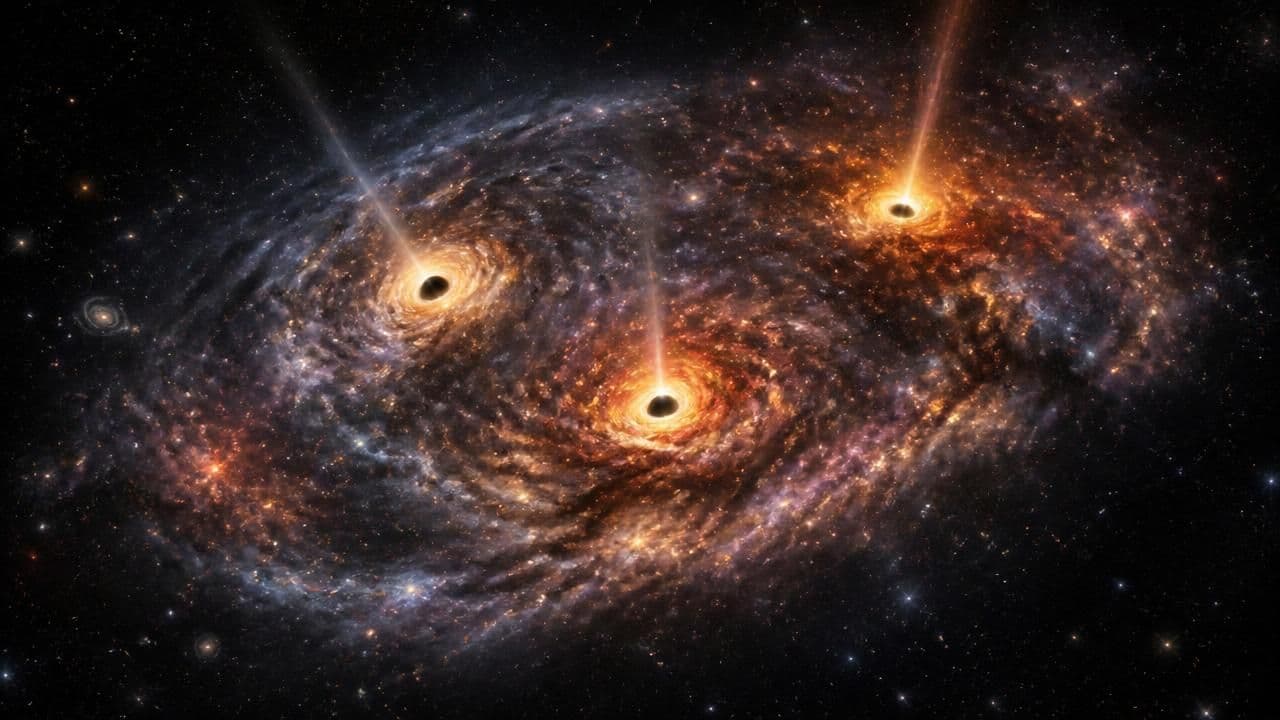
NASA has unveiled a new gallery of 16 images of galaxies — swiftly dubbed “cosmic gems” in headlines around the world — assembled from observations by the agency’s Chandra X-ray Observatory and several other major telescopes. The collection offers the public a rare, multi-wavelength look at some of the most violent and productive environments in the cosmos: galaxies locked in collision, black holes feeding at extraordinary rates, and vast stellar nurseries hidden behind veils of interstellar dust.
The release represents more than a pretty picture drop. Each image layers data from instruments that see fundamentally different things, turning the gallery into a compact demonstration of how modern astrophysics reconstructs objects that no single telescope could ever fully capture.
What NASA Released
According to NASA, the gallery collects images of galaxies chosen for being both “visually and scientifically interesting.” The images were released by Chandra X-ray Observatory and other telescopes, and NASA pointed readers toward further galaxy photography from the mission.
The composite imagery draws on three distinct windows on the universe:
- X-ray data (magenta) from Chandra, which pinpoints powerful black hole activity and hot, million-degree gas — the energetic heart of each system.
- Optical data (blue and white) from NASA’s Hubble Space Telescope, revealing stars, dust lanes and the familiar shapes of galaxies.
- Infrared data from NASA’s James Webb Space Telescope, which pierces interstellar dust to expose stellar nurseries that would otherwise remain invisible.
Image processing was carried out by NASA/CXC/SAO’s L. Frattare and J. Major, with credit shared among the Chandra X-ray Center, the Space Telescope Science Institute and the European Space Agency.
The Centerpiece: II Zw 096
The standout in the set is II Zw 096, a system in which two galaxies are merging at a furious rate. In the released image, dated Aug. 25, 2026, the combining systems appear as a knot of X-ray-bright activity and dust-shrouded star formation — a natural laboratory for studying what happens when galaxies collide.
“Systems like II Zw 096 show us how powerful galaxy collisions shaped the early universe.”
— NASA, describing the Chandra image release
The system exemplifies why astronomers care about mergers. When galaxies interact, gravitational forces compress gas, driving bursts of star formation and funneling material toward central black holes. The result is a brief, brilliant phase in galactic life — one that was far more common billions of years ago, when the universe was denser and collisions more frequent.
Reading the Image
What makes the II Zw 096 portrait instructive is the way each wavelength tells a different part of the story. The optical layers trace the disrupted structure of the merging galaxies. The infrared layer reveals where new stars are being born inside thick clouds of dust. And the magenta X-ray glow marks the hottest, most energetic processes — shocked gas and accretion onto black holes.
Overlay the three, and a coherent narrative emerges: a merger is not a simple train wreck but a chain reaction, in which gravitational disruption triggers star birth and black hole growth in sequence.
Why It Matters
The gallery arrives as astronomers continue trying to answer one of the field’s central questions: how did galaxies grow into the massive, structured systems we see today? Observations of nearby mergers such as II Zw 096 serve as nearby analogues for processes that dominated the early universe, when the cosmic merger rate was dramatically higher.
Chandra, launched in 1999 aboard the Space Shuttle Columbia, has been central to that effort. Its X-ray vision is uniquely suited to detecting the superheated gas and accreting black holes that optical telescopes cannot isolate. Hubble, now in its fourth decade of operation, supplies the sharp optical detail, while Webb’s infrared instruments — operational since 2022 — add the ability to see through dust that stymied earlier observatories.
The combined result is a layered archive that researchers can mine for years, even as the images circulate publicly as eye candy.
How the Story Was Framed
The different outlets covering the release largely reflected their own house styles rather than any disagreement about the science.
NASA’s own release emphasized process and physics, framing the gallery around how galaxy collisions shaped the early universe and detailing the instrument contributions behind each layer. Science and aggregation outlets leaned into the mystery, with headlines promising a look at “the hidden forces shaping the universe.” The New York Post took the most visual route, presenting the images as “stunning new photos of cosmic gems,” while other syndicated versions described a “rare look at 16 dazzling galactic wonders.”
The gap is instructive. For researchers, the value lies in the data — spectra, fluxes and resolved structure. For the broader public, the appeal is the spectacle of two galaxies tearing into one another across millions of light-years.
The Bigger Picture
Chandra’s continued output has taken on added significance amid recurring budget debates over the observatory’s future, making each new data release a reminder of what X-ray astronomy contributes to the multi-telescope era.
For now, the 16-image gallery stands as both a scientific resource and a public showcase — a reminder that the universe’s most beautiful objects are often its most violent, and that seeing them clearly requires looking in more than one kind of light.