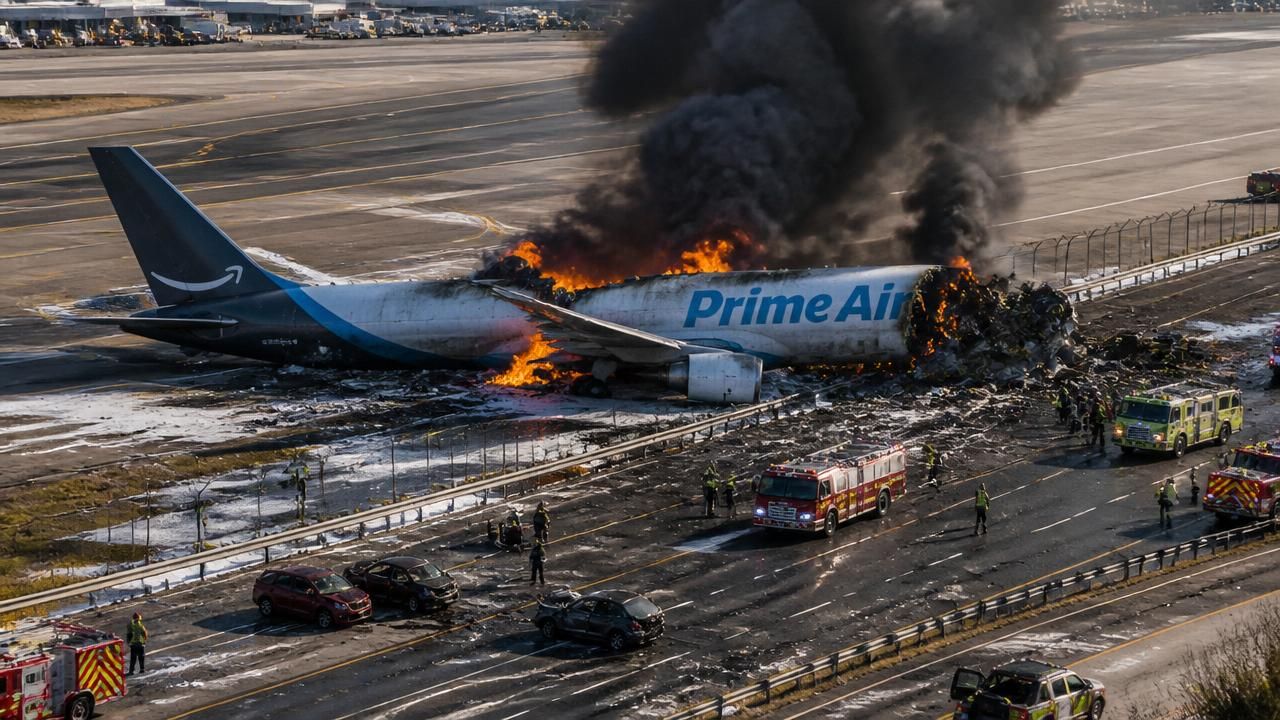
A Boeing 767-300 freighter operating on behalf of Amazon Prime Air crashed at Miami International Airport after overrunning the runway, striking multiple vehicles and leaving at least five people dead, according to emergency officials. The incident produced a fire and a column of smoke visible for miles, temporarily halting all flight operations at one of the busiest airports in the United States.
What Happened
Miami-Dade Fire Rescue dispatched a large emergency response after the aircraft failed to decelerate on landing and careened off the end of the runway. The airplane, painted in Amazon's dark blue and white Prime Air livery, sliced through airport fencing before crashing into vehicles traveling on a road just beyond the airfield. The Boeing 767-300, a twin-engine widebody freighter common in the cargo sector, came to rest in flames, leaving mangled metal and debris strewn across the area.
"There were multiple patients, but their injuries were not immediately known," officials at the scene said, according to The New York Times.
As the rescue operation unfolded, the death toll rose. CNN and other outlets confirmed at least five fatalities and five additional injuries. Authorities have not yet identified the victims or said exactly how many were on the ground versus aboard the aircraft.
Emergency Response and Disruptions
Dramatic television footage showed crews battling the blaze, with thick black smoke billowing into the South Florida sky. Miami International Airport suspended all arrivals and departures, creating a backlog of flights across the Eastern seaboard. Several flights were diverted to Orlando International Airport, which said it was assisting affected passengers. Travelers were warned to expect severe delays.
Key Facts
- At least 5 people killed, 5 injured after cargo plane overrun.
- Aircraft: Boeing 767-300 in Amazon Prime Air markings.
- Location: Miami International Airport, a major hub north of downtown.
- Plane slammed into vehicles beyond the runway, then caught fire.
- National Transportation Safety Board is investigating.
Amazon Prime Air in Context
The crash puts Amazon's ambitious air cargo operation under a grim spotlight. Amazon Prime Air, which began in 2015, is now a major player in the package delivery business, operating dozens of Boeing 767 freighters through leased and chartered aircraft. The program is central to Amazon's promise of one-day or same-day delivery, but it has also drawn attention from labor unions and safety regulators over its rapid expansion.
While the specific operator of this flight was not identified in early reports, freighters in the Prime Air fleet are typically flown by partner airlines such as Atlas Air and Air Transport Services Group. Whatever carrier was involved, the incident raises thorny questions about fatigue, maintenance, training, and the increasingly tight schedules of modern cargo operations.
Runway Overrun Risks
Runway overruns are among the most common accident categories in commercial aviation, often linked to unstable approaches, wet or slippery pavement, or mechanical problems. The Federal Aviation Administration has invested heavily in "runway safety areas" – engineered sections of pavement designed to slow aircraft that leave the runway. Miami International's geography, with adjacent roadways and highways, heightens the stakes when planes fail to stop in time.
In the coming weeks, investigators will examine the aircraft's flight data and cockpit voice recorders, weather radar, tire marks, and the condition of the runway. A preliminary report is expected within a month, though final findings may take a year or more. The NTSB will likely look at whether the landing was routine up to the point of overrun and whether any warning signs were missed.
Coverage and Different Framings
Global media cast the story in different light. The New York Times focused initially on the uncertainty of casualties, reporting that responders found "multiple patients" with injuries unknown. The Guardian provided a straightforward report on the five deaths and Amazon's role, linking the event to the massive scale of e-commerce. The Sun described the plane as crashing "onto a motorway," stressing the public danger beyond the airport fence. And in Florida, local stations like WESH highlighted the knock-on effect of diverted flights at Orlando International Airport. These divergent angles show how a single aviation tragedy touches on public safety, corporate responsibility, and regional logistics.
What Comes Next
For the families of those who died, the wait for answers has just begun. For the aviation industry, the investigation could reshape how cargo flights are operated into busy airports. For nearby residents and road users, this is a harrowing reminder that airports are not isolated launch pads but activity hubs immediately adjacent to daily life. As the NTSB begins its careful, methodical work, Miami residents and observers worldwide will be looking for one thing: accountability grounded in fact.