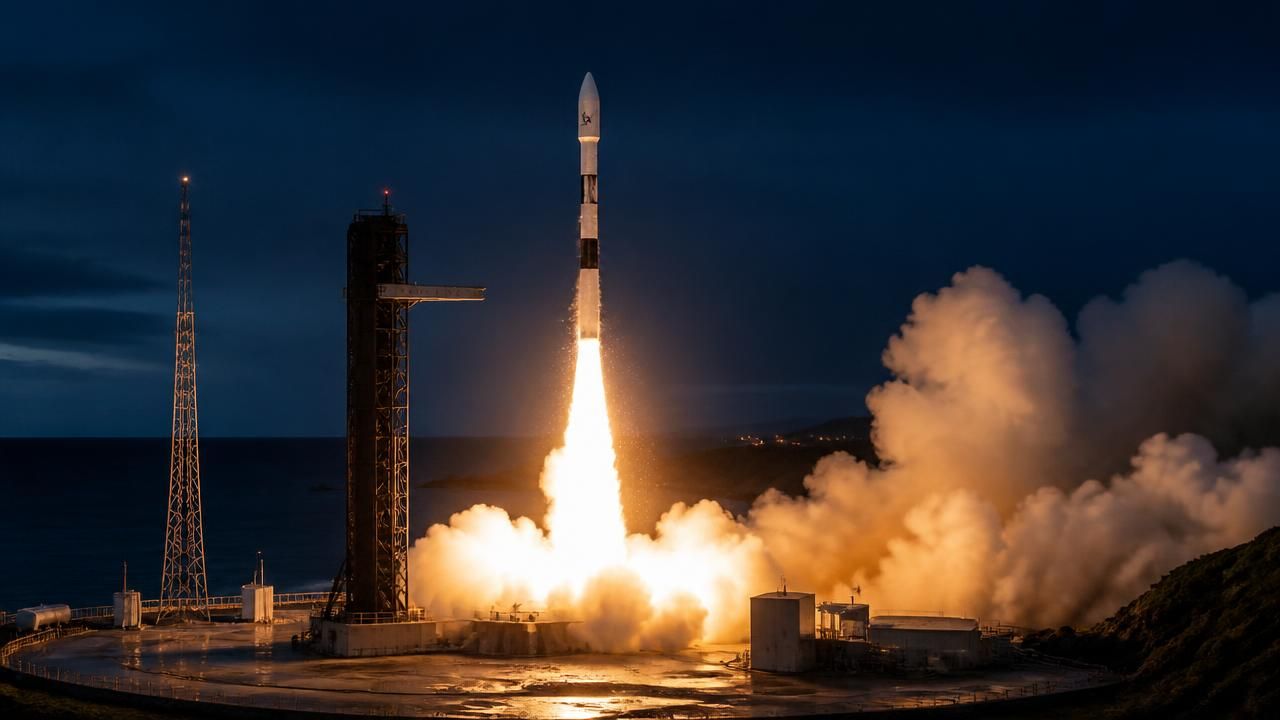
In a historic achievement for the European space sector, German startup Isar Aerospace has successfully launched its Spectrum rocket to low-Earth orbit, becoming the first fully commercial launch vehicle developed in Europe to do so. The two-stage rocket lifted off on Saturday at 10:12 pm local time (20:12 UTC) from Andøya Spaceport in Norway, just inside the Arctic Circle. Approximately seven minutes after liftoff, Spectrum delivered its upper stage into orbit, marking a major milestone for the continent's ambitions to foster a competitive private launch industry.
The flight was the first orbital launch attempt by Isar Aerospace, which was founded in 2018 by three students at the Technical University of Munich: Daniel Metzler, Josef Fleischmann, and Markus Brandl. The company's goal was to build a lightweight, cost-effective launcher capable of delivering small satellites to space, a market that has flourished with the rise of satellite constellations and Earth-observation missions. With Saturday's success, Isar has taken the lead among a crowded field of European launch startups that have spent years trying to break Europe's institutional dependence on state-funded rocketry.
A New Chapter for European Space
Europe's launch industry has struggled in recent years. The retirement of the workhorse Ariane 5 in 2023 and the loss of access to Russian Soyuz launchers, due to international sanctions after the invasion of Ukraine, left Europe without a dedicated medium-lift vehicle for a significant period. The long-delayed Ariane 6 rocket carried out its first commercial mission only in 2025, but many analysts agree that Europe needs a strong commercial small-launch sector to complement its institutional rockets.
Until now, no private European company had succeeded in reaching orbit from European soil. Isar Aerospace's Spectrum has finally broken that barrier. The rocket is 28 meters (92 feet) tall and designed to place up to 1,000 kilograms into a 500-kilometer Sun-synchronous orbit, a sweet spot for small communications satellites, Earth observation platforms, and technology demonstrations.
Technical highlights
Spectrum is powered by Isar's in-house developed Aquila engines. The first stage uses a cluster of nine engines, while the second stage is equipped with a single vacuum-optimized version. The engines burn liquid oxygen and propane, a fuel choice that provides a good balance of density and performance while simplifying storage and handling compared to more exotic propellants. The entire system has been designed from the ground up for modularity and cost efficiency, enabling rapid production and integration.
The launch from Andøya Spaceport, located on the Norwegian island of Andøya at approximately 69 degrees north, was carefully timed for the polar corridor, allowing payloads to reach high-inclination orbits with minimal fuel use. The late-summer evening provided a dramatic backdrop, as the final bluish hues of daylight vanished while the rocket climbed skyward. Norwegian spaceport authorities hailed the launch as the first orbital mission from their country, a boost for their ambitions to become a hub for small-satellite launches.
Why this launch matters
The significance extends well beyond the technological achievement. Europe's heavy reliance on non-European launch providers, particularly SpaceX, has raised concerns about supply-chain and security issues. Satellites are essential for weather forecasting, navigation, communications, finance, and defense. Having independent access to space is a strategic priority for many European countries. Isar's success demonstrates that the private sector can help provide that independence.
Moreover, this milestone is likely to reshape the competitive landscape among European launcher startups. Rocket Factory Augsburg, another German company, suffered a setback when its first orbital attempt failed in 2024. Other ventures, such as Spain's PLD Space and Britain's Skyrora, are still in the final stages of development. Isar is now the clear leader, with a proven vehicle and a full commercial launch manifest that includes contracts with dozens of customers, ranging from European governments to commercial satellite operators.
According to industry observers, the global small-satellite launch market is expected to grow to more than $20 billion by the mid-2030s. The ability to provide dedicated launches, rather than rideshare with larger payloads, is particularly valuable for companies that require specific orbits or timing. Spectrum's payload class puts it directly in the middle of this growing market, and the successful orbital flight will provide strong evidence for its reliability and precision.
What lies ahead
Isar Aerospace has said it will continue a series of test flights before transitioning to fully operational commercial missions. The company aims to achieve a steady launch cadence, with later versions of Spectrum possibly incorporating reusability to further reduce launch costs. Meanwhile, the success is expected to boost investment in Europe's New Space ecosystem, encouraging policymakers to streamline regulations and provide infrastructure support for launch sites across Norway, Sweden, Scotland, and the Azores.
Though this is just one flight, it sends a clear signal: Europe can play a significant role in the commercial space race. For a startup founded by students just seven years ago, reaching orbit is not just a win for the team; it is validation for every venture that dares to challenge the status quo.
"With this launch, Europe's private sector has demonstrated that it can achieve what was once thought impossible. The new space age will include many players, and today Europe has moved to the forefront."