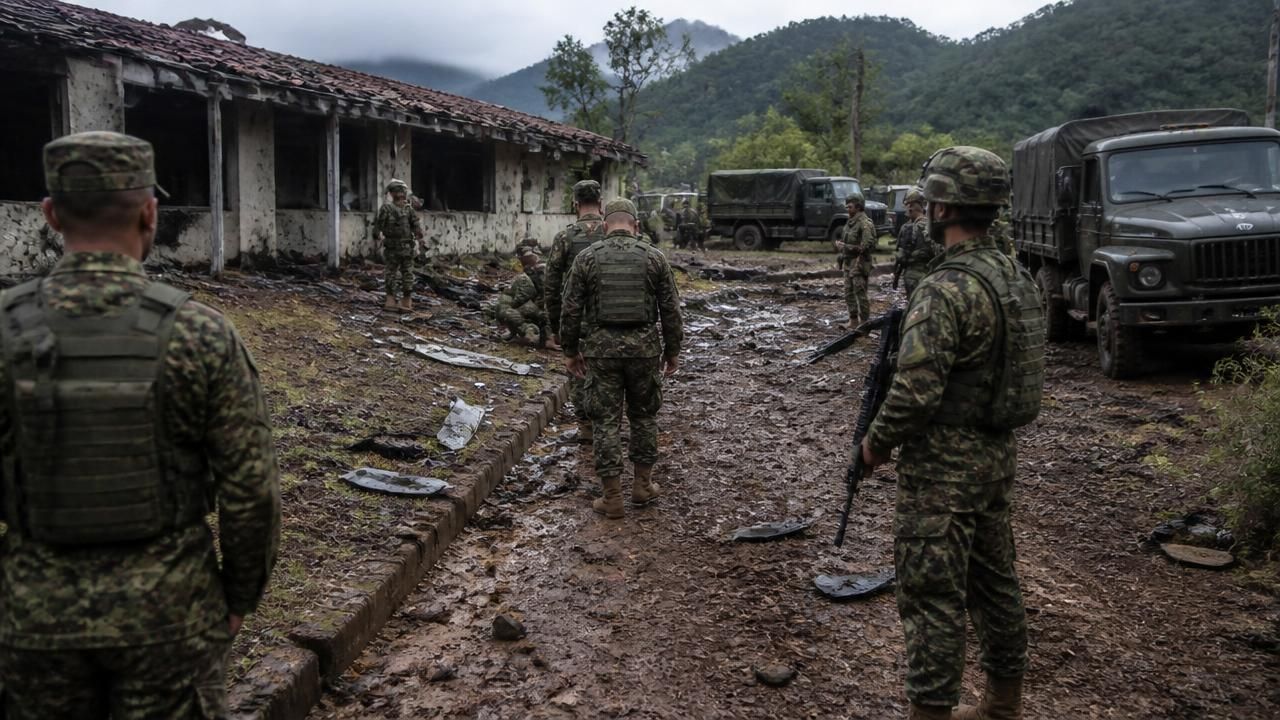
A drone attack blamed on the National Liberation Army (ELN) killed at least three Colombian soldiers and wounded four others late Friday inside a military compound in north-eastern Colombia, according to the army. The assault, which involved explosives dropped from drones followed by an armed clash within the base, has sharply heightened tensions amid stalled peace talks between the government and the country's last recognized guerrilla group.
Local authorities and military officials swiftly pointed the finger at the ELN, a rebel group with a long history of using unconventional tactics. The attack took place in a rural area of the department of Norte de Santander, near the Venezuelan border, a region long plagued by guerrilla activity, drug trafficking, and illegal mining.
Details of the Attack
According to Colombia's army, the assault began late Friday night when small drones dropped explosive devices onto the military installation. The blast was followed by gunfire as suspected ELN fighters attempted to storm the compound, triggering a firefight with soldiers. The army confirmed that at least three soldiers were killed and four others injured. Earlier reports, including from Agence France-Presse (AFP), cited two fatalities, but the Colombian army later revised the death toll to three after a thorough search of the compound.
The use of drones to deliver explosives represents a troubling escalation in guerrilla tactics. While the ELN and other armed groups have employed drones for surveillance in the past, weaponized drones are an emerging threat that military analysts say is increasingly difficult to counter. The compound, located in the Catatumbo region, one of Colombia's most volatile areas, had reportedly been on heightened alert due to recent intelligence suggesting a possible ELN offensive.
“Officials accuse the National Liberation Army of launching a strike followed by a clash inside a military compound,” the Guardian reported, citing unnamed local authorities.
Who Is the ELN?
The National Liberation Army (Ejército de Liberación Nacional, ELN) is Colombia's largest remaining guerrilla insurgency after the demobilization of the FARC in 2017. Founded in 1964 by Marxist-Leninist revolutionaries inspired by the Cuban Revolution, the ELN has been embroiled in a six-decade conflict with the Colombian state. With an estimated 2,500 to 4,000 fighters, the group finances its operations through drug trafficking, illegal mining, kidnapping, and extortion. It has been designated a terrorist organization by the United States and the European Union.
The ELN has historically operated in regions rich in natural resources and along the Venezuelan border, where it finds refuge and logistical support. The Catatumbo region is a strategic corridor for cocaine production and smuggling routes, making it a hotly contested area.
Peace Talks and Ceasefire Violations
Friday's attack comes at a delicate moment for Colombia's peace process. President Gustavo Petro, elected in 2022 as the country's first leftist leader, has pushed for a 'total peace' policy that seeks to negotiate a ceasefire with armed groups, including the ELN. The government and the ELN had resumed formal talks in November 2022, and a six-month bilateral ceasefire took effect in August 2023. However, the ceasefire has been marred by numerous violations, and the ELN has refused to halt all hostilities.
Earlier this month, the ELN suspended peace talks in protest over a government decision to negotiate with a splinter faction in southern Colombia. The group accused the government of betraying trust. The drone attack is seen by many analysts as a signal that the ELN is willing to return to armed action to exert pressure, potentially derailing the fragile negotiations.
Response and Aftermath
Colombia's army condemned the attack, with Defense Minister Iván Velásquez vowing to arrest and prosecute those responsible. In a statement, the military expressed solidarity with the victims' families and said it would reinforce security in the region. The attack has also drawn political reactions. Some opposition leaders criticized the government's peace policy, arguing that it emboldens militant groups.”
In the aftermath of the attack, local authorities reported an increased military presence in the area, with checkpoints and patrols being reinforced. Residents near the base were urged to stay indoors. Meanwhile, the United Nations and international human rights organizations called for restraint and for both sides to return to the negotiating table.
Media Framing and Discrepancies
Coverage of the incident varied slightly across outlets. The Guardian, msn.com, and CBS News all reported at least three soldiers killed and four wounded, relying on official Colombian army statements. AFP initially put the death toll at two, likely reflecting earlier information from a security source before the army's full count was released. The discrepancy underscores the chaotic nature of combat reporting in remote conflict zones, where official confirmation often lags behind initial field reports.
Moreover, while all sources attributed the attack to the ELN, some noted that the accusation had not been independently verified. The ELN has, in the past, denied involvement in incidents attributed to it. However, the pattern of the attack—using drones followed by ground assault—is consistent with the ELN's evolving tactics, which have been observed in recent skirmishes along the border.
Implications and Regional Security
This attack is a stark reminder that Colombia's internal conflict is far from over. With the ELN and other groups such as the dissident FARC factions controlling significant territories, rural communities remain vulnerable to violence. Drone warfare adds a new layer of complexity to counterinsurgency operations, demanding advanced anti-drone technology and patrol procedures.
The incident also complicates Colombia's relations with Venezuela, as the ELN's presence along the shared border has strained diplomatic ties. President Petro has sought cooperation with Caracas on border security, but failure to halt guerrilla attacks may intensify domestic pressure to adopt a harder line.
For now, the families of the fallen soldiers mourn, and a nation that has endured decades of violence looks again for a path to peace. The attack may prove to be a significant test for the Petro administration's ambitious 'total peace' policy, as public tolerance for ceasefires diminishes when soldiers are killed.