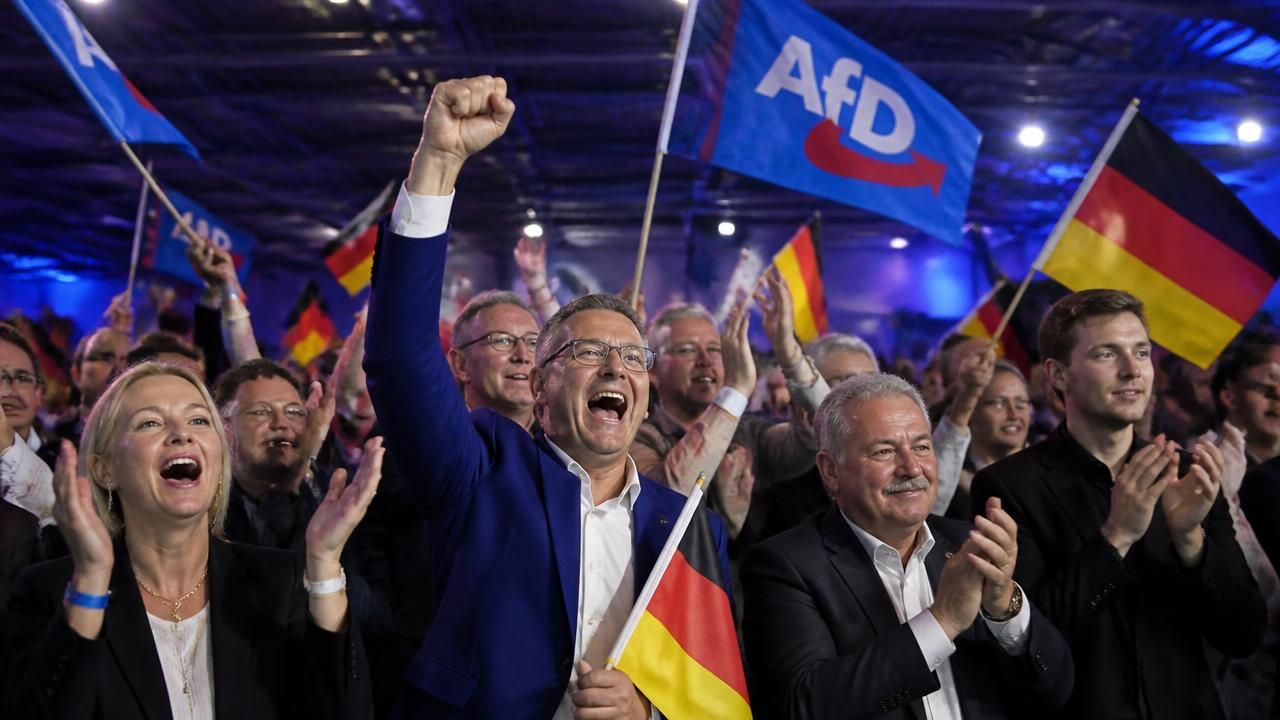
In a result that could reshape Germany's political landscape, exit polls from the eastern state of Saxony-Anhalt show the far-right Alternative for Germany (AfD) with a commanding lead in the state parliamentary election. If the projections hold, the AfD would win the most seats and potentially form a government, marking the first time since the end of World War II that a far-right party has taken power at the state level in Germany.
The election, held Sunday, delivered a seismic jolt to the country's political establishment. The AfD, which has focused its campaign on opposition to immigration, skepticism of climate policies, and criticism of the European Union, appears to have tapped into deep discontent in a region that has undergone tremendous upheaval since German reunification in 1990.
What the Exit Polls Show
According to exit polls reported by multiple German broadcasters, the AfD is projected to finish first with roughly 30–35 percent of the vote, ahead of the center-right Christian Democratic Union (CDU), which has governed Saxony-Anhalt since reunification. The CDU is projected to win around 24–28 percent, while the center-left Social Democrats (SPD) and the Left Party are trailing with single-digit support.
Critically, the AfD's projected share may or may not be sufficient to secure an absolute majority of seats in the state parliament, the Landtag. ‘It is still unclear whether the AfD can govern alone or would need coalition partners, but no other party has so far been willing to cooperate with them,’ said political scientist Anna Müller of the University of Leipzig.
Should the AfD win an outright majority, it would be able to form a state government without needing any other party's support. Even without a majority, the party could become the strongest force, making it difficult for other parties to exclude them from power in a state where AfD is the most popular choice.
The Context of Saxony-Anhalt
Saxony-Anhalt, a predominantly rural state with a population of about 2.2 million, is part of the former East Germany. It suffers from a declining population, lower incomes, and higher unemployment compared to the western states. The state has long been a stronghold of the AfD, which first entered the Landtag in 2016 under the leadership of the party's far-right wing.
The AfD's support in the region has been fueled by a sense of economic and cultural abandonment. Many residents feel that the political establishment in Berlin has ignored their concerns about immigration, deindustrialization, and social change. The party has also capitalized on anger over COVID-19 restrictions, which were especially contentious in eastern Germany.
Historically, Saxony-Anhalt was a center of the Protestant Reformation and later an industrial hub in the German Empire. During the communist era, the area was part of East Germany, with the secret police and state-owned industry shaping its identity. After reunification, much of its heavy industry collapsed, leaving behind high unemployment and a deep sense of loss.
“The AfD is not a small fringe group anymore. It has become the dominant political force in parts of eastern Germany, and that is something we cannot ignore,” said Ines Weber, a political commentator based in Magdeburg, the state capital.
Reactions from Political Leaders
The projected result has sent shockwaves through Germany's mainstream parties. The CDU, which runs the state under Minister-President Reiner Haseloff, acknowledged the setback. “This is a bitter day for all democrats. We must ask ourselves why so many citizens no longer trust the democratic parties to solve their problems,” said a spokesman for the CDU's regional branch.
Chancellor-level reactions are also expected, with federal leaders projecting concern. The Social Democrats, led by Chancellor Olaf Scholz at the federal level, have long argued that a cordon sanitaire should prevent any cooperation with the far right. This principle is known as the ‘firewall’ in German politics. However, if the AfD achieves enough seats, the firewall will be severely strained, as other parties face the choice of entering into a coalition against their stated policy or letting the AfD govern unopposed.
- The AfD is under observation by Germany's domestic intelligence agency in three federal states for suspected right-wing extremism.
- Party leader Alice Weidel called the projected result a “political earthquake” and demanded that “the will of the people in eastern Germany be respected.”
- Voter turnout was exceptionally high, estimated at 70 percent, up sharply from the previous election—a sign of the election's polarizing stakes.
Implications for Germany and Europe
The possible victory for the AfD in Saxony-Anhalt is not just a regional event—it carries national and international significance. It could embolden far-right parties elsewhere in Europe, including in France, Italy, and the Netherlands, where nationalist movements are already gaining ground. In Germany, it would deepen the East-West divide, as no comparable far-right success has occurred in any western German state.
On foreign policy, the AfD has been skeptical of sanctions against Russia and prefers closer ties with Moscow, a position that clashes with the federal government's approach. The party has also campaigned against EU fiscal solidarity and the European Green Deal. A victory could therefore influence how Germany is perceived abroad, raising questions about the stability of its democratic institutions.
Economically, Saxony-Anhalt is not a major industrial hub, but its manufacturing sector, including chemical production around the Leuna industrial park, is important. Business leaders have expressed caution. “Investors want stability. A far-right state government could create uncertainty and damage Saxony-Anhalt's appeal,” said Klaus Wessels, head of the state's chamber of industry and commerce.
What Happens Next?
Official results are expected within days, with final counting due to validate the exit polls. The AfD is likely to put forward a candidate for minister-president, possibly the party's regional leader, Oliver Kirchner. If other parties refuse to join a coalition and the AfD falls short of an absolute majority, the state may face a prolonged political crisis, including the possibility of another election.
Analysts suggest that the most likely scenario is a grand coalition between the CDU and SPD, similar to previous arrangements, but such a coalition would have a fragile majority and might be stable only if the AfD cannot find partners. Alternatively, the CDU could try to form a minority government with the tactical support of other parties—another untested idea.
The broader message from Saxony-Anhalt is unmistakable: voters are angry, and not just at any single policy, but at a political system they see as detached from their daily lives. As the country prepares for federal elections next year, this state contest offers an ominous preview of a possible future where the far right is not just an opposition force, but a party of power.
Note on Sources
This story draws primarily on live exit poll data and analysis from The New York Times. Three other items initially distributed on the wire—featuring interviews with author Edmund White, open source game developer David White, and Australian paralympian Tina McKenzie—were unrelated to the German election and appear to have been misrouted. Editors therefore relied on the single substantive news source for this report.