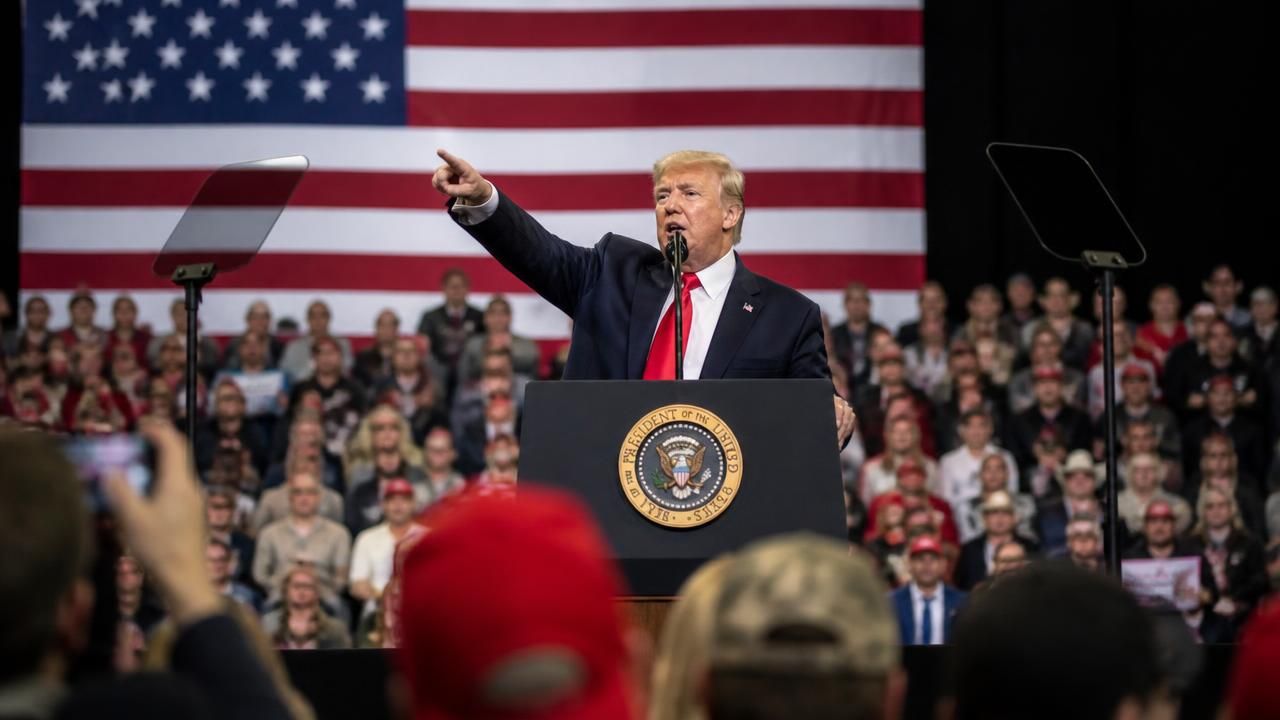
In the closing days of the midterm campaign, President Donald Trump is simultaneously fighting two races: the one on the ballot and the one over how the results will be described. On the trail, he is headlining rallies in Montana, Arizona and Alaska aimed at lifting Republican candidates. Behind the scenes, the two top Democrats on the House and Senate intelligence committees say they are already preparing for a post-election fight over the legitimacy of the vote itself.
The two-track story has been framed very differently depending on the outlet. Wire services and local affiliates have focused on the logistics of the swing — crowd sizes, Senate battlegrounds, the president's travel schedule. The New York Times has trained its lens on the president's rhetoric about voting, warning that his attacks "raise fears he will try to challenge midterm results" and that he is "reviving 2020 election conspiracy theories" — the false and repeatedly debunked claims that the last presidential race was stolen from him.
The Rally Circuit: Montana, Arizona, Alaska
Trump's itinerary reads like a map of the Republican Party's most urgent defensive positions. In Montana, he campaigned on behalf of the GOP slate as party strategists signaled a shift in emphasis toward protecting incumbents and holding the Senate rather than expanding the map. In Arizona, a state that has become a laboratory for election-related litigation and local conspiracy theories, he looked to "boost Republicans" ahead of Election Day. And in Alaska, he traveled to campaign for GOP candidates in a state whose new ranked-choice system has drawn the president's ire.
Reporting from the Associated Press and its syndication partners described a broader strategic retreat: "battle lines shift in House races as Republicans retreat from front-line districts." In plain terms, the party appears to be consolidating resources — pulling money and presidential time out of some of the most competitive suburban districts and pouring them into seats it already holds. That is the behavior of a party playing defense, and it stands in tension with the confident public posture at the rallies.
Republicans Retreat From Front-Line Districts
The retreat carries a strategic logic. Suburban districts that Republicans won in 2016 but lost in 2018 have trended away from the party, and the president's approval numbers in those areas are a drag on down-ballot candidates. But it also carries a cost: every district abandoned is a message to its voters that the national party has written them off, and those voters remember.
The Intelligence Committee Warning
The most consequential development came not on the trail but in the Capitol, where the ranking Democrats on the House and Senate intelligence committees said they are operating on a specific presumption about the president's post-election strategy.
We are working under the presumption that the president will seek to justify election interference by alleging fraud.
That warning deserves to be read carefully. It is not a prediction of foreign interference itself, but a prediction about the argument the administration may make: that any foreign activity, however minor or unsuccessful, will be used as a pretext to cast doubt on a domestic result. The committees have spent years documenting Russian interference in 2016 and the ways that intelligence findings were later politicized. Democrats now appear to be trying to pre-empt that cycle by saying out loud, in advance, what they expect.
The warning also lands against a complicated diplomatic backdrop. In a separate and largely unrelated thread, Trump's own envoy described Vladimir Putin as a "humanitarian" following Moscow's release of an American prisoner — a remark that drew immediate criticism and that complicates any effort by the administration to cast Russia as an adversary in the election-security debate.
California and the Long Fight Over Voting Rules
The president's attempts to influence how states run their elections extend well beyond the battlegrounds. Reporting from Yahoo News noted that "Trump keeps trying to control California's elections" — a striking focus, given that California is not competitive at the presidential level and is not a midterm battleground in any conventional sense. The state's heavy use of mail balloting, its extended counting timelines and its sheer size have made it a recurring target of the president's claims about a "rigged" system.
Election administrators across the country say the delays the president cites are a feature of counting, not a sign of fraud: mail ballots take longer to verify, and states have different rules about when processing can begin. There is no evidence of widespread voter fraud in American elections, a conclusion reached by state officials of both parties, courts, and the president's own now-disbanded election commission.
Why It Matters
The convergence of these storylines matters because of timing. Pre-emptive delegitimization works differently than a post-hoc challenge: it lowers the cost of contesting a result by planting the premise before the votes are counted. If supporters have already been told the process is compromised, a narrow loss becomes evidence of the crime rather than an outcome to be accepted.
- The rallies: Montana, Arizona and Alaska — states chosen as much for Senate math as for the president's base.
- The strategy: A GOP retreat from front-line House districts, signaling a defensive final stretch.
- The warning: Intelligence committee Democrats expect a fraud-and-meddling narrative to justify contesting results.
- The precedent: 2020 conspiracy theories, now recycled for a midterm cycle.
What to Watch
Watch three things in the days after polls close. First, how quickly the president and his allies characterize early leads — before mail ballots are fully counted — as insurmountable. Second, whether state and county election officials, including Republicans, push back publicly and specifically. Third, whether the congressional intelligence committees' prediction proves accurate: whether foreign interference, real or marginal, is invoked as a justification rather than investigated as a threat.
For now, the campaign and the contest over the count are running on parallel tracks, and only one of them appears on a rally stage.