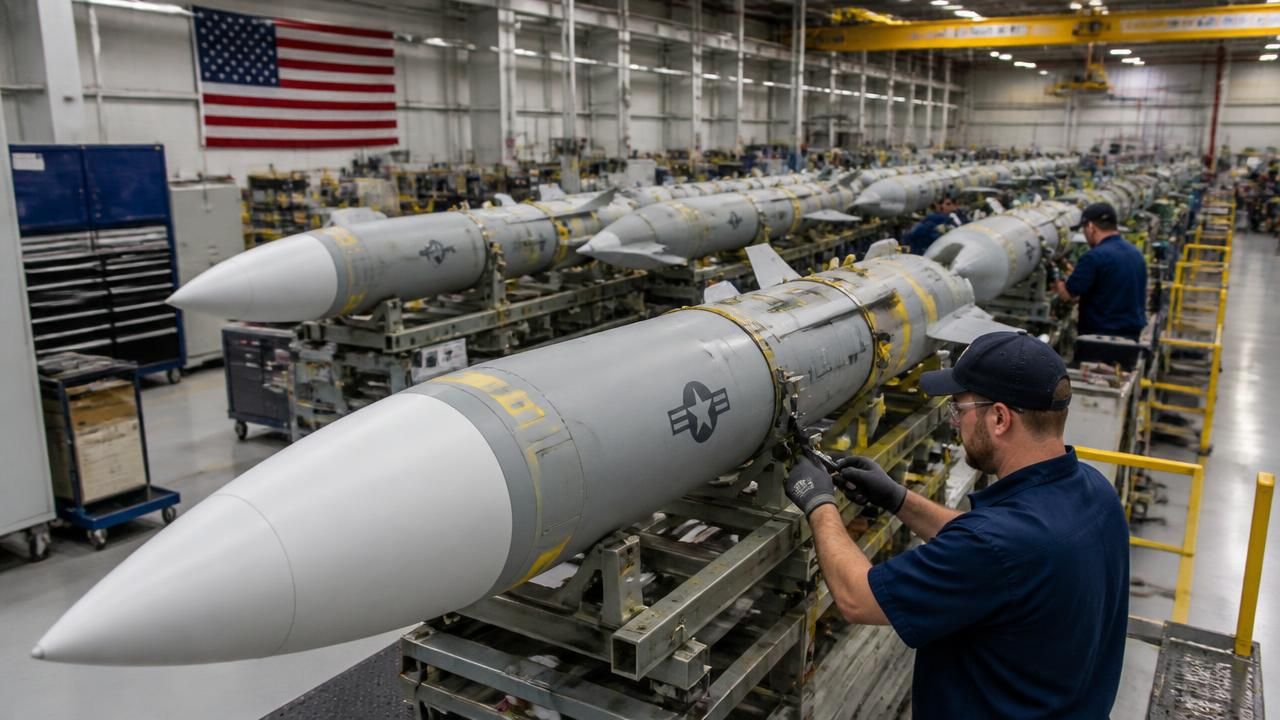
The United States is urgently accelerating missile production, awarding defense giant Raytheon billions of dollars in new contracts as the Pentagon seeks to replenish stockpiles strained by recent operations in the Middle East. The push spans both advanced interceptor missiles and strike weapons like the Tomahawk cruise missile, reflecting growing anxiety over the depth of America's arsenal in an era of multiple simultaneous global threats.
Why the Sudden Urgency?
The urgency stems from months of intense US military activity in the Middle East, particularly strikes and defensive operations linked to the Israel-Iran conflict. According to Al Jazeera, the Pentagon has explicitly called for faster weapons production amid concerns that stockpiles of high-end munitions are being consumed faster than they can be replaced. While the US retains significant capacity to conduct operations against Iran, insiders acknowledge that inventories of sophisticated interceptors have come under greater pressure than initially projected.
This is not just a question of keeping Iran in check. Pentagon planners are acutely aware that any drawdown in reserve munitions could be exploited by other adversaries, particularly in the Asia-Pacific theater where China continues its military buildup and where Russia remains a potent challenger despite its focus on Ukraine.
The Contracts: Billions for Raytheon
At the center of this industrial surge is Raytheon, a division of RTX Corporation. Recent Pentagon awards show the scale of the effort:
- A $745 million contract for missile interceptor production, which will expand Raytheon's operations in Arizona, according to the Phoenix Business Journal. This deal is specifically aimed at increasing the output of interceptors such as the Standard Missile-3 (SM-3) and the Patriot family, both critical for defending against ballistic and cruise missile threats.
- A $22.9 billion contract to boost Tomahawk cruise missile output, as reported by MSN. While the Tomahawk is an offensive strike weapon rather than an interceptor, its inclusion underscores the broader shortfall in precision-guided munitions across the US military.
The combination of these contracts signals a long-term commitment from the Defense Department to rebuild and expand the industrial base for missiles of all classes.
Military Experts Weigh In
Col. Wayne Sanders, Senior Defense Analyst at Bloomberg Intelligence, discussed the challenges on Bloomberg This Weekend. He told host Christina Ruffini and Jeff Mason that manufacturers are being pushed to sharply increase production, but the process is complicated by sprawling supply chains and concerns about preserving advanced weapons for other potential conflicts.
"Manufacturers are being pushed to sharply increase production, a process complicated by sprawling supply chains and concerns about preserving advanced weapons for other potential conflicts."
Indeed, the components for modern missiles often come from dozens of subcontractors spread across multiple states and even countries. A bottleneck in a single specialized chip or rocket motor can delay the entire line. Moreover, military leaders are loath to see all newly produced interceptors shipped to the Middle East, as that would leave other theaters dangerously exposed. This is not merely a theoretical concern; both China and Russia are closely monitoring the US production surge to gauge how quickly American forces can regenerate combat power after a high-intensity conflict.
A Long Road to Restock
Despite the influx of cash, the Christian Science Monitor reports that restocking US missile interceptors will take years. The industrial base for advanced interceptors is not like a car factory that can simply increase output overnight. Precision manufacturing, rigorous testing, and specialized tooling all impose limits on speed. Separate supply chains for seekers, warheads, and propulsion systems each have their own lead times.
Analysts estimate that even with the new contracts, it could take until the end of the decade to fully return inventories to pre-2024 levels. In the meantime, the US military must manage risks carefully, calibrating its use of expensive interceptors against the probability of future conflicts.
Geopolitical Repercussions
China and Russia are not idle observers. Military analysts say Beijing and Moscow are studying how the US handles this production crunch, particularly whether Washington can simultaneously support an ally like Israel and maintain enough weaponry to deter Asia-Pacific contingencies and NATO's eastern flank. The CS Monitor's report underscores that these countries are "watching" the restocking timeline, drawing conclusions about American staying power in any prolonged confrontation.
For the Defense Department, the challenge is twofold: accelerate the current output to meet immediate operational demands, while also building resilience into the supply chain so that future crises do not trigger similar tail-chasing. The $23 billion-plus in Raytheon contracts is a concrete step, but experts caution that industrial policy must be backed by sustained funding, skilled workforce development, and strategic stockpile management.
Conclusion
The US missile production surge is a clear acknowledgment that modern warfare consumes ammunition at rates previously seen only in the largest computer simulations. With billions in new contracts and a palpable urgency from the Pentagon, the defense industry is responding. But the road to full readiness is long, and America's adversaries are taking note. As the military-industrial complex gears up, the ultimate test will be whether the United States can rebuild its arsenal fast enough to maintain deterrence across the globe — without exhausting its industrial capacity or leaving another front under-supplied.