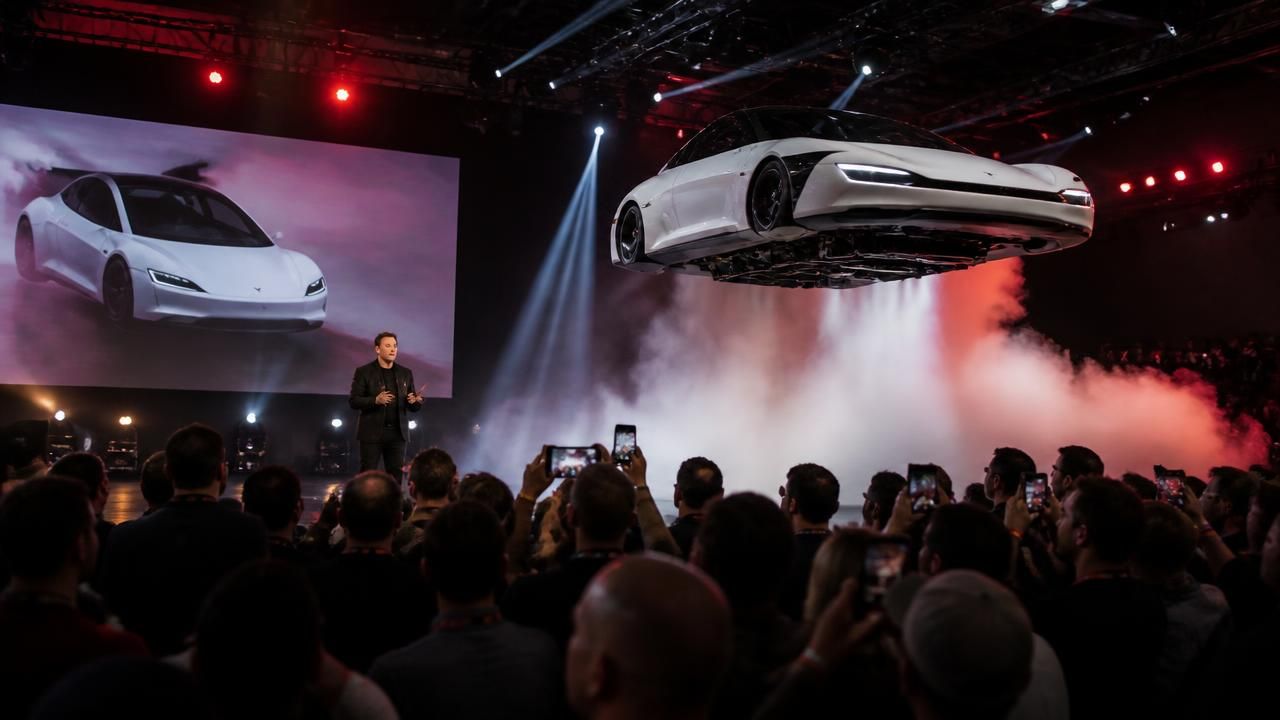
Tesla reported third-quarter results on Wednesday, and once the smoke — literal and otherwise — cleared from its theatrical Roadster demonstration, the numbers told a far less dramatic story. The electric-vehicle maker posted $1.7 billion in net income on $28.0 billion in revenue for the quarter ended in September, a top-line figure that was essentially flat against the $28.1 billion it booked in the same period a year earlier.
The revenue print cleared Wall Street's consensus of $27.9 billion, according to data compiled by LSEG, but landed short of Tesla's own company-compiled expectation of $28.3 billion — a nuance that reframes the "beat" as a modest miss against internal guidance. The company also flagged a 4 percent year-over-year decline on one profitability measure, even as reported net income rose from $1.4 billion a year ago, a discrepancy that appears to reflect adjusted or segment-level figures in the release.
A spectacle in search of a business model
The earnings call arrived days after Tesla staged an elaborate demo of a flying Roadster — a vehicle the company has now positioned for 2028, and one that has slipped repeatedly from earlier timelines. The stunt dominated social feeds and briefly juiced the stock into the print, but it did little to change the fundamental conversation on the call.
That gap between spectacle and substance is where coverage of the quarter diverged sharply. FinanceFeeds framed the demo as a potential catalyst — if it can be converted into revenue: "Tesla's Flying Roadster Could Lift TSLA Into Earnings, but the Demo Has to Become a Business." MSN, meanwhile, focused on the more prosaic issue of quarterly deliveries while noting the Roadster had been delayed yet again. KuCoin's market-facing read was blunter still, arguing the Roadster 2.0 demonstration "fails to sustain high valuation" as earnings approached.
"The Tesla Story Is Falling Apart, And A Flying Roadster Won't Save It." — Seeking Alpha
Seeking Alpha's framing represents the bearish pole of the coverage, treating the aerial Roadster as a distraction device deployed precisely when the core automotive business is decelerating. Yahoo Finance posed a similar question in the form of a headline — "Can Tesla's Flying Roadster Distract From Its Real Risks?" — while The Verge, covering the earnings directly, led with the "cold reality" that revenue has flatlined.
Same revenue, different story
For a company that spent much of the past decade compounding revenue at double-digit rates, a flat top line is the story. Tesla's Q3 revenue of $28.0 billion is effectively a photo finish with last year's $28.1 billion, and the company's internal forecast of $28.3 billion implies management itself expected only marginal growth.
- Revenue: $28.0 billion, roughly flat year over year and above LSEG's $27.9 billion consensus.
- Net income: $1.7 billion, versus $1.4 billion in Q3 of the prior year as reported.
- Profitability: a reported 4 percent year-over-year decline on one measure, a signal that pricing pressure and cost inflation are squeezing margins.
- Product pipeline: the Roadster slips to a 2028 target, extending a delay that has now spanned multiple years.
The margin question matters more than the revenue beat. Tesla has spent the past two years leaning on price cuts and financing incentives to defend volume in an increasingly crowded EV market, and each incremental discount lands directly on the bottom line. A company growing revenue at 30 percent can absorb that; a company growing at zero cannot.
Deliveries, demand, and the credibility gap
Attention now turns to quarterly delivery figures, the metric Tesla watchers treat as the truest demand signal. Deliveries have become the focal point for investors trying to determine whether flat revenue reflects soft unit sales, a richer mix of lower-priced vehicles, or both.
The Roadster complicates that calculus. Announcing a flying car is, functionally, an announcement about a product that will not generate revenue for at least two years — and possibly longer, given the company's history of timeline slippage. The Cybertruck, the Semi, and the original second-generation Roadster all arrived later than promised. Investors who have watched that pattern are understandably skeptical of a 2028 date attached to a vehicle that flies.
"As the smoke clears from its outrageous Roadster demo, Tesla reported Q3 earnings on Wednesday — and the cold reality is that revenue has flatlined." — The Verge
There is a defensible bull case: the demo generated enormous free media, reinforced Tesla's positioning as a technology company rather than a carmaker, and may help sustain a valuation multiple that pure automotive fundamentals would not support. The KuCoin analysis effectively concedes this dynamic even while dismissing it — the demo's purpose is valuation support, not demand generation.
What to watch next
Three things will determine whether this quarter reads in hindsight as a pause or a plateau. First, deliveries: any year-over-year decline would convert "flat revenue" into something worse. Second, gross margin excluding regulatory credits, which reveals whether the core business still generates cash at scale. Third, energy storage and services, the segments Tesla has increasingly leaned on to offset automotive softness.
The deeper tension, though, is one of narrative. Tesla has always traded on the future — on autonomy, on robots, on rockets, and now on a car that levitates. Wednesday's results suggest the present is catching up. A flying Roadster can command a headline, but it cannot yet book revenue, and a company whose revenue has flatlined at $28 billion needs the latter far more than the former.