It began with unusually heavy rain falling on the Bhotekoshi river and spread like a dark ribbon through Nepal's central Himalayan foothills and down toward the capital. The floodwaters struck with little warning, sweeping away homes, bridges, buses, and entire families. More than a week later, Nepal is counting the cost: a death toll that has passed 1,200, a missing list that approaches 5,000, and communities that are holding funerals for people who may never come home.
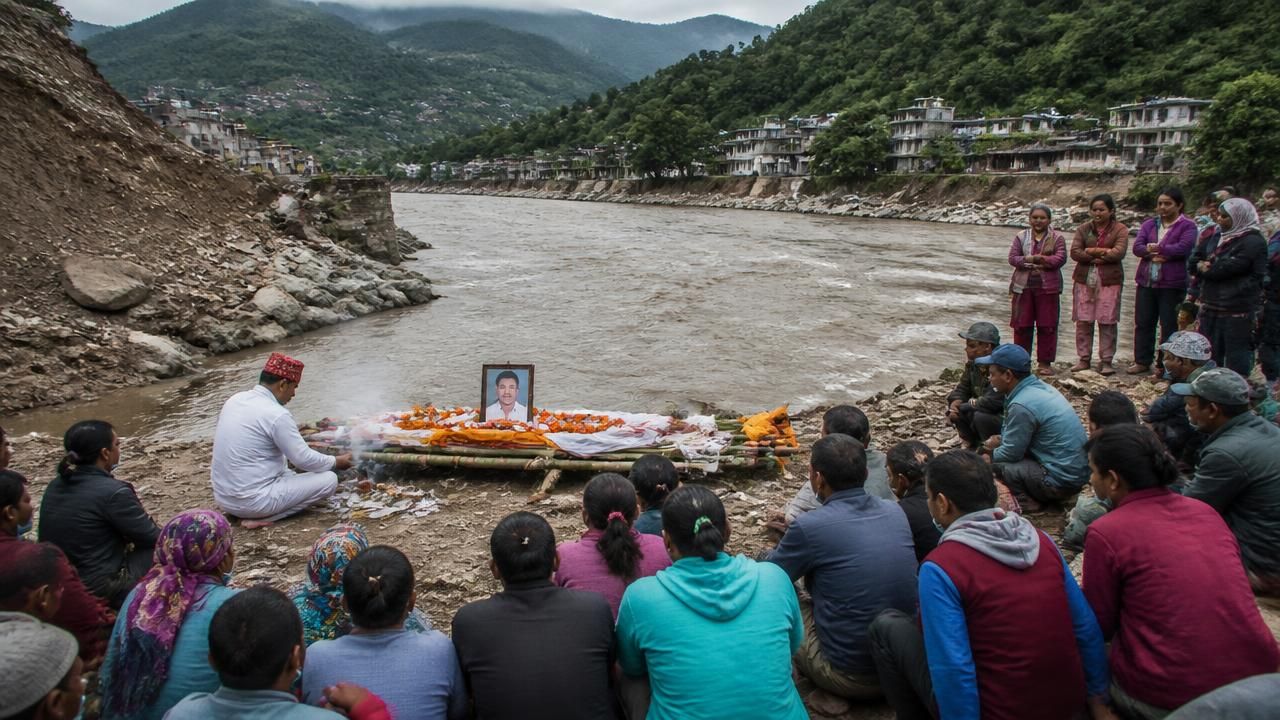
In a painful paradox, many of these funeral rites are being performed without bodies. The New York Times’ South Asia bureau chief, Mujib Mashal, witnessed one such ceremony in a village along the flooded river, where relatives chanted prayers over an empty stretcher and placed a photograph where a body should have been. It is a scene being repeated across the region as the disaster’s true scale emerges.
Scale of Loss Remains Uncertain
Reporters have struggled to get a complete picture. Official numbers have been revised upwards nearly every day, with the Philippine News Agency and Al Jazeera reporting death tolls above 1,250. Meanwhile, tens of thousands of soldiers, police, and volunteers are searching ravines, riverbanks, and high-altitude settlements for the missing.
- At least 1,252 confirmed deaths as of the latest official count cited in reports.
- Up to 5,000 people listed as missing, per Mashable and other news outlets.
- Mass burials underway for unidentified victims, according to the Irish Examiner.
Authorities in Nepal have declared September 7 a day of national mourning, an announcement carried by The Himalayan Times and VOV. Flags will fly at half-staff across the country. For those who cannot wait any longer, symbolic cremations have provided a way to begin the grieving process. Yet for hundreds of families, the uncertainty remains the cruelest part.
Mass Burials Highlight the Human Toll
While some communities have embraced symbolic ceremonies, others are being forced to bury strangers. The Seattle Times, in a photo report headlined “as other flood victims are buried in unmarked graves,” documented the grim reality that many recovered bodies are never identified. Mass burials of unclaimed or unidentified victims have begun, carried out under strict protocols, but volunteers fear that the scale of the disaster is overwhelming the system.
“The pain is deeply overwhelming,” a relative mourning a flood victim told local media, in words that have been widely quoted across the region.
Diaspora Communities Rally Across the World
Meanwhile, the grief has radiated far beyond Nepal’s borders. In the United States, vigils have been held in Rochester, New York; Erie, Pennsylvania; and in California’s Bay Area, where the Nepalese community has mobilized to raise funds for families still waiting for news. In South Korea, Nepalese residents gathered in prayer, while Korean Protestant church groups issued a statement of solidarity, citing the world’s shared and “heavy responsibility” for the climate crisis that is intensifying Himalayan weather extremes.
In the UK, restaurants and shops in cities like Plymouth have become hubs of community fundraising and grieving after local business owners lost family members in the disaster. In Australia’s Northern Territory, Nepalese families have also gathered to mourn and have appealed for public donations.
King Charles Offers Personal Message
King Charles said he was “heartbroken” at the loss of life, according to a message shared by Town & Country. The monarch’s message reflected a broader sense of loss at the international level, with world leaders lining up to offer condolences.
Official and Spiritual Responses
The Nepali government has announced special prayer ceremonies and provisional support for families of the missing. Still, many survivors say the response is not enough. With September 7 now declared a day of national mourning, the country will pause to honor a disaster that has touched nearly every district.
Climate Lessons Cannot Be Ignored
The Korean Protestant groups’ link between the floods and the climate crisis has been echoed by environmental advocates. Scientists say warming temperatures in the Hindu Kush Himalaya are melting glaciers and changing precipitation patterns, making catastrophic floods more frequent and severe. The Bhotekoshi river flooding, in particular, appears to have been triggered by a glacial lake outburst, raising urgent questions about how well the region is protected.
As communities begin the slow task of rebuilding, many are also asking what will stop the next tragedy from becoming even worse. For now, though, the immediate focus is on those who are still missing. In Nepal and in Nepali communities worldwide, the search for closure continues — one symbol at a time.