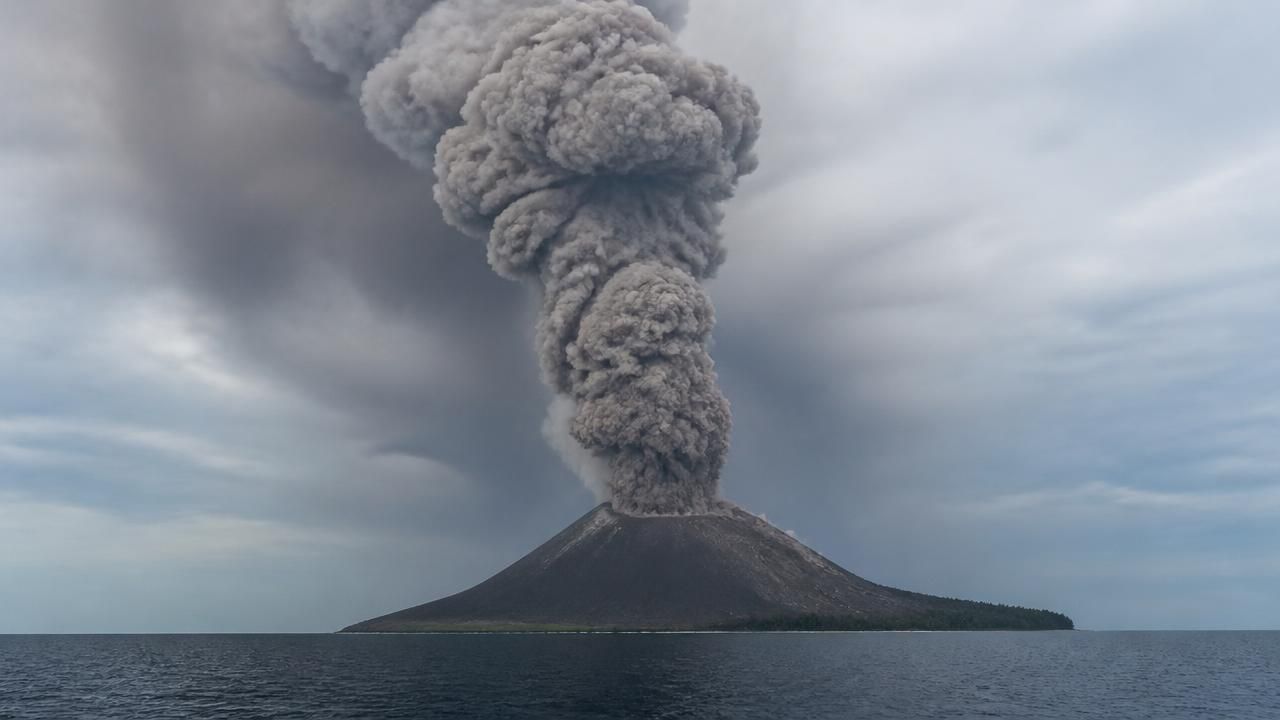
Indonesia suspended flights at airports in Jakarta and Lampung on Sunday after volcanic ash from Mount Anak Krakatau spread across parts of Java and Sumatra, according to state-owned airport operator InJourney Airports. The disruption hit the country's busiest gateway, Soekarno–Hatta International Airport in Jakarta, as well as Radin Inten II Airport in Lampung Province, as prevailing winds carried ash into flight paths, threatening jet engines and reducing visibility.
What happened
Anak Krakatau, the restless volcanic island in the Sunda Strait, erupted with a column of ash and gas that drifted northwest toward Indonesia's main island of Java and the southern tip of Sumatra. The ash cloud prompted aviation authorities to halt departures and arrivals at the affected airports, stranding hundreds of passengers and forcing airlines to cancel or delay flights.
InJourney Airports did not immediately disclose how many flights were affected or when operations would resume, but witnesses reported long queues at terminal information desks as travelers sought alternative arrangements. Local meteorological and volcanology agencies are monitoring the eruption and tracking the ash plume, which is being blown across densely populated regions, including the greater Jakarta area.
Why volcanic ash is a hazard
Volcanic ash is not typical dust; it consists of fine, abrasive rock and glass particles that can melt inside jet engines, causing flameout and catastrophic failure. The International Civil Aviation Organization recommends avoiding ash clouds at all costs, and airlines routinely reroute or cancel flights when volcanic activity is detected. The decision to close airports in Jakarta and Lampung is a precautionary measure echoed by similar actions after previous eruptions in Indonesia, including the 2010 disruption caused by Mount Merapi and the 2015 event at Mount Raung that closed Bali's airport.
Anak Krakatau has a particularly notorious history. It emerged from the sea in the early 20th century at the site of the legendary Krakatau volcano, whose 1883 eruption killed more than 30,000 people and generated tsunamis that devastated coastal communities. In December 2018, Anak Krakatau erupted violently, causing a tsunami that struck the Sunda Strait coastlines and killed more than 400 people. Since then, the volcano has remained active, with occasional eruptions that serve as reminders of the region's tectonic instability.
Impact on travel and business
The suspension of flights at Jakarta's main international airport—a central hub for domestic and international travel—disrupted connectivity across the Indonesian archipelago and beyond. Business travelers, tourists, and cargo operations faced delays, raising concerns about economic ripple effects in a country that relies heavily on air transport to link its thousands of islands. The Jakarta airport serves as a gateway for many global airlines, and the closure forced carriers to divert incoming flights to alternative airports or hold them at their origins.
Bloomberg Markets, one of the first to report the disruption, framed the situation primarily through a business lens, noting the operational halt ordered by InJourney Airports. That coverage mirrors how financial markets react to infrastructure shocks, with potential effects on airline stocks, tourism-related businesses, and logistics companies. In contrast, Australia's ABC News focused on the broader human impact, emphasizing the chaos and confusion felt by passengers as news of the eruption and flight suspensions spread.
Official response and outlook
InJourney Airports, which operates 37 airports across Indonesia, said it was coordinating with airlines, air traffic control, and geological agencies to assess the safety situation. "We prioritize the safety of all passengers over schedule certainty," a representative said in a statement. "We are continuously monitoring the volcanic ash dispersion and will update the public as conditions change."
Authorities have urged residents and travelers to stay informed, while the Center for Volcanology and Geological Hazard Mitigation (PVMBG) has maintained a hazard alert level for Anak Krakatau, recommending a 5-kilometer exclusion zone around the crater. The volcano's activity is unpredictable, and experts warn of possible further eruptions that could extend the flight suspensions.
Different angles, common ground
The coverage across sources reflects a spectrum of editorial priorities. Bloomberg Markets zeroed in on the operational and financial angle, naming InJourney Airports and emphasizing the state-owned operator's decision. MSN's various short dispatches, likely pulled from wire services, offered almost no additional analysis—merely restating that Jakarta's main airport had suspended flights because of Anak Krakatau. ABC News, meanwhile, used slightly more descriptive language, noting that ash was dispersing across "western Indonesia" and framing the story as a natural-hazard alert for an international audience.
All sources converge on the key facts: an eruption, ash in the air, grounded flights, and uncertainty. The story fits a recurring pattern in Indonesia, where volcanic activity and aviation are often in conflict. More than 150 active volcanoes pepper the archipelago, making it one of the most geologically volatile places on Earth. For every disruption, authorities must weigh safety against the immense economic cost of closing airspace.
What to watch
In the coming hours, the key question will be whether the ash plume moves away from flight corridors or dissipates sufficiently to allow airports to reopen. Satellite imagery and pilot reports will guide decisions. For travelers, the advice is to check with airlines before going to the airport and to allow extra time for rebooking. For observers, the eruption is another chapter in the ongoing—and sometimes dangerous—relationship between human infrastructure and Indonesia's fiery geology.
While Sunday's suspensions have no immediate global parallels, the world is watching: Anak Krakatau's past tsunamis and eruptions have shown that local events can have regional and even international consequences. For now, the priority is clear: keep aircraft out of the ash cloud, keep passengers safe, and wait for the volcano to calm.