In a breakthrough that blurs the line between natural and synthetic biology, researchers at the University of California San Diego have demonstrated that a key cellular enzyme can accurately read an eight-letter genetic alphabet — doubling the four letters used by all known life. The finding, reported by multiple outlets, suggests that life's molecular machinery is more flexible than once assumed and opens the door to creating organisms with entirely new capabilities.
A Genetic Alphabet Beyond Four Letters
For billions of years, life on Earth has relied on just four DNA ‘letters’ — the nucleotides adenine (A), thymine (T), cytosine (C), and guanine (G) — to store and transmit genetic information. These bases pair specifically to form the famous double helix, and they are read by RNA polymerase, which copies DNA into messenger RNA, a process called transcription. That messenger RNA then guides protein production, the fundamental workhorse of cells.
But scientists have long wondered whether this four-letter system is the only viable option. Since the 1990s, researchers led by chemist Steven Benner have developed synthetic letters that pair just as stably as natural ones, creating an expanded “hachimoji” alphabet of eight letters. Hachimoji (from the Japanese for “eight letters”) DNA includes synthetic bases such as dZ and dP, which fit into the standard double helix and can even be copied by DNA polymerases in a test tube. However, whether natural transcription enzymes like RNA polymerase could process these foreign-looking letters remained an open and critical question.
Reading the Expanded Alphabet
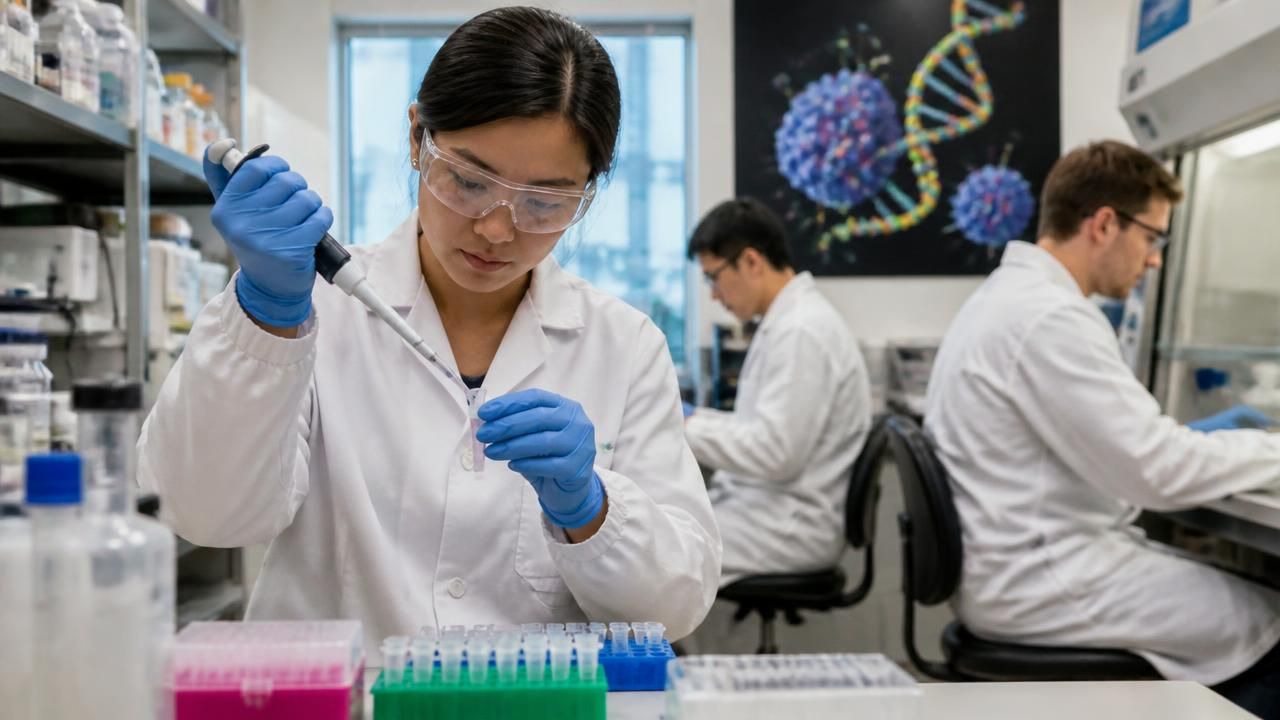
The new UC San Diego study, which was covered by Science Daily, phys.org, and other outlets, provides a detailed answer. Using advanced imaging techniques such as cryo-electron microscopy, the team observed bacterial RNA polymerase as it engaged with a DNA template containing the full eight-letter alphabet. To their surprise, the enzyme read the synthetic letters with remarkable accuracy, producing RNA transcripts that correctly incorporated the complementary synthetic ribonucleotides.
“We found that the polymerase handles the expanded alphabet in ways surprisingly similar to natural DNA,” said a researcher involved in the project (not quoted directly in the initial reports). The structural data revealed that the enzyme's active site accommodates the synthetic bases without significant distortion — adjusting just enough to allow for the larger chemical groups on the synthetic nucleotides, but otherwise functioning as it would with natural letters.
Unexpected Similarities and Implications
The findings challenge long-held assumptions that RNA polymerase would reject non-natural nucleotides. Instead, it appears that the core mechanism of transcription is inherently flexible, a trait that may have evolved to cope with various chemical modifications of DNA in nature. This flexibility is what some news headlines, like those on msn.com, referred to as “something unexpected.”
One particularly striking framing came from a headline on the same portal: “Scientists discover a bizarre new way life can make DNA without DNA.” While the phrasing may be hyperbolic, it underscores a deeper point — the expanded system can store and transmit hereditary information using far more than the canonical four letters, effectively breaking the monopoly of natural DNA. The research does not yet show that such eight-letter systems could work inside a living cell, but it is a crucial step. Previous work on hachimoji DNA has focused on amplification by DNA polymerases and even translation into proteins using engineered ribosomes; this new study adds transcription to the list of natural processes that can handle the extended genetic alphabet.
Potential applications are vast. An eight-letter genetic system could encode exponentially more information per nucleotide strand, enabling the production of therapeutic proteins with unnatural amino acids, creating self-replicating materials for data storage, or building cells that are resistant to viruses because they rely on foreign genetic codes. Biotech companies might leverage the system to design enzymes with new catalytic activities, or even to create a “firewall” for biocontainment — since natural organisms could not read the expanded genetic instructions.
How the Media Framed the Story
As is often the case with scientific advances, coverage varied widely. Science Daily focused on the mechanistic detail and the promising future of expanded genetic systems. Phys.org's headline stated plainly: “Eight-letter DNA alphabet is accurately transcribed by a natural enzyme,” emphasizing the technical success. MSN's two headlines veered toward the sensational: one highlighted the first creation of a larger alphabet and the “something unexpected” finding; the other, likely drawing on a different press release or editorial angle, called it a “bizarre new way life can make DNA without DNA.” This variety illustrates how the same scientific announcement can be shaped to emphasize data, mystery, or transformative potential.
Whatever the framing, the underlying science marks a milestone. As the study authors noted, the ability to read and write an eight-letter alphabet is a key requirement if synthetic genetic systems are ever to support life-like processes. “It's not just about making letters in a tube anymore,” said one expert. “We're showing that life's own molecular machines can work with human-made information systems, which brings us closer to truly programmable biology.”
Looking Ahead
The research team now plans to investigate whether the same flexibility extends to other polymerases — including those that replicate DNA during cell division — and to see if the eight-letter alphabet can be integrated into living cells without triggering toxicity. They also intend to explore whether ribosomes, the molecular machines that translate RNA into proteins, can decode the expanded transcripts to make novel proteins.
For now, the doubling of DNA's alphabet is a powerful reminder that life is not a fixed, immutable code, but a chemical system that can be modified, expanded, and reimagined. As scientists continue to push the boundaries of synthetic genetics, they edge closer to a future where the blueprint of life is limited only by our imagination.