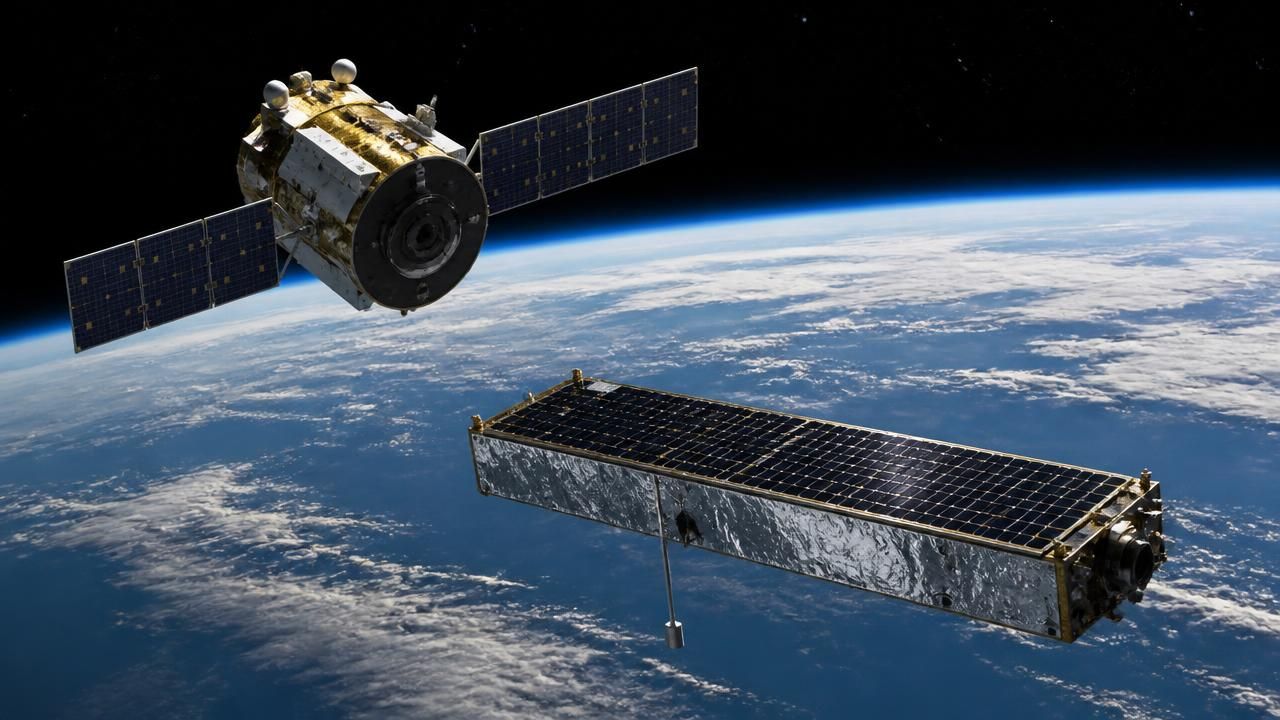
A Russian military satellite carried out a deliberate, close-range maneuver around a U.S.-operated commercial Earth-imaging satellite used by Ukraine, according to orbital intelligence firm LeoLabs, in what the company called the first known unsanctioned rendezvous in low-Earth orbit.
The Russian spacecraft, Kosmos 2612, closed from hundreds of kilometers away to "extreme proximity" with ICEYE-X36, then maneuvered around it, remained nearby for an extended period and began moving away, LeoLabs said. The encounter drew alarmed coverage from Ars Technica, The New York Times, Scientific American and CNN, each emphasizing a different dimension of the same event: technical novelty, menacing intent, risk to commercial space assets and the absence of permission.
What happened in orbit
LeoLabs, which tracks objects in low-Earth orbit using radar, described a deliberate series of maneuvers toward the ICEYE satellite. The company said Kosmos 2612 closed from hundreds of kilometers to extreme proximity, then maneuvered around ICEYE-X36 and stayed nearby for an extended period before moving away. Ars Technica reported that U.S. military officials and independent analysts have tracked Kosmos 2612 since its April launch on a Soyuz rocket from a spaceport in northern Russia. Within weeks, it became apparent that at least four of the six satellites from that launch were stalking ICEYE-X36 after adjusting their orbits to line up with the ICEYE spacecraft.
"Kosmos 2612 closed from hundreds of kilometers away to extreme proximity to ICEYE-X36. It then maneuvered around ICEYE-X36, remained nearby for an extended period, and then began moving away." — LeoLabs
The word "unsanctioned" is central to LeoLabs' assessment. Rendezvous and proximity operations—spacecraft deliberately approaching and maneuvering near another object—are not inherently hostile. They can be used for inspection, servicing or debris monitoring. But when one military satellite closes on another country's commercial spacecraft without coordination, the maneuver becomes a signal of intent and a test of orbital norms.
Why ICEYE-X36 is sensitive
ICEYE-X36 is a commercial Earth-imaging satellite operated by a U.S. company, and Ars Technica describes it as used by Ukraine. That combination—private ownership, commercial remote sensing and military relevance—makes it a particularly charged target. Ukraine has relied on commercial satellite imagery and data for battlefield awareness and intelligence during the war with Russia. A Russian military satellite closing on such a craft is therefore not just a technical curiosity; it is an intelligence and signaling event.
CNN framed the episode as a possibly unprecedented approach to another spacecraft without permission. The New York Times called it a menacing approach. Scientific American focused on expert alarm, reporting that a Russian satellite is stalking a U.S. spacecraft in orbit. The headlines differ in tone, but they converge on the same facts: a Russian military craft deliberately maneuvered near a U.S.-operated commercial satellite, did so without consent and remained in the vicinity for an extended period.
Context: gray zones in low-Earth orbit
Low-Earth orbit is increasingly crowded with commercial imaging, communications and scientific satellites. That density makes close approaches riskier and more ambiguous. A maneuver that might once have been dismissed as an anomaly now has to be interpreted against a backdrop of military reconnaissance, commercial dual-use technology and rising tensions between Russia and the West. The April launch and subsequent orbital adjustments are important because they suggest planning. According to Ars Technica, at least four of the six satellites from that launch adjusted orbits to line up with ICEYE-X36, indicating coordinated activity rather than a single accidental drift.
Such maneuvers sit in a gray zone of international space norms. Rendezvous is not banned, but unsanctioned close approaches can be read as provocative—especially when the target is a commercial satellite with defense and intelligence applications. The lack of a formal incident does not erase the concern. Experts cited by Scientific American are worried precisely because the episode demonstrates how easily a military satellite can approach a valuable commercial asset in orbit, and how difficult it can be to distinguish inspection from intimidation.
What comes next
The immediate questions are what Kosmos 2612 was doing near ICEYE-X36 and whether the maneuver will prompt a diplomatic or military response. LeoLabs' public disclosure gives analysts a common dataset and puts the episode on the record. The U.S. military and independent trackers are likely to keep monitoring Kosmos 2612 and the other satellites from the April launch. For commercial operators, the incident is a reminder that space assets are exposed not only to debris and accidents but also to deliberate proximity operations by state actors.
The broader significance is normative. If unsanctioned rendezvous in low-Earth orbit becomes routine, the line between acceptable inspection and coercive stalking will erode further. The coverage from Ars Technica, CNN, The New York Times and Scientific American shows that the event is already being framed as a test case: a Russian military satellite approached a U.S.-operated commercial craft without permission, and the world is now watching how governments, militaries and space companies respond.