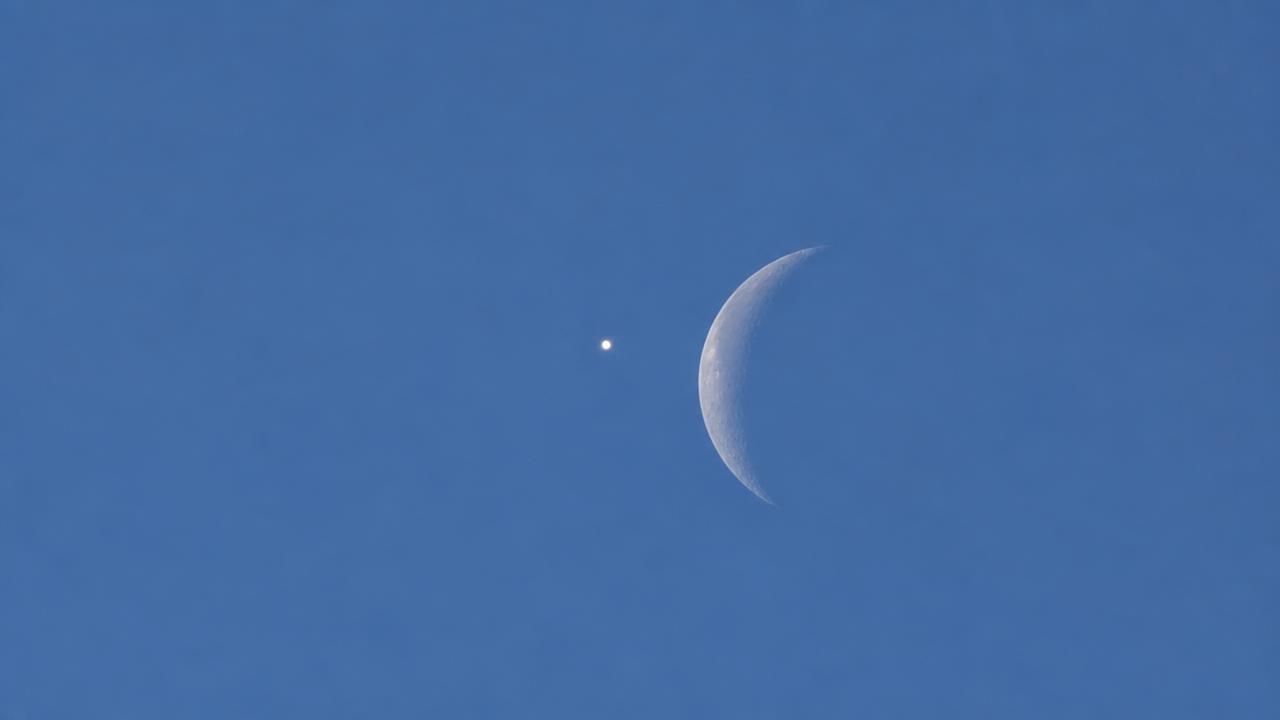
On Wednesday, June 17, skywatchers across the United States and parts of Canada were treated to a rare celestial spectacle as the Moon glided directly in front of Venus, briefly hiding the brilliant planet from view in broad daylight. The event, known as a lunar occultation, provided a striking visual for those who happened to look skyward at the right moment.
A Celestial Hide-and-Seek
A lunar occultation occurs when the Moon moves between Earth and another celestial object, such as a planet or star, from the observer's perspective. While occultations of stars are relatively common, occultations of bright planets like Venus are more noteworthy—and when they happen during the day, they offer an unusual opportunity to see Venus with the naked eye against a blue sky.
On this occasion, the Moon, a slim crescent, approached Venus from the west and slowly covered the planet for observers along a narrow track that swept across the continental United States and into parts of Canada. The exact timing varied by location, with some cities witnessing the disappearance in the early afternoon and others later, but all shared the same awe-inspiring sequence: Venus shining brightly, then fading behind the Moon's edge, only to reappear some time later.
NASA photographer Joel Kowsky captured the start of the occultation from the Mary W. Jackson NASA Headquarters building in Washington, D.C., where Venus could be seen just before it slipped behind the lunar limb. The image, released by NASA, shows the planet appearing as a bright white disk against the dark edge of the Moon, a reminder of how close these two worlds can appear in our sky.
"It's always thrilling to see an occultation," said Dr. Sarah Martinez, an astronomer at the U.S. Naval Observatory. "Venus is so bright that it can pop out in the daylight sky, making for an extraordinary experience. The Moon's slow, patient concealment of the planet is a beautiful demonstration of celestial mechanics."
The Science Behind the Spectacle
Occultations are more than just pretty sights. For centuries, astronomers have used them to refine our understanding of the Moon's orbit and the Earth-Moon distance. By precisely timing when a star or planet disappears behind the Moon's edge—known as the lunar limb—scientists can map small irregularities in the Moon's surface and improve models of its motion.
In the 20th century, timing occultations of bright stars helped astronomers measure the angular diameters of stars, a technique that laid groundwork for modern interferometry. Today, lunar occultations still provide valuable calibration data for spacecraft and helping to study atmospheric effects on light, especially in observations of the Moon's thin exosphere.
For Venus specifically, occultations are relatively rare for any given location on Earth, because the planet's orbit lies within 47 degrees of the Sun as seen from Earth, meaning it is only visible in a narrow portion of the sky during twilight or daytime. When the Moon happens to pass in front of Venus, the alignment must be nearly perfect, and the path of viewing may cover only a small geographic region.
Three Occultations in 2026
The June 17 event was just the first of three lunar occultations of Venus in 2026, each visible from a different part of the world. The upcoming dates include:
- September 14, 2026 — visible from parts of Asia, Africa, Europe, and western Russia.
- November 7, 2026 — visible from southern South America.
These events are part of a series that occurs when Venus's orbital path lines up with that of the Moon. Because the Moon moves about 13 degrees per day across the sky, occultations happen in multiples, with the geometry repeating over an 8-year cycle for Venus.
"If you missed June's show, don't despair," said Dr. Martinez. "The September and November events will offer another chance, though you may need to travel to see them. Even a partial occultation, where Venus grazes the Moon's edge, can be a breathtaking sight."
How to Observe Upcoming Occultations
Viewing a daylight occultation of Venus requires a bit of planning. Unlike a solar eclipse, there is no need for special filters—Venus is safe to look at with the naked eye. The main challenge is simply finding Venus in the bright sky.
A good technique is to locate the Moon first, since it is relatively easy to spot even in daylight, then scan just above or beside it for Venus. Binoculars or a small telescope will greatly enhance the view, revealing the planet's crescent phase and the Moon's rugged terrain. Observers should check local timing tables for their region, as the moment of disappearance varies by dozens of minutes across different cities.
For those unable to travel to the viewing paths, many observatories and astronomy organizations—including NASA—plan to stream the events online, allowing sky enthusiasts worldwide to watch the celestial hide-and-seek from the comfort of home.
A Reminder of Our Place in the Cosmos
Occultations like the one on June 17 serve as a poetic reminder that the solar system is in constant, orderly motion. Ancient cultures often interpreted such alignments as omens, while today astronomers use them as precise tools for science. For the casual observer, though, an occultation is simply a chance to witness the intimate dance of the Moon and planets—a quiet, daylight moment that connects us to the universe's grand clockwork.
Whether you planned it or stumbled upon it by chance, the sight of Venus vanishing behind the Moon is one that lingers in memory. And with two more opportunities on the horizon, the night—or in this case, day—sky still has wonders to offer.