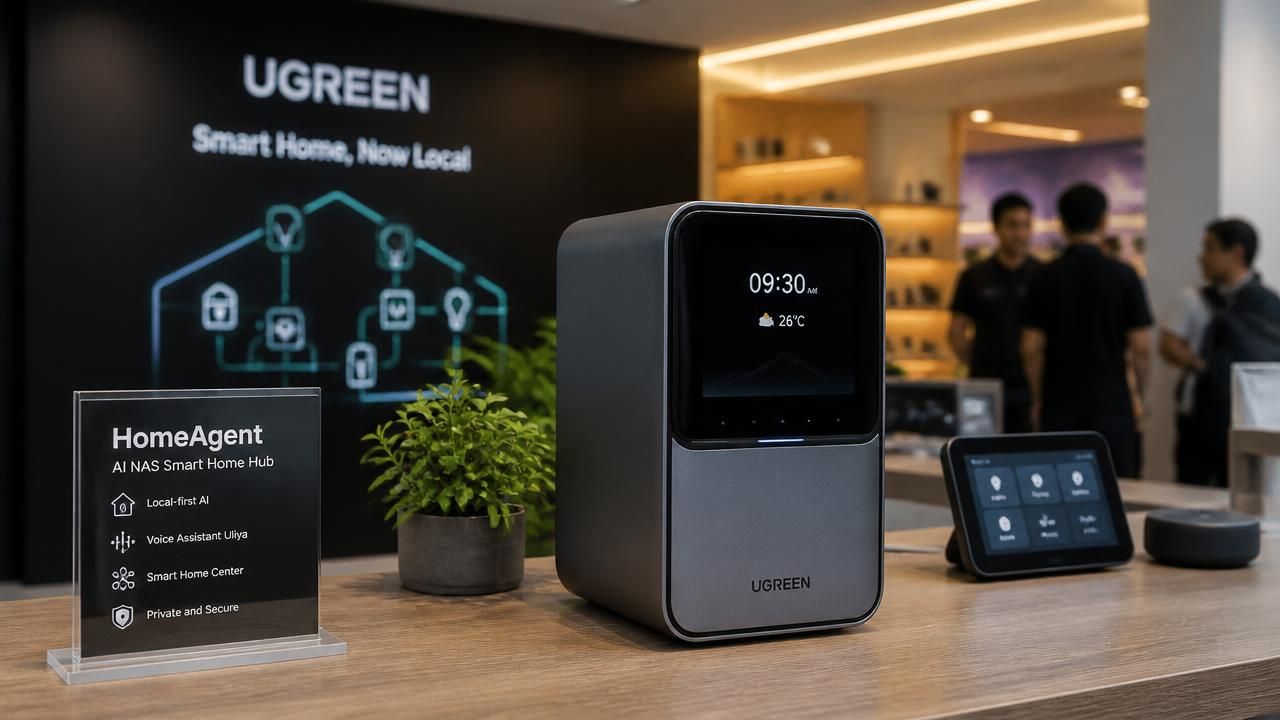
The smart home hub is getting a serious upgrade. At IFA 2025 in Berlin, two major electronics makers—Ugreen and Anker—unveiled new devices that aim to move your smart home's brain out of the cloud and into a box sitting on your shelf. Both the Ugreen HomeAgent and the Anker MindBase combine network-attached storage (NAS), on-device AI, and a voice assistant into a single, local-first system that promises greater privacy, lower subscription costs, and more control over your data.
The announcements signal a growing shift in the industry, fueled by consumer fatigue over monthly fees and concerns about cloud surveillance. These hubs tap into an expanding NAS market that has long been the domain of tech enthusiasts but is now going mainstream.
Ugreen HomeAgent: Local AI with Voice Assistant Uliya
Ugreen, best known for power banks and chargers, used IFA to launch its HomeAgent smart home platform. At its core sits a hub that acts as the brain of your smart home, running what Ugreen calls a 'local-first AI' system. The hub comes in three configurations—entry-level to fully loaded—allowing users to choose the storage and processing power they need. A built-in voice assistant, named Uliya, lets you interact with your home using natural language, similar to Amazon's Alexa or Google Assistant, but with one crucial difference: your commands and automations are processed on-device, not in a data center.
The Verge, which got an early look, notes that the system 'combines security camera storage, on-device AI, and smart home control in one system, managed by a voice assistant called Uliya.' It's a bold pitch, but there are caveats. Ugreen's 'local-first' approach still requires an internet connection for some features, and the AI's capabilities may be limited compared to cloud-based counterparts.
Tom's Guide framed the announcement as a direct challenge to the established players:
"Forget Alexa — UGreen wants you to use its new local AI assistant to control your smart home."That sentiment is echoing around the tech press, as consumers grow increasingly wary of sending voice recordings and camera feeds to corporate servers.
Anker MindBase: Doubling as NAS and AI Hub
Not to be outdone, Anker—through its smart home and security division—introduced the MindBase Home Hub. Like Ugreen's offering, MindBase runs AI locally and doubles as a NAS device. MacRumors reported that the hub is designed to 'run AI locally, doubles as NAS,' giving users a central repository for their files, media, and security camera footage without relying on third-party cloud storage.
Goosed.ie called the MindBase 'a local AI hub built to run your whole smart home,' emphasizing that it can take over from fragmented ecosystems and centralize processing under your roof. Anker is positioning MindBase as a privacy-first alternative for consumers who already use its eufy security cameras and other smart devices, offering a natural upgrade path.
The NAS Trend Hits the Smart Home
The introduction of NAS capabilities into smart home hubs is no accident. Over the past few years, NAS devices have evolved from tech-savvy toys into essential home infrastructure. Android Central and PCMag both highlight the growing importance of NAS for media streaming: Android Central's guide to the best NAS for Plex shows how people are building their own Netflix replacements, while PCMag's best NAS roundup for 2026 notes the rise of AI-powered search in personal libraries.
Tom's Guide's recent guide to DIY home media servers put it bluntly: if you hate paying for streaming services, a NAS with a Plex server can give you a lifetime of content with no throttling, no ads, and no data mining. A NAS also provides the backbone for secure cloud backup solutions, as Acronis explains, allowing you to mirror on-site storage to off-site clouds while keeping your data encrypted.
What's new here is that Ugreen and Anker are fusing NAS storage with smart home control. This means your Ring-style doorbell footage, your indoor cameras, your motion sensors, and your voice commands can all be stored and processed locally—eliminating many of the privacy concerns that plague cloud-based systems.
Why Local AI and Storage Matter for Privacy
The smart camera industry has been under scrutiny for years. A Verge guide on keeping smart cam footage safe and private highlights the risks of cloud-based video storage, including data breaches, law enforcement requests, and accidental exposure. Storing footage on a local NAS hub mitigates those risks, giving you physical control over who can access the recordings. Similarly, voice assistants like Alexa and Google Assistant are always listening; a local AI hub can process commands without sending audio clips to huge data centers.
The Verge explained in its Ugreen coverage that the HomeAgent hub runs 'on-device AI,' and that privacy is the primary selling point. Tom's Guide echoed this, wondering if this could be the year consumers finally ditch their cloud speakers. "The first turnkey local AI-powered smart home hub is here and I'm excited," wrote one MSN contributor, reflecting a growing appetite for tech that respects user privacy.
The push to local computing also aligns with broader trends. Users are reviving old Intel Macs and Windows PCs as DIY home servers, as PCMag notes, while companies like NVIDIA are building powerful local AI clusters for homes and small businesses. The homelab movement, reviewed by Its FOSS through products like ZimaCube, shows that more people want a 'local cloud'—a private server for data, automation, and media.
What This Means for the Future of Smart Homes
The arrival of Ugreen's HomeAgent and Anker's MindBase could mark an inflection point in the smart home market. While Amazon and Google have dominated the voice assistant space with cloud-centric architectures, their business models rely heavily on data collection. Local AI hubs challenge that assumption, offering a viable alternative that doesn't sacrifice functionality for privacy.
However, there are hurdles. Local AI requires more powerful hardware, which drives up costs. The quality of speech recognition and natural language understanding may not match cloud services like Alexa or Google Assistant, which have far larger training datasets. And consumers have grown accustomed to free services; paying a premium for hardware that doesn't need a subscription may be a hard sell—even if it saves money in the long run.
PCMag's NAS reviews indicate a growing market for multi-bay enclosures that can hold terabytes of data, but it also cautions that the average home user may find setup and maintenance intimidating. Ugreen and Anker seem aware of this: the HomeAgent and MindBase are designed to be 'turnkey' solutions with slick mobile apps and simple interfaces. They want to make local-first smart homes easy enough for anyone.
Bottom Line
With these announcements, Ugreen and Anker are betting that privacy is no longer a niche feature. By combining NAS storage, on-device AI, and a voice assistant into one product, they're addressing some of the biggest pain points users face with cloud-based ecosystems: data ownership, recurring fees, and vulnerability to hacking. Whether consumers will embrace them remains to be seen, but if the buzz from IFA is any indication, the era of the local-first smart home has just begun.
For tech enthusiasts, the choice is now clearer than ever: keep trusting the cloud, or bring your smart home under your own roof.