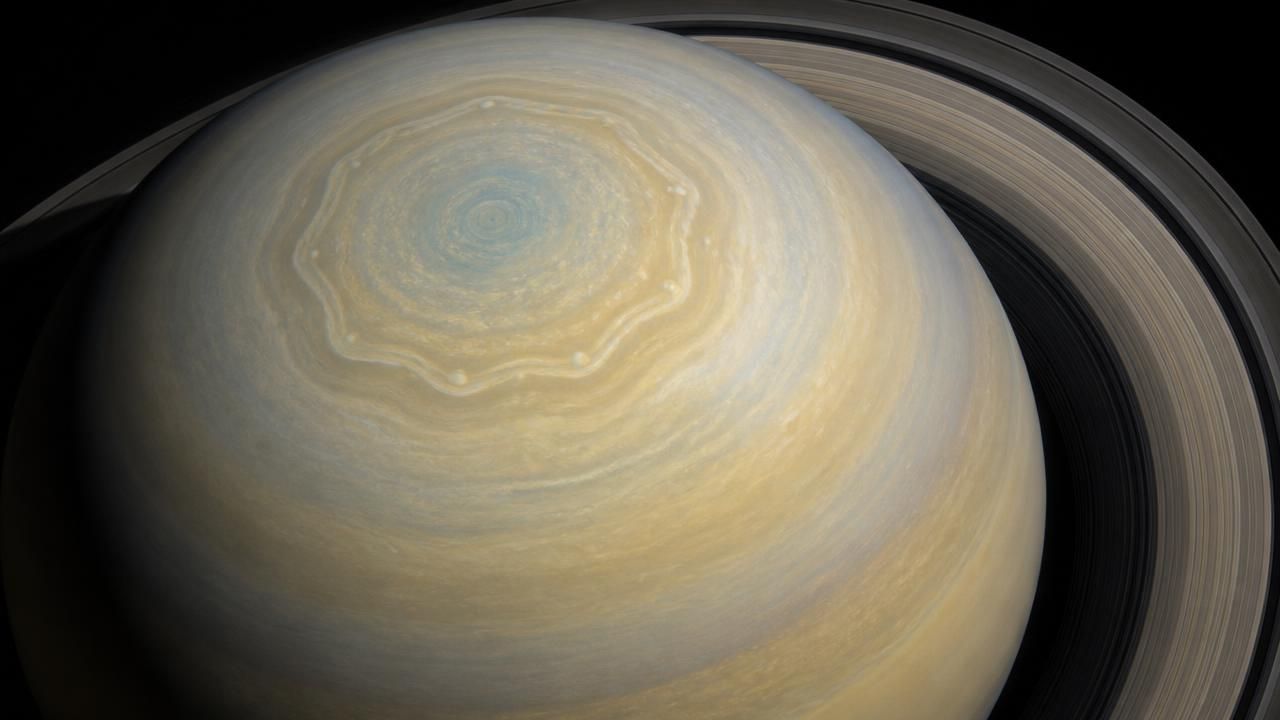
Astronomers using NASA's Hubble Space Telescope have uncovered a striking new weather pattern at Saturn's southern pole: a giant, 10-sided wave — a decagon — circling the planet's southernmost clouds. The discovery, announced in recent Hubble images, adds another mystery to the gas giant's atmospheric dynamics and reignites comparisons to the planet's well-known hexagonal jet stream at its north pole.
The finding, made by an international team led by Agustin Sánchez-Lavega of the University of the Basque Country in Spain, along with Amy Simon of NASA's Goddard Space Flight Center and Michael Wong of the University of California, Berkeley, was published from observations taken by Hubble's high-resolution imaging instruments. The decagon appears as a stable, wavy jet stream extending across multiple layers of Saturn's atmosphere, making it one of the largest coherent wave structures ever observed in a planetary atmosphere.
A Surprising Shape in Saturn's Southern Skies
Unlike Saturn's north pole, which has been known since the 1980s for its striking hexagon — a six-sided jet stream about 30,000 kilometers wide — the south pole had appeared comparatively calm in previous observations. But the new Hubble images, captured as part of the Outer Planet Atmospheres Legacy (OPAL) program, reveal a clear 10-sided ripple in the clouds at the southern pole, a feature that had gone unnoticed until now.
"Observations show the decagon extends through multiple layers of Saturn's atmosphere," NASA officials said in a statement, describing the phenomenon as an atmospheric wave that stretches vertically through the planet's cloud deck. That vertical coherence suggests the wave is not a shallow cloud feature but rather a deep-seated atmospheric oscillation, likely tied to Saturn's internal winds or its rapid rotation.
The shape itself is extraordinary. While polygons and polygonal wave patterns have been seen in laboratory rotating fluids and computer models, only Saturn has produced such regular geometric features in nature — first the hexagon, now the decagon. The discovery challenges existing models of how planetary jet streams can bend into stable shapes without dissipating into turbulence.
How Hubble Caught the Decagon
The decagon was spotted in ultraviolet and visible-light images taken by Hubble's Wide Field Camera 3. By tracking the movement of clouds over several hours, astronomers were able to map wind speeds and identify the wave's boundaries. The south pole region is now entering summer in Saturn's 29-year seasonal cycle, meaning the pole is fully illuminated and visible for the first time in years. This seasonal lighting allowed Hubble to probe details that were previously obscured by darkness or viewing angle.
"When I first saw the images, I was amazed," said Sánchez-Lavega in a press release accompanying the data. "We had seen the hexagon at the north pole for decades, but to find a completely different polygonal wave at the south pole was completely unexpected. It suggests that Saturn's atmosphere is far more structured than we thought."
"We had seen the hexagon at the north pole for decades, but to find a completely different polygonal wave at the south pole was completely unexpected." — Agustin Sánchez-Lavega
Key Features at a Glance
- Shape: A 10-sided polygon (decagon) in the cloud bands near Saturn's south pole.
- Size: The wave pattern is roughly 20,000 to 25,000 kilometers across, comparable to the width of Earth.
- Location: Concentrated around Saturn's southern pole, at approximately 65 to 70 degrees south latitude.
- Depth: Extends through multiple atmospheric layers, indicating a deep-rooted process.
- Speed: The jet stream winds along the boundary reach speeds of up to 300 kilometers per hour.
Media Framing: From 'Cloud Mystery' to 'Weird Decagon'
News coverage of the discovery has varied in tone, with some outlets emphasizing the strangeness of the find. The Press Democrat described it as a "huge 10-sided wave pattern swirling in the clouds over Saturn's south pole," while Yahoo News headlines called it a "giant 10-sided cloud mystery" and "a mysterious wave shaped like a decagon." MSN simply labeled it "a big, weird decagon around its south pole." NASA, by contrast, framed the find in more measured scientific terms, referring to it as "a new decagon encircling Saturn's south pole" and explaining its significance for understanding planetary waves.
This variation in framing highlights how a purely scientific discovery can become a pop-culture curiosity — partly because the shape echoes the iconic north polar hexagon that has fascinated researchers and the public since the Voyager missions first imaged it in 1980.
The Hexagon Connection: A 40-Year Puzzle
Saturn's north polar hexagon is one of the most famous features in planetary science. It is believed to be caused by a narrow, fast-moving jet stream circulating at about 78 degrees north latitude, guided by atmospheric Rossby waves — the same kind of large-scale waves that influence Earth's weather. But atmospheric models have struggled to replicate how such a geometrically perfect hexagon can persist for decades. The discovery of a decagon at the south pole complicates the picture: why would one pole have six sides and the other ten?
"The fact that the two poles have different polygonality is significant," said Amy Simon in a NASA feature. "It likely reflects differences in the depths of the winds, the rate of rotation beneath the cloud deck, or the influence of seasonal solar heating. Saturn is a natural laboratory for testing our understanding of fluid dynamics."
Unlike the north pole, which has been studied for more than 40 years by multiple space missions — including Voyager 1 and 2 and the Cassini spacecraft — the south pole only became fully visible to Earth-based telescopes recently. Cassini, which orbited Saturn from 2004 to 2017, flew over the south pole during its "Grand Finale" but focused mainly on the planet's rings and inner magnetosphere, not long-term cloud tracking. Hubble's long baseline of observations, now spanning over three decades, allows astronomers to detect slow-moving structures that shorter missions might miss.
What Does the Decagon Mean for Saturn Science?
The discovery could help researchers refine models of Saturn's interior and atmosphere. A wave of this size and persistence implies that the planet's lower atmosphere is rotating at different rates at different depths, a phenomenon known as differential rotation. The decagon is likely a manifestation of a Rossby wave that has become "trapped" and stretched into a standing pattern by the pole's circular geometry. Similar waves are believed to exist in Earth's oceans and atmosphere, but they rarely produce such sharp polygons.
"The decagon is far more than a pretty sight," explained Michael Wong, a planetary scientist at UC Berkeley and a co-investigator on the OPAL program. "It is a direct probe of Saturn's atmospheric dynamics. Measuring its drift, its shape, and its vertical extent gives us a new lever on the planet's deep jet streams, which have been notoriously difficult to measure."
Astronomers will continue to monitor the decagon using Hubble's successors, including NASA's James Webb Space Telescope and the future Roman Space Telescope. They also plan to compare the new data with simulations of rotating fluids in laboratory settings, where researchers have been able to create polygon-shaped vortices by spinning a cylinder of water with a fast-moving central rod. Saturn's decagon, however, is thousands of kilometers deep and may reveal how such instabilities grow in a compressible, hydrogen-helium atmosphere.
Broader Implications and Next Steps
The discovery not only adds a new chapter to Saturn's atmospheric atlas but also highlights the enduring value of Hubble as a planetary observer. While originally designed for deep-space astronomy, Hubble has been instrumental in monitoring the outer planets for more than 30 years. The OPAL program, which annually images all four giant planets, allows scientists to track seasonal changes and transient weather events across long baselines.
"This is one of those discoveries that reminds us that even our solar system's familiar planets can still surprise us," Sánchez-Lavega said. "Saturn is far from fully explored. We are looking forward to what else Hubble and its successor telescopes might reveal as the seasons change."
The findings were presented at the American Geophysical Union fall meeting and have been submitted for publication in a peer-reviewed planetary science journal. As the data undergo further analysis, researchers are eager to determine whether the decagon is a persistent feature or a temporary seasonal phenomenon. Preliminary estimates suggest it has existed for at least a decade, based on archival Hubble images from earlier observing cycles.
For now, the decagon joins the hexagon as one of the solar system's most enigmatic atmospheric structures. It serves as a testament to the power of long-term space observatories and the ever-evolving picture of what lies beyond our own blue sky.