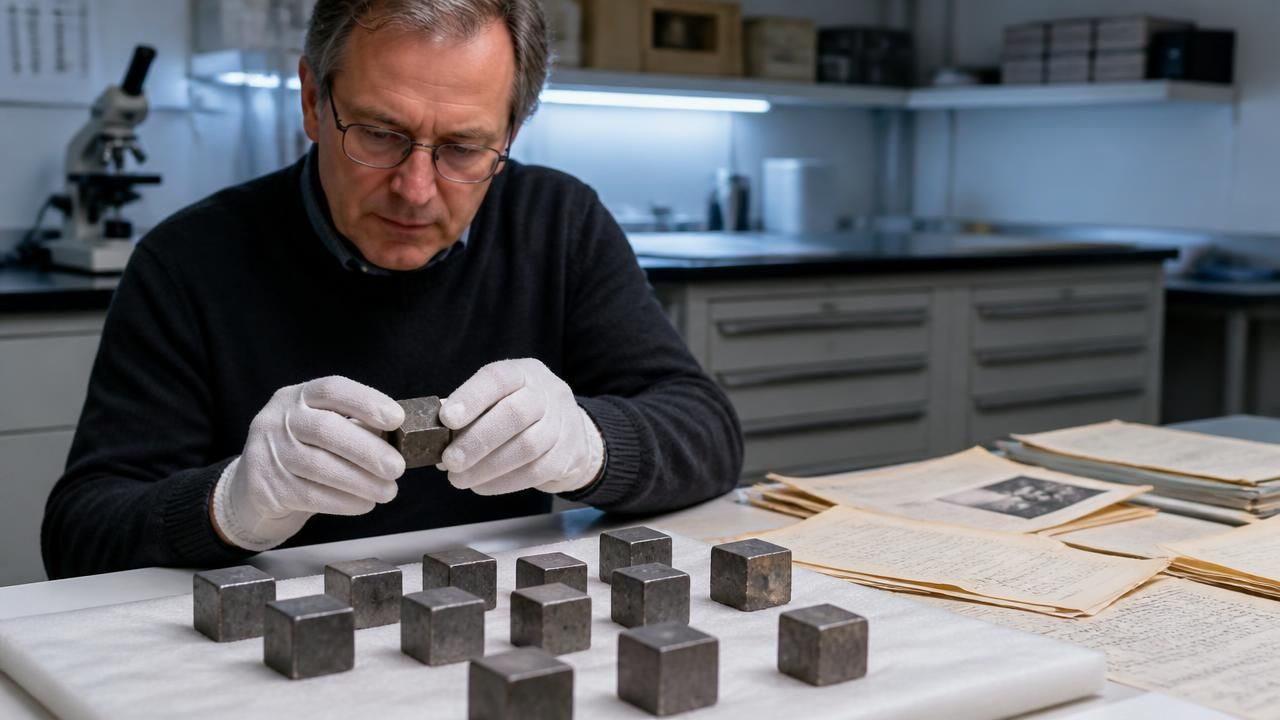
A new analysis of surviving uranium cubes and wartime documents has undermined one of the most durable legends of World War II: that Nazi Germany’s nuclear program was on the brink of a working reactor—and perhaps a weapon—when the war ended. The findings, reported by Science Daily and echoed in MSN, Yahoo and LAist coverage, indicate that Germany’s final experimental reactor was nowhere near criticality. The physical evidence and the paper trail point to the same conclusion: the regime lacked the enormous quantities of uranium and heavy water required to make its reactor operational.
The evidence in the cubes
The uranium cubes are the most tangible remnants of the German nuclear project. Each cube represents scarce natural uranium metal that had to be produced, safeguarded and deployed under wartime conditions. By counting and analyzing surviving cubes, researchers can estimate how much material the program actually had. Wartime documents fill in the rest: procurement records, laboratory reports and administrative correspondence. Together, they show a program constrained at every turn. The shortfall was not a marginal miscalculation but a fundamental material gap.
MSN’s coverage frames the issue as a question of feasibility: Could Nazi Germany’s nuclear reactor work in 1945? The material gap explained. Its other headlines put the conclusion more sharply, saying Germany was much farther from a working nuclear reactor—and a nuclear weapon—than Werner Heisenberg claimed. Yahoo’s version asks the same public question: How close did Nazi Germany really come to a nuclear reactor? LAist’s headline, A Story of Nazi Uranium, approaches the same evidence as a narrative about the material itself. Science Daily leads with the artifacts: The uranium cubes that exposed Nazi Germany’s nuclear failure.
The reactor that never went critical
Germany’s nuclear effort began after the discovery of nuclear fission in 1938, but it never became the industrial juggernaut of the American Manhattan Project. The final experiment, often associated with Haigerloch in southern Germany, was an attempt to assemble uranium cubes in a vessel moderated by heavy water. It never achieved a self-sustaining chain reaction. The new analysis suggests it was not close.
The obstacles were cumulative:
- Uranium metal: A reactor needed far more fissile material than the German program could reliably produce and assemble. The surviving cubes are a reminder of how limited the stock was.
- Heavy water: Germany depended heavily on Norwegian production at Vemork, which became a target for Allied sabotage and bombing. Without enough moderator, a reactor could not go critical.
- Strategic priority: Nazi Germany’s war economy was stretched across multiple fronts. Nuclear research competed for resources with weapons programs that promised faster results, and the regime’s polycratic chaos further hampered progress.
Heavy water was especially vulnerable. The Norwegian plant at Vemork was the main European source; Allied sabotage and bombing disrupted production. Even if German scientists had designed a workable reactor, they could not conjure the moderator and fuel at the scale required. Nor could they match the industrial mobilization of the Manhattan Project.
Heisenberg and the myth of near-success
Werner Heisenberg, the most famous physicist associated with the German program, became a central figure in postwar debates. After the war, his statements and the broader ambiguity of the German effort fed a narrative that Nazi scientists were either close to a bomb or deliberately steered away from one. The new material accounting does not resolve every question about motives. But it shifts the emphasis from intention to capacity. A program that lacked sufficient uranium and heavy water was not months away from a reactor. MSN’s framing—that Germany was farther from a working reactor, and from a weapon, than Heisenberg claimed—captures that shift.
Historians have long debated how to interpret the German program. Some accounts stress the moral choice of scientists who may have slowed the work; others stress the regime’s resource constraints, bureaucratic chaos and the persecution of Jewish scientists. The new evidence supports the latter emphasis without settling the former. It also cautions against reading postwar recollections as technical proof.
Why it matters
The story is not only about Nazi Germany. It is about how nuclear myths are made and unmade. The ‘what if’ narrative—that Hitler was close to an atomic bomb—has long shaped popular culture and historical debate. The cubes are a corrective: they turn an abstract debate into a measurable shortfall. They show that the final German reactor was subcritical not because of a single failed experiment, but because the entire supply chain fell short.
The finding also has implications for nuclear archaeology and the history of science. Physical artifacts can test claims that documents alone cannot. In this case, the cubes and the wartime paperwork converge: Germany’s reactor program was not on the verge of success. The story’s different tellings—Science Daily’s artifact-focused account, MSN’s material-gap explanation, Yahoo’s public question and LAist’s narrative of Nazi uranium—all point to the same conclusion.
For readers, the lesson is that proximity to a breakthrough can be exaggerated by memory, politics and the desire for a dramatic ‘what if.’ The evidence suggests a more mundane and more decisive reality: Nazi Germany was far from a working reactor, and even farther from a nuclear weapon. The final experimental reactor was not about to work. It was missing the ingredients.