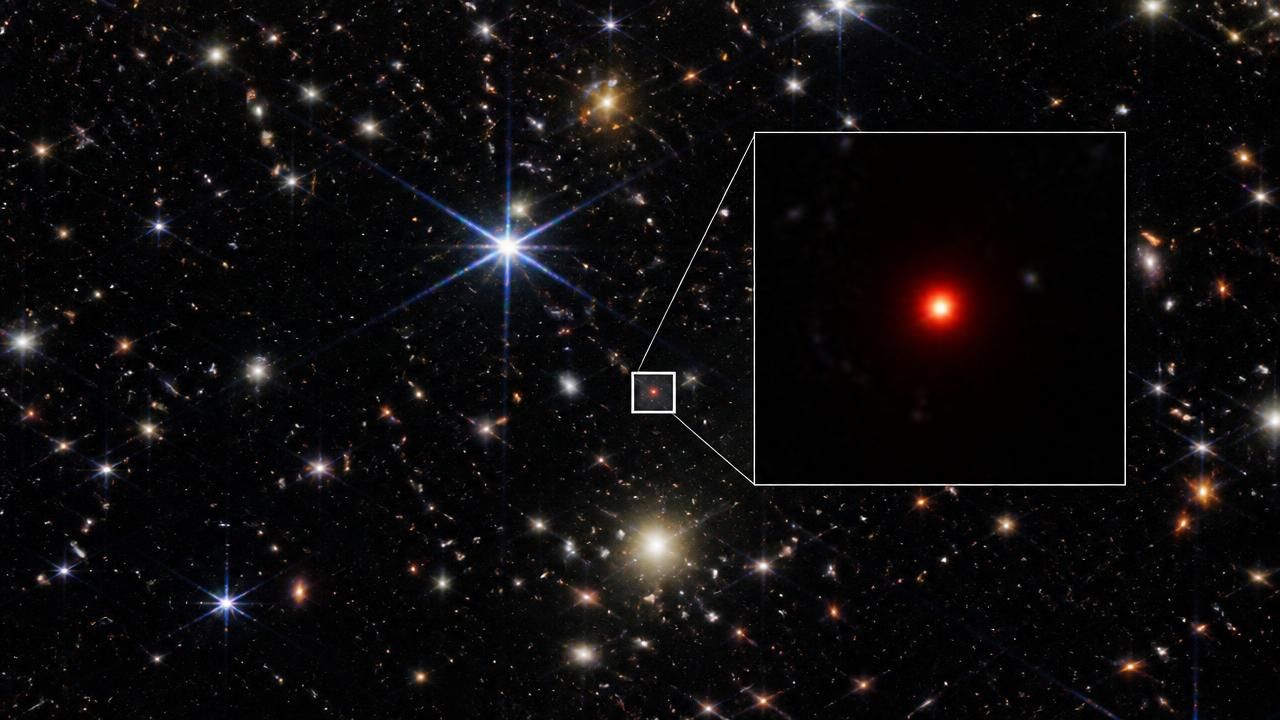
In the relentless flood of scientific breakthroughs and technological marvels, some discoveries inevitably slip through the cracks. Ars Technica’s monthly “Research Roundup” series is designed to rescue those overlooked gems, and August’s edition delivers a particularly dazzling collection. Leading the pack is the discovery of a strange celestial object astronomers have dubbed a “black hole star”—an entity that defies conventional classification and could reshape our understanding of the early universe.
A Cosmic Anomaly: The ‘Black Hole Star’
Astronomers combing through data from the James Webb Space Telescope (JWST) in 2024 noticed hundreds of “little red dots”—compact, intensely red objects believed to be baby quasars, shining when the universe was just a few hundred million years old. Among them, one dot stood out: extremely red, extraordinarily bright, and exhibiting properties that matched no known astrophysical object. After months of analysis, researchers concluded that this object is a “black hole star,” a hypothetical class of star that is physically the size of a large star yet produces energy comparable to an active black hole.
“It’s the size of a large star but produces far more energy than would be possible via nuclear fusion—energy comparable to what an active black hole would produce,” the team explained in their research.
The discovery challenges existing models of star formation and black hole seeding. If confirmed, “black hole stars” could represent a missing link between the first stars and the supermassive black holes that later dominated galactic centers. Scientists believe these objects may have formed in the dense, gas-rich environment of the early universe, where dark matter annihilation could have provided an additional energy source. The finding also underscores the transformative power of JWST, which continues to push the horizon of observable cosmic history.
Why “Black Hole Star” Matters
- It explains anomalously bright objects seen in the early universe without invoking exotic physics.
- It offers a new pathway for the formation of supermassive black holes.
- It highlights the importance of re-examining “little red dot” populations in JWST data.
While the paper is still undergoing peer review, the astronomy community has reacted with cautious excitement. “If this holds up, it will be a landmark discovery,” said one astrophysicist not involved in the research. “It’s exactly the kind of unexpected result that JWST was designed to uncover.”
Other August Highlights: From Plastic Cookies to Avocado Sex Changes
The August roundup also featured a trio of quirky yet impactful studies. In environmental science, researchers engineered microbes that can break down plastics and convert them into edible biomass—yes, literally turning pollution into cookies. The experimental process, while years away from commercial use, offers a circular-economy solution to plastic waste that might even address food scarcity.
Meanwhile, marine biologists discovered a fascinating connection between whale calls and Einstein’s special theory of relativity. Whales appear to adjust the frequency of their songs based on the Doppler effect, compensating for relative motion between caller and receiver. This insight not only deepens our understanding of cetacean communication but also demonstrates how fundamental physics principles manifest in nature.
On a botanical note, avocado trees were found to switch the sex of their flowers during the day, a previously unknown mechanism that enhances cross-pollination. The finding has practical implications for agriculture, potentially improving yield in avocado orchards worldwide.
The Value of Science Roundups
Ars Technica’s roundups are a testament to the breadth of modern science. Yet the series itself is part of a broader journalistic tradition. The BBC, for instance, runs its own weekly “stories you may have missed” for regional news in Cornwall and Devon, while other outlets generate similar lists for AI, startups, and health. For readers, these compilations serve as a safety net, ensuring that important—but not always headline-grabbing—findings reach the public eye.
Past editions of Ars Technica’s roundup have covered a wide spectrum: a May edition explored why cats prefer silver vine to catnip, while a September edition delved into how “prebunking” (inoculating people against misinformation) can restore public trust. Together, these stories illustrate the sheer diversity of scientific inquiry—from the cosmic to the feline.
Implications for Science and Society
The “black hole star” discovery, if validated, would not only rewrite textbooks but also inform future telescope designs. It could also inspire new theoretical work on the boundary between stars and black holes. On a more immediate level, the plastic-eating microbes offer a glimmer of hope in the fight against pollution, while the whale-call research deepens our appreciation for the complexity of animal communication.
Science journalist and author Maria Popova once said, “The greatest gift of science is not knowledge but wonder.” The stories in this roundup embody that spirit—reminding us that the universe holds surprises far beyond our wildest imaginings, whether they lurk in the deepest reaches of space or in the avocado groves of our own planet.
How Different Outlets Frame the Story
Ars Technica frames these discoveries as “cool science stories” worthy of attention but not necessarily breaking news. The BBC, in its regional roundup, focuses on community relevance. This contrast highlights a broader trend: science journalism is increasingly bifurcated into breaking news and “curiosity” reporting. While the latter lacks the urgency of a pandemic or a rocket launch, it builds long-term public engagement with science. A 2023 Pew Research study found that 68% of Americans say they encounter science news through such features, making them vital for scientific literacy.
Ultimately, the August edition of Ars Technica’s Research Roundup is more than a list of curiosities—it is a reminder that the scientific enterprise is vast, imaginative, and inexhaustible. As we await further confirmation of the “black hole star,” we can savor the other revelations, secure in the knowledge that there will always be more stories waiting to be rescued from obscurity.