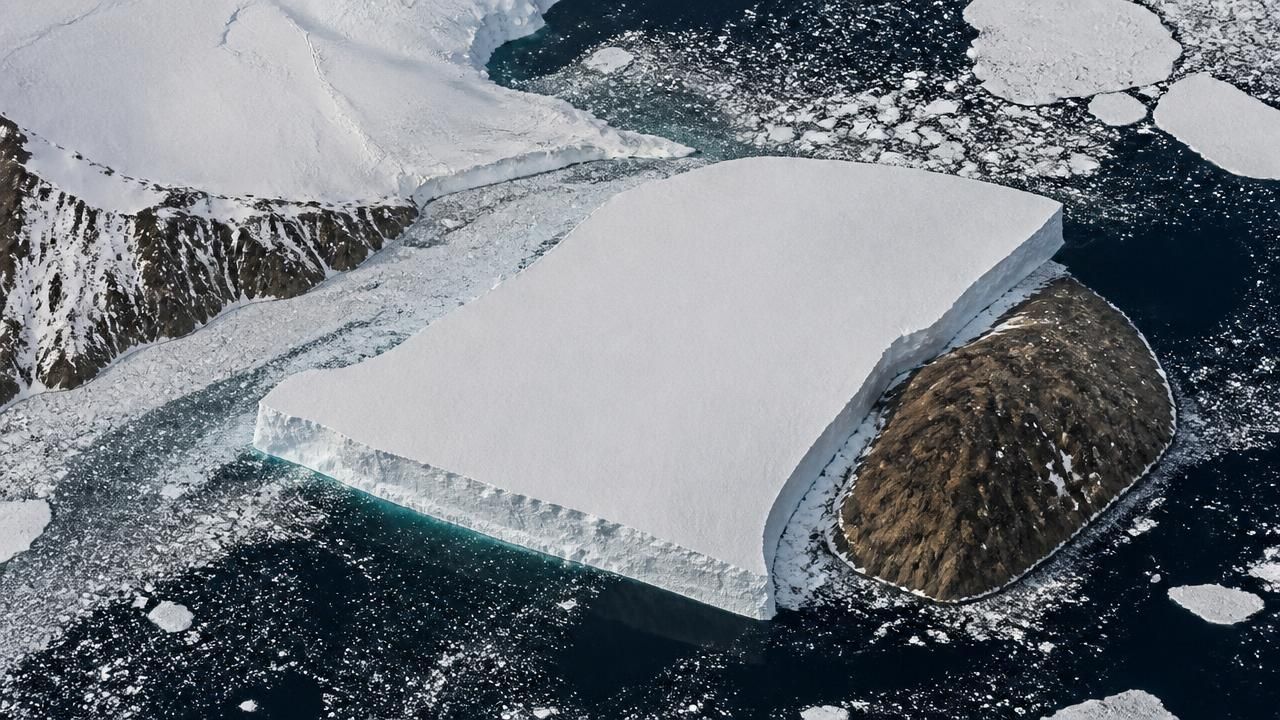
In a dramatic display of nature's raw power, a massive tabular iceberg from Greenland's Petermann Glacier has been photographed colliding with a small, brown island in the remote Nares Strait. The encounter, captured by NASA's Earth Observatory satellites, shows the iceberg pivoting out of its home fjord and wedging against Joe Island—surviving the impact largely intact. The event, which occurred around August 23-24, offers a rare glimpse into the dynamic behavior of glacial ice in a rapidly warming Arctic.
The Collision: A Satellite View
NASA Earth Observatory images, released by Lauren Dauphin, provide a before-and-after sequence of the event. On August 23, the iceberg is seen at the junction of Petermann Fjord and Nares Strait, a narrow passage separating Greenland from Canada's Ellesmere Island. By August 24, the iceberg has rotated nearly 90 degrees, pushing into the strait and running aground against Joe Island, a small rocky outcrop that stands in stark contrast to the icy giant.
"A satellite view shows the iceberg after it pivoted out of the fjord into Nares Strait, wedged against a small, brown island." — NASA Earth Observatory
The images highlight the sheer scale of the iceberg, which dwarfs the island. Tabular icebergs, characterized by flat tops and steep sides, are fragments of ice shelves that break off—or calve—from glaciers. This particular iceberg likely originated from Petermann Glacier, one of Greenland's largest glaciers, known for producing some of the most spectacular icebergs on Earth.
Petermann Glacier: A History of Giants
Petermann Glacier, located in northwestern Greenland, drains about 4% of the Greenland ice sheet. It has a long history of calving massive icebergs. In 2010, an iceberg roughly four times the size of Manhattan broke away from the glacier, drawing global attention. In 2012, another large chunk separated. The glacier's floating ice shelf acts as a buttress, slowing the flow of ice from the interior. When pieces calve, the glacier can accelerate, contributing to sea-level rise.
While calving is a natural process, scientists have observed an acceleration in recent decades, driven by warming ocean temperatures and atmospheric warming. The Petermann Glacier's ice shelf has thinned significantly, making it more vulnerable to fractures and calving events. The recent collision with Joe Island is a reminder of how dynamic and unpredictable these processes can be.
Why the "Run-In" Matters
The fact that the iceberg survived the collision is notable. Icebergs of this size carry tremendous momentum, and impacts with land can cause them to fracture or capsize. The satellite imagery shows the iceberg wedged against the island, potentially stuck for some time. This can affect local ocean currents, marine navigation, and the distribution of freshwater as the ice eventually melts.
For scientists, such events provide valuable data on iceberg behaviour, ocean-ice interactions, and the structural integrity of ice shelves. Monitoring these events from space allows researchers to track changes in polar regions with precision, informing climate models and predictions of sea-level rise.
Broader Implications for the Arctic
The Arctic is warming at nearly four times the global average, a phenomenon known as Arctic amplification. This warming is causing glaciers across Greenland to retreat and calve more frequently. Each large calving event is not just a spectacle; it contributes to the ongoing loss of polar ice, which has global consequences—from rising sea levels to changes in ocean circulation and weather patterns.
- Sea-level rise: The Greenland ice sheet holds enough ice to raise global sea levels by about 7 meters if it were to melt completely. Each large iceberg that calves into the ocean is a small but measurable part of that potential.
- Ocean circulation: Freshwater from melting icebergs can disrupt the Atlantic Meridional Overturning Circulation (AMOC), which regulates climate across the Northern Hemisphere.
- Ecosystem impacts: Icebergs and melting glacial ice affect marine habitats, from microscopic plankton to top predators like polar bears and seals.
The encounter at Joe Island is a microcosm of these larger changes. It shows that even a relatively small island can influence the trajectory of a giant iceberg, creating eddies and altering local ice patterns. As the Arctic continues to transform, such events will become more frequent, offering both challenges and opportunities for scientific study.
A Timely Reminder
The NASA Earth Observatory images serve as a striking reminder of the power of ice and the fragility of our polar regions. While the iceberg's survival is a minor event in the grand scheme of global climate, it underscores the ongoing, observable changes happening thousands of miles away from most of us. For scientists, every data point brings us closer to understanding the complex processes shaping our planet's future.
As the Petermann Glacier continues to calve, researchers will be watching closely—both from space and on the ground—documenting the next chapter in the Arctic's transformation. For now, Joe Island stands as a silent witness to just how close—and how dramatic—these encounters can be.