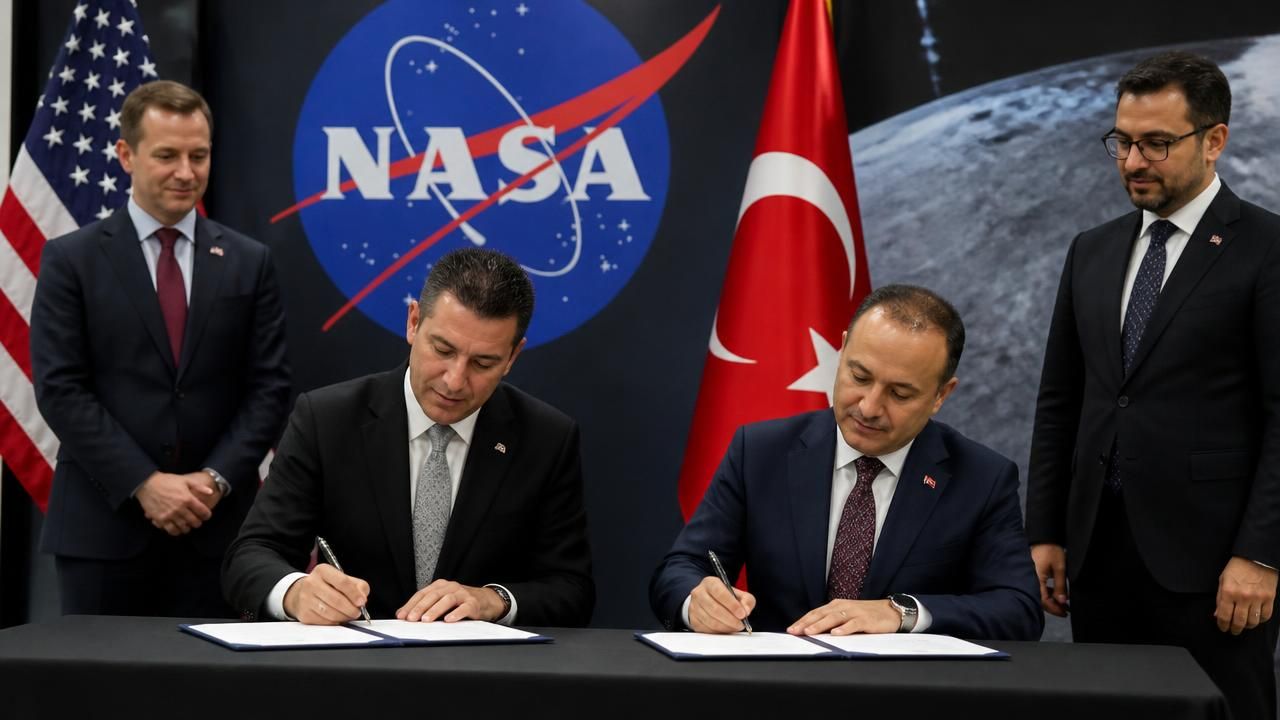
In a ceremony at NASA Headquarters in Washington on Monday, the Republic of Türkiye officially signed the Artemis Accords, becoming the 71st nation to join the international framework for peaceful and transparent space exploration. NASA Administrator Jared Isaacman hosted the event, which was attended by Turkish Minister of Industry and Technology Mehmet Fatih Kacır, U.S. Deputy Assistant Secretary of State for Space and Environment Connor Tomlinson, and Turkish Space Agency President Yusuf Kıraç.
The signing marks a significant milestone in the accords' rapid growth, reflecting a global commitment to responsible behavior in space. The Artemis Accords, first established in 2020, set out principles for the peaceful exploration of the Moon, Mars, and beyond, including transparency, interoperability, and the protection of heritage sites.
A Milestone for Global Cooperation
During the ceremony, Administrator Isaacman emphasized the importance of international collaboration in NASA's renewed lunar ambitions. "It is my privilege to welcome the Republic of Türkiye as the 71st signatory of the Artemis Accords," he said. "Last year, President Trump directed NASA to accelerate its return to the lunar surface and establish humanity's first enduring presence on another world, a Moon Base, as well as lay the foundation for the manned exploration of Mars. NASA never undertakes these grand endeavors alone."
Isaacman also highlighted how the accords are being put into practice on the Moon: "On the Moon Base, we're taking the Artemis Accords principles and putting them into practice on the lunar surface. NASA has invited every signatory to take part in this endeavor, creating opportunities for nations to contribute major pieces of hardware, scientific payloads, technology demonstrations, CubeSats, and other capabilities to future Artemis missions."
"NASA never undertakes these grand endeavors alone. On the Moon Base, we're taking the Artemis Accords principles and putting them into practice on the lunar surface."
Other Recent Signatories
Türkiye was not the only nation to join the accords in recent weeks. According to reports from international media, Armenia signed on as the 43rd signatory, and Latvia also formalized its participation. While the exact dates of these signings were not specified in the available coverage, the announcements underscore the accords' broad appeal across Europe and Asia.
The Armenian Mirror-Spectator reported the country's accession, highlighting its significance for a nation with a growing interest in space technology. Similarly, Eurasia Review noted Latvia's signing, positioning it as part of the Baltic region's increasing engagement in space affairs. These additions, alongside Türkiye, bring the total number of signatories to over 70, demonstrating the wide international consensus behind the Artemis framework.
What Are the Artemis Accords?
The Artemis Accords, named after NASA's Artemis program to return humans to the Moon, were launched in 2020 as a set of non-binding principles to guide civil space exploration. Key provisions include:
- Peaceful purposes: All activities under the accords are for peaceful purposes, consistent with the Outer Space Treaty.
- Transparency: Signatories commit to transparent policies and plans for space operations.
- Interoperability: Systems are designed to be compatible with international common standards.
- Emergency assistance: Countries agree to provide aid to astronauts in distress.
- Space resources: Utilization of space resources is permissible, but must be done in a manner compliant with international law.
- Orbital debris: Signatories agree to mitigate the creation of harmful debris.
The accords have become a cornerstone of modern space diplomacy, with signatories ranging from major space powers like Japan and Canada to smaller nations seeking to participate in lunar exploration.
Divergent Perspectives in Coverage
Different outlets have framed the recent signings in distinct ways. NASA's official release focused on the ceremony and the visionary aspects of Moon Base and Mars missions. The Armenian Mirror-Spectator, as an ethnic publication, emphasized Armenia's national pride and its entry into the international space community. Meanwhile, a media advisory from NASA (reported by Cerebral Overload) invited journalists to the Türkiye signing ceremony, underscoring the agency's commitment to transparency and public engagement. These varied angles illustrate how a single diplomatic event can carry different meanings for different audiences.
Implications for the Future
The expansion of the Artemis Accords comes at a pivotal time. NASA is actively planning the Artemis missions, including the establishment of a permanent Moon Base and eventual human missions to Mars. Under the accords, signatory nations can contribute hardware, scientific instruments, and even crew members to these missions, creating a truly international effort.
For Türkiye, the signing aligns with its ambitions to develop a robust space program. The country has already launched its own space agency and has announced plans for a lunar mission. By joining the accords, Ankara secures a seat at the table in the next era of exploration. Similarly, Armenia and Latvia gain access to collaborative opportunities and the credibility that comes with participating in a leading international framework.
However, analysts note that the accords are not without controversy. Some nations, including China and Russia, have not signed, and there are debates about the interpretation of space resource utilization. Yet the growing number of signatories suggests that the Artemis Accords have become the de facto standard for lunar exploration governance.
As the world looks toward the Moon and beyond, the alliance of over 70 nations under the Artemis Accords represents a powerful example of what can be achieved through cooperation. With Türkiye, Armenia, and Latvia now on board, the path to a sustainable human presence on the Moon is increasingly an international endeavor.