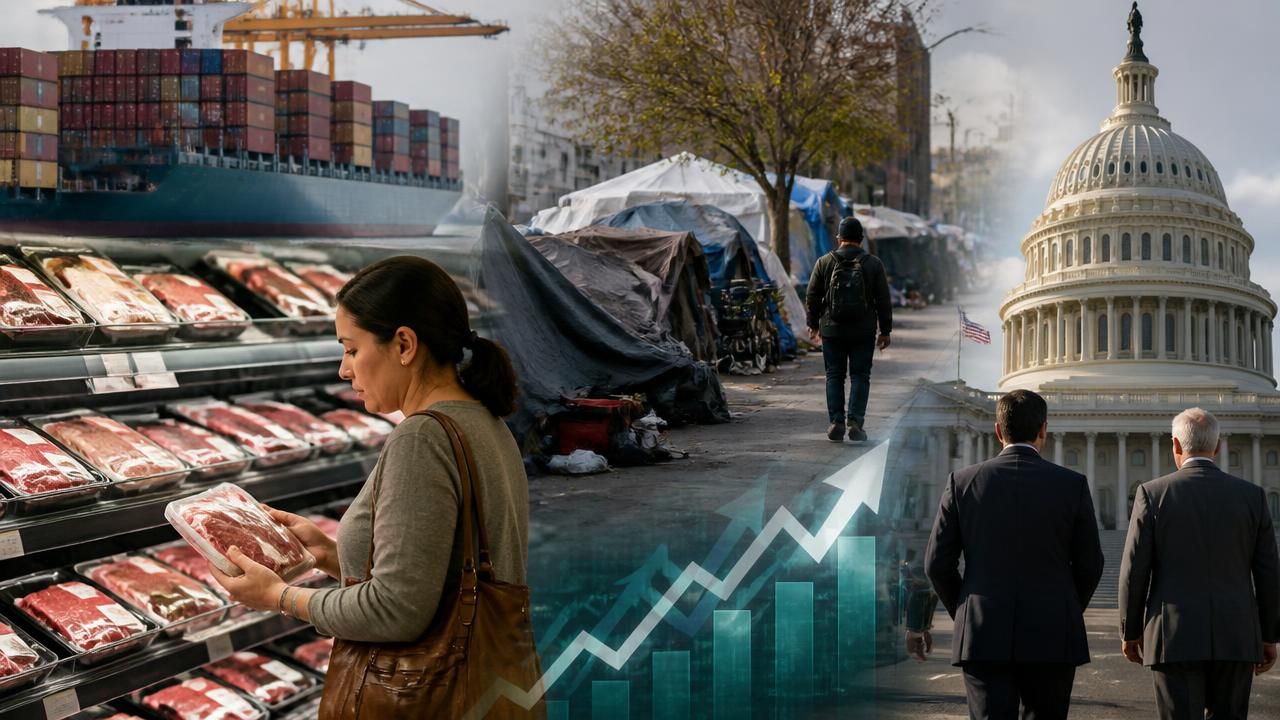
In a striking acknowledgment of the unintended consequences of protectionist trade policy, Bloomberg Opinion columnist Kathryn Edwards said the Trump administration's move to lower tariffs on beef imports is a “remarkable admission” that tariffs are increasing prices for American consumers. Edwards, who hosts the Optimist Economy podcast, characterized the broader struggle over food and other essentials as a “war” being fought “on multiple fronts,” encompassing environmental pressures, industry competition, and economic policy.
The comment lands amid a broader national moment where “multi-front” battles are becoming the norm—from the ongoing fight against homelessness in local communities to the jockeying for future political leadership. A close reading of headlines across the country reveals a nation grappling with interconnected crises that demand attention on several fronts at once.
The Affordability War: Tariffs, Beef, and the Cost of Living
The Bloomberg report, published this week, highlights a growing tension in the White House's economic strategy. By temporarily easing tariffs on imported beef, the administration hopes to cool down the fastest-rising food prices in decades. But Edwards argues that this move is a tacit confession: tariffs, which were meant to protect domestic industries, are actually feeding inflation. “This is a remarkable admission from a administration that has repeatedly claimed tariffs don't hurt consumers,” she said in the interview. “If they didn’t, why would you need to reduce them to lower beef prices?”
The cost of beef has surged due to a combination of drought-driven herd reduction, high feed costs, and supply chain bottlenecks. And tariffs on imported beef only added to the squeeze, making it harder for retailers to source affordable alternatives. Edwards points out that the affordability challenge extends beyond beef to dairy, grains, and energy—all of which have seen price spikes driven by climate events and market consolidation. “We're fighting this war on multiple fronts,” she explained. “Environmental conditions, industry competition, and economic policy are all converging to push prices up.”
“We're fighting this war on multiple fronts,” Edwards said. “Environmental conditions, industry competition, and economic policy are all converging to push prices up.”
For families, the result has been a steady erosion of purchasing power, even as headline inflation shows signs of cooling. The beef tariff rollback is a short-term fix, but Edwards and other economists caution that without a broader reassessment of trade and agricultural policy, the underlying pressures will persist.
Another Front: Homelessness in Lake County
The same language of “fighting on multiple fronts” appears in local news from central Florida. A report in the Daily Commercial details the county's comprehensive approach to reducing homelessness, which officials describe as a “fight on multiple fronts.” Unlike the federal tariff battle, this is a grassroots effort involving shelter expansion, mental health services, job training, and affordable housing initiatives.
In Lake County, the homeless population has grown in step with rising rents and the lingering effects of the pandemic. The county's strategy includes not just emergency shelter but also permanent supportive housing and partnerships with local nonprofits. “We can't simply arrest our way out of this,” said one county official in the article. “We need to address the root causes—housing stability, healthcare, and income inequality.”
The parallel is telling: whether dealing with inflation or homelessness, American institutions are finding that single-point solutions fail. A multi-front approach requires coordination across policy areas, just as Edwards suggests for the economy. In Lake County, the effort is showing early signs of progress, with a 10% reduction in unsheltered individuals over the past year. But officials stress that the battle is far from over.
Political Fronts: 2028 Speculation and Democratic Narratives
The phrase “front runner” takes on a different meaning in politics, but the same multi-front dynamic is at play. A recent New York Times headline asks, “Is JD Vance the 2028 Front Runner? Trump Has Questions.” The story, though short on details, points to Vice President Vance's increasingly visible role and the quiet jockeying within Republican circles for the post-Trump era. Trump’s own posture toward Vance remains ambiguous—part public endorsement, part private skepticism—creating a political front that could define the next election cycle.
Meanwhile, the New Republic publishes a piece titled “Democrats Need New Stories,” echoing a growing sentiment within the Democratic Party that its messaging has failed to connect with working-class voters. The piece argues that the party's reliance on data-driven policy wonkery and identity politics has left it without a compelling narrative to counter the GOP's cultural offensive. This internal battle for the soul of the party is yet another front in the nation's ongoing political conflict.
These political stories, while seemingly separate from the economic and social battles, are part of the same broader struggle: a country trying to define its future amidst rapid change and deep uncertainty. The affordability war affects everyday lives; the homelessness crisis tests community values; and the political narratives shape how Americans understand these challenges.
Intersections and Implications
What connects these seemingly disparate stories is the concept of “multiple fronts.” Whether it's a columnist analyzing trade policy, a county official coordinating homeless services, or a political strategist crafting a narrative, each is responding to a reality where problems overlap and solutions require multidisciplinary thinking.
Kathryn Edwards’ remark about the beef tariffs resonated not just because it highlighted a policy contradiction, but because it encapsulates a moment when many Americans feel they are under siege from all sides. The Lake County approach offers a local model of how to confront such complexity—not with a single silver bullet, but with a portfolio of interventions. Similarly, the political arena is waking up to the need for new stories and new strategies.
The next few years will test whether the country can coordinate its efforts across these fronts. The alternative—continuing to fight each battle in isolation—risks leaving no front truly won. As Edwards put it, “You can’t win a war on multiple fronts if you keep sending all your troops to one battlefield.”
For now, Americans are left to navigate the intersections of policy, price, and purpose. The stories we tell—about tariffs, housing, and leadership—will determine how effectively we confront the multifaceted challenges ahead.