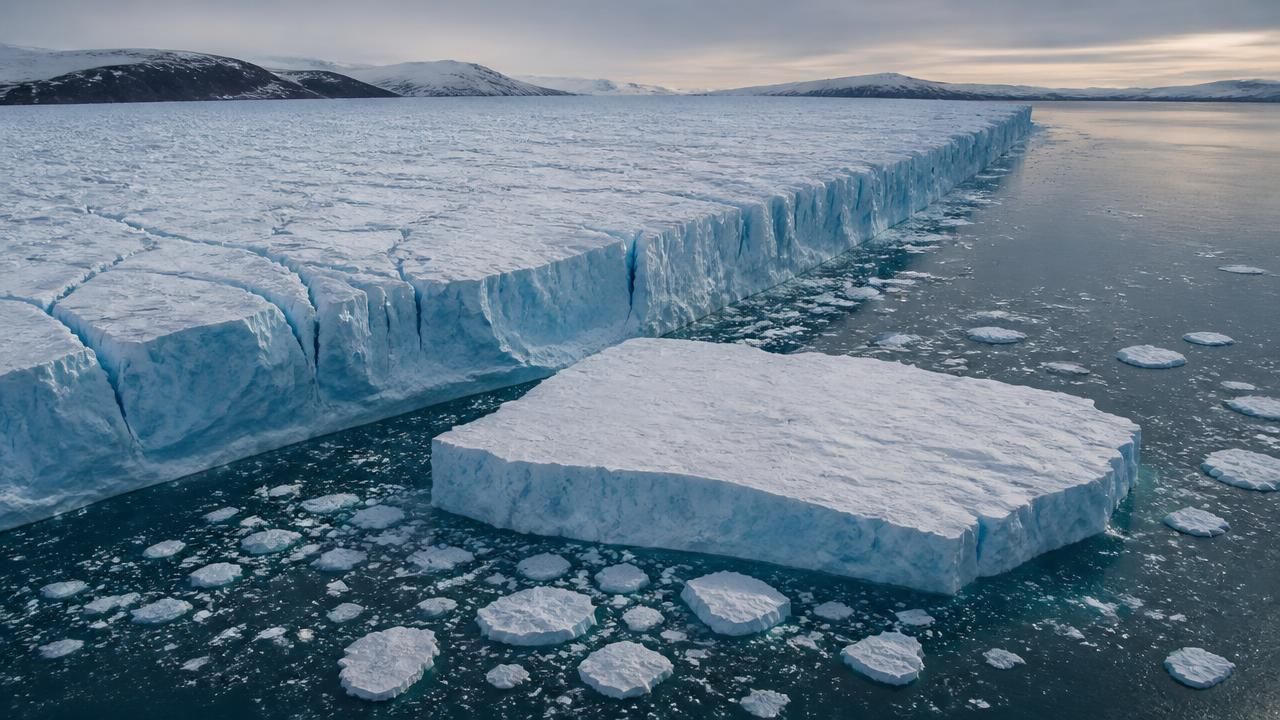
In a dramatic reminder of the Arctic's accelerating transformation, a massive ice island roughly the size of Manhattan has sheared away from Greenland's Petermann Glacier. The calving event — the largest on this glacier since 2012 — was captured by satellite imagery and is being closely monitored by an international team of glaciologists. Scientists warn that two more enormous sections are poised to break off, potentially stripping away 22 percent of the glacier's remaining floating ice tongue.
A Glacier Under Stress
Petermann Glacier, one of Greenland's largest outlet glaciers, sits along the island's northwestern coast, about 1,000 kilometers south of the North Pole. For years, growing fractures have weakened the glacier's floating ice tongue — the seaward extension of the glacier that floats on ocean water. The recent break, detected by Europe's Sentinel-1 radar satellite, produced an iceberg comparable in size to Manhattan, which spans roughly 59 square kilometers.
The event was not entirely unexpected. Researchers from the University of Stirling and the University of Leeds, along with colleagues from other institutions, had been tracking the widening cracks. "We've seen this coming," one glaciologist noted. "The fractures have been growing for years, and now we're seeing the result."
"Scientists expect two more huge sections could soon detach, potentially removing about 22 percent of the remaining ice tongue."
Largest Calving Since 2012
This incident marks Petermann's most significant ice loss in over a decade. In 2012, a similar but smaller iceberg broke away, and now this new island has surpassed it. The 2010 event remains the glacier's record-holder: an enormous ice island four times the size of Manhattan — and half as thick as the Empire State Building is tall — calved on August 5, 2010. That island, designated PII-A, drifted into the Labrador Sea, eventually breaking into smaller pieces that posed hazards to shipping and offshore oil rigs.
While thousands of icebergs calve from Greenland's glaciers each year, events of this magnitude are rare and scientifically significant. The 2010 PII-A contained enough fresh water to keep the United States' public tap water flowing for 120 days, according to researchers at the University of Delaware.
Why Scientists Are Nervous
The recent calving has put the scientific community on alert, and not just because of its size. The Petermann Glacier's floating ice tongue acts as a buttress, slowing the flow of inland ice toward the sea. As pieces break away, this natural dam weakens, allowing ice from Greenland's vast interior to slide into the ocean more rapidly, contributing to sea-level rise.
Adding to the concern is a phenomenon described in a companion study: massive hidden waves are rapidly melting Greenland's glaciers from beneath. Warm ocean water traveling in waves along the glacier's submerged base can undercut the ice, accelerating calving. This process is thought to have played a role in the fracture patterns observed at Petermann.
A Pattern of Breakup
Petermann is not alone. In a sign that the phenomenon is widespread, similar calving events have been documented in Antarctica, including the Pine Island Glacier, which has experienced repeated splits in recent years. These events are part of a broader trend tied to rising global temperatures.
What Happens Next?
The immediate fate of the new ice island depends on ocean currents and winds. It could drift southward like its 2010 predecessor, eventually breaking into smaller bergs. But the larger concern is what remains behind. If the two additional sections detach — as scientists expect — the glacier will lose nearly a quarter of its floating tongue, fundamentally altering its stability.
Monitoring will continue from space and the ground. The Sentinel-1 mission, with its radar capability, offers year-round surveillance even through polar clouds and darkness. "We have a rare opportunity to study this process up close," said a researcher from the University of Stirling. "Every calving event teaches us more about how these ice giants respond to a warming world."
Global Implications
Greenland's ice sheet contains enough water to raise global sea levels by about seven meters if it melted completely. While a single calving event does not directly add to sea level (the ice was already floating), it does remove a key buffer that holds back land ice. The eventual contribution from Petermann could be measured in millimeters — but multiplied across dozens of Arctic glaciers, those millimeters add up.
Outlets around the world seized on different angles: some marveled at the satellite imagery of the "icy island," others focused on the "nervous scientists," and many drew parallels to the 2010 mega-berg. Yet all converged on a common theme — the Arctic is changing faster than ever, and the rest of the planet is along for the ride.