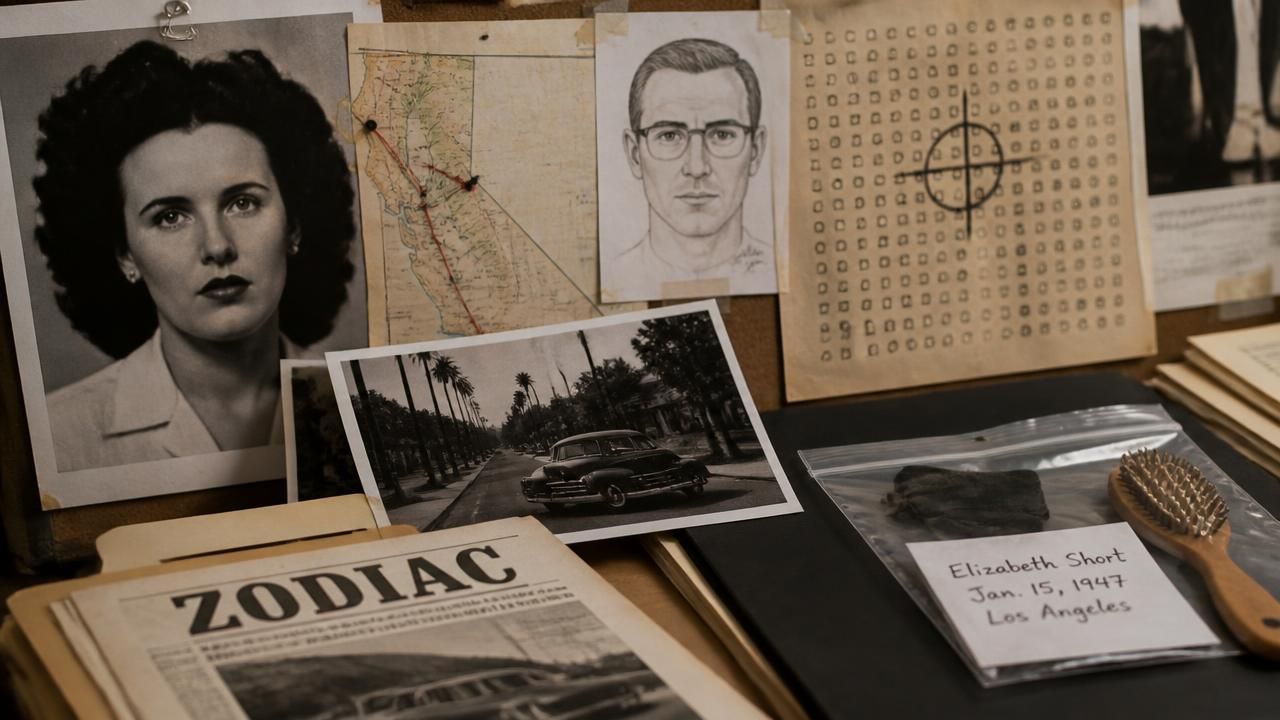
For more than seven decades, the brutal 1947 murder of Elizabeth Short—known forever as the Black Dahlia—has stood as one of Los Angeles' most haunting cold cases. Across the state, the Zodiac Killer terrorized Northern California in the late 1960s with taunting ciphers and a string of murders that were never conclusively solved. Now a provocative new theory suggests these two iconic cases are the work of a single killer, and a famed crime novelist is putting his reputation on the line to say so.
A New Theory Linking Two Notorious Cases
Michael Connelly, the best-selling author behind Harry Bosch and Mickey Haller, is the narrator and executive producer of the podcast Killer in the Code. In it, he argues that the Zodiac Killer—the unidentified serial killer who claimed five murders in the San Francisco Bay Area between 1968 and 1969—also murdered Short in Los Angeles in 1947. Connelly, who was a crime reporter for the Los Angeles Times before turning to fiction, acknowledges the theory is a stretch. Yet, according to an interview with The New York Times, he says the evidence is “completely convincing.”
At the heart of the new claim is an amateur codebreaker whose work is featured in the podcast. According to the Los Angeles Times, this sleuth has “cracked” a previously unsolved Zodiac cipher and found within it references to the Black Dahlia murder and a specific suspect. The San Francisco Chronicle similarly reports that an “amateur sleuth” has claimed to have cracked both cases. The suspect, whose name has not been publicly confirmed, has apparently drawn the attention of law enforcement: multiple outlets, including MSN, report that the LAPD is now testing fingerprints and DNA in both cases against evidence from this individual.
The Evidence: Ciphers, DNA, and Fingerprints
The Zodiac Killer is famous for sending cryptic letters and ciphers to newspapers. While some have been solved over the years, others remain unsolved—including the so-called “340 cipher” that was cracked in 2020 by a team of amateur cryptologists. The new claim appears to center on a different cipher, one that reportedly contains an explicit confession linking the Zodiac to Short's murder.
In addition to the cipher breakthrough, investigators have reportedly obtained DNA evidence from a member of the suspect's family, triggering a familial DNA search. The New York Post reports that a family is “convinced its patriarch is the Black Dahlia killer,” and they have been cooperating with authorities. The Sun adds that eerie similarities between the Zodiac's known behaviors and the Black Dahlia's murder scene—such as the way the body was posed and the lack of forced entry—are being cited as further proof.
What Exactly Is the New Evidence?
According to the Fox News report, the investigator claims to have “cracked Zodiac cipher names Black Dahlia suspect.” The codebreaker reportedly deciphered a message that includes the suspect's initials or a pseudonym, along with phrases that connect him to both crime scenes. While not yet peer-reviewed, the findings are said to be “startling” by Connelly, who compares the experience to a plot twist in one of his own novels.
LAPD officials have not confirmed or denied testing, but sources close to the investigation told MSN that fingerprints from the Black Dahlia case are being reexamined alongside latent prints recovered from Zodiac letters. The department has a history of reopening cold cases in the wake of genetic genealogy breakthroughs, as seen in the 2018 arrest of the Golden State Killer.
The Suspect and the Family
While the suspect's name has not been officially released, the New York Post story focuses on a family that believes their ancestor is responsible. The family patriarch, who would have been in his 20s at the time of the Black Dahlia murder and in his 40s during the Zodiac attacks, reportedly had ties to both Northern and Southern California. Relatives told the Post that they have long suspected him, citing his violent temper, his knowledge of police procedures, and his ability to move between cities undetected.
“It’s a strange thing to realize your grandfather might be one of the most infamous killers in American history,” a family member said. “But we’ve seen the evidence, and it adds up.”
The family has voluntarily provided DNA samples and old personal effects to investigators. They also note that the patriarch died in the 1970s, meaning he would have stopped killing around the time the Zodiac letters ceased—a timeline that aligns with the podcast's theory.
Skeptics Weigh In
Not everyone is convinced. The New York Times notes that “critics’ skepticism” surrounds Connelly's podcast. Many true-crime experts point out that the Black Dahlia case has a long history of false confessions and suspect theories—including a doctor named George Hodel, who was investigated by his own son, and a man named Jack Wilson, who claimed a deathbed confession. The Zodiac Killer, likewise, has been blamed on dozens of people, from Arthur Leigh Allen to more obscure figures.
Cipher experts are also wary. Past Zodiac ciphers have been “solved” to great fanfare only to be debunked later. The Zodiac often wrote in code, but his messages were frequently rambling and inconsistent. As one cryptologist told the L.A. Times (speaking on condition of anonymity), “It’s easy to find patterns in a cipher after the fact, especially when you already have a suspect in mind. That’s confirmation bias.”
Connelly, however, remains undeterred. “I’ve written about cold cases for 30 years,” he said on the podcast. “I know a plausible narrative when I see one. This one fits every known fact.” He also stresses that the podcast is an exercise in investigative journalism, not a formal legal prosecution.
Historical Context: The Black Dahlia and the Zodiac
Elizabeth Short, 22, was found dead in a vacant lot in Leimert Park, Los Angeles, on January 15, 1947. Her body had been severed at the waist and drained of blood, and her face was slashed in a grotesque smile. The case created a media frenzy and remains officially unsolved, though hundreds of suspects have been proposed.
The Zodiac Killer operated in Benicia, Vallejo, Lake Berryessa, and San Francisco between 1968 and 1969. He killed at least five people and wounded two, sending coded letters to newspapers that mocked police. The last confirmed Zodiac letter was in 1974, though the killer was never identified.
The two cases share several superficial characteristics: both killers seemed to enjoy taunting law enforcement, both murdered women (though Zodiac also killed men), and both occurred in California. Yet they were separated by 20 years and hundreds of miles. Linking them requires a suspect who was geographically mobile and who could escape detection for decades.
A History of Unlikely Theories
The idea that a single serial killer might be responsible for both cases has emerged before. In 2018, a woman named Janice Knowlton wrote a book claiming her father, George Knowlton, killed both Short and others. More recently, a documentary speculated that the Zodiac was a traveling salesman who could have been in Los Angeles in 1947. But Connelly's podcast argues that new technological evidence—genetic genealogy and cryptanalysis—finally makes the connection credible.
What Happens Next?
The LAPD has not announced any official reopening of either case. However, the fact that they are supposedly testing fingerprints and DNA suggests that the new lead is being taken seriously. If the evidence holds, it could finally put names to two of America's most infamous unidentified serial killers.
Until then, the public is left with a compelling story—one that Connelly acknowledges might be seen as the ultimate true-crime entertainment. “If I wrote this as a novel, publishers would say it’s too far-fetched,” he said. “But sometimes reality is stranger than fiction.”
The podcast Killer in the Code is available now, and the full codebreaker report is expected to be published in a peer-reviewed journal in the coming months. Whether or not it convinces the authorities, it has already reignited public fascination with these two enduring mysteries.