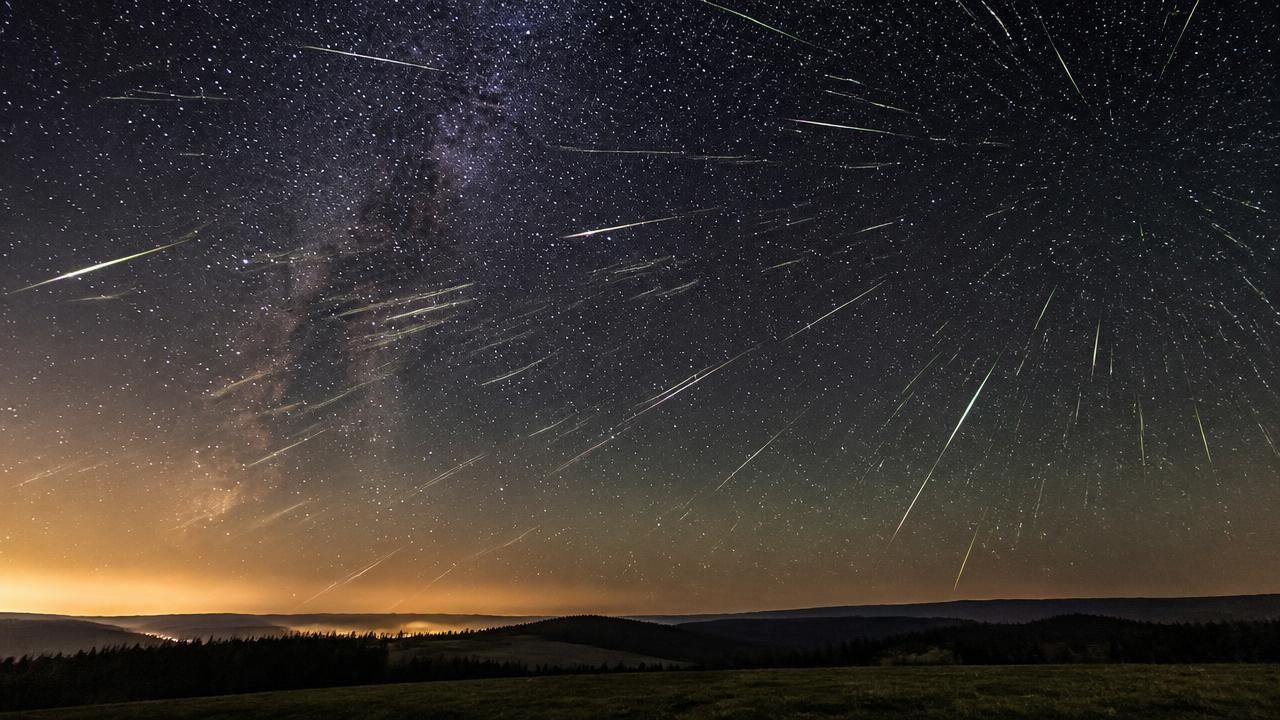
The night of August 12–13, 2026, was a celestial fireworks display par excellence. As Earth plowed through the debris trail of Comet Swift-Tuttle, the annual Perseid meteor shower reached its peak, painting the sky with thousands of streaks of light. Astronomers and sky enthusiasts around the world turned their eyes upward, but one particular observatory in Czechia went a step further: it deployed four dedicated meteor-monitoring cameras, and the result is a stunning all-sky composite now featured as NASA's Astronomy Picture of the Day (APOD) on August 22, 2026.
A Night of 1,706 Meteors
The APOD image, titled "Mostly Perseids," was created by astrophotographer Jakub Koukal. By aligning and combining images from four cameras over the entire night, Koukal produced a panoramic view of the sky from horizon to horizon. The data is remarkable: a total of 1,706 meteors were recorded during that single night. Because the observation coincided with the peak activity of the Perseid shower, the vast majority of those meteors were Perseids.
"Their overwhelming numbers make them easy to spot. Quite convincingly, perseid trails all trace back to a single radiant on the sky at the upper right, a region in the annual shower’s eponymous constellation Perseus." — APOD explanation
Indeed, the composite image makes the radiant unmistakable: every Perseid meteor streak, when traced backward, points to the same celestial region. This perspective geometry is a hallmark of meteor showers and a beautiful demonstration of Earth’s motion through space.
More Than Just Perseids
While Perseids dominate the frame, careful analysis reveals fainter meteors from other sources. The APOD notes the presence of Kappa Cygnids, a minor shower whose radiant lies in the constellation Cygnus, as well as meteors from the antihelion complex, a broad region near Aquarius opposite the Sun in the sky. These weaker showers are often drowned out by richer activity, but with the all-sky camera array, they become visible as separate streaks crossing the Perseid trails.
This ability to disentangle multiple meteor showers from a single night's data is a boon to planetary scientists. Each shower's unique radiant and velocity provide clues about the parent bodies and the structure of interplanetary dust.
August's Celestial Lineup
The Perseids were not the only highlight of August 2026. Forbes astronomer Jamie Carter recently reminded readers of a triple threat of sky events: a solar eclipse, the Perseid meteor shower, and a 96% 'Blood Moon' — a deep partial lunar eclipse. While the exact dates of these events vary, the month offered a rare confluence of solar and lunar activity alongside the annual meteor display.
The partial lunar eclipse, with 96% of the Moon entering Earth's umbral shadow, was expected to be a dramatic sight in itself, briefly giving the Moon a reddish hue. Meanwhile, a solar eclipse — likely annular or partial depending on location — added to the month's appeal. Together, these events turned August 2026 into a skywatcher's paradise.
How to Watch the Perseids
For those who missed the peak, the Perseid shower remains active for several weeks, though at reduced rates. MSN's guide to the 2026 Perseids offered practical advice: find a dark location away from city lights, bring a reclining chair or blanket, and let your eyes adapt for at least 20 minutes. No special equipment is needed—just patience and clear skies.
- Best time: After midnight, when the radiant is highest in the sky.
- Where to look: Toward the northeast, but meteors can appear anywhere.
- Pro tip: Avoid looking at your phone; white light ruins dark adaptation.
The Science Behind the Shower
The Perseids are caused by Earth passing through the debris stream left by Comet Swift-Tuttle, which orbits the Sun every 133 years. As tiny dust particles — some as small as a grain of sand — hit Earth's atmosphere at 59 km/s, they burn up, creating the brilliant streaks we see. The shower has been observed for millennia, with Chinese records dating back to AD 36, and it remains one of the Northern Hemisphere's most reliable and prolific displays.
Modern astronomy, as demonstrated by the Czech observatory's camera network, adds a quantitative layer to what was once pure spectacle. Counting meteors, mapping their radiants, and identifying less-active showers contributes to our understanding of the solar system's dynamic debris fields.
Other Space Milestones
August 2026 also saw NASA's Psyche spacecraft receive a gravity assist from Mars on July 29, using the Red Planet's pull to slingshot toward its metal-rich target asteroid. While not directly related to meteor showers, the mission highlights the renewed focus on the small bodies of our solar system — the same population that gives rise to meteors and shooting stars.
Context and Implications
The APOD composite is more than just a beautiful image; it's a snapshot of our planet's place in the solar system. By documenting the peak of the Perseids with such precision, astronomers can refine models of meteor showers and forecast future activity. For the rest of us, it's a reminder to look up—because the universe is not so far away; it's overhead every clear night.