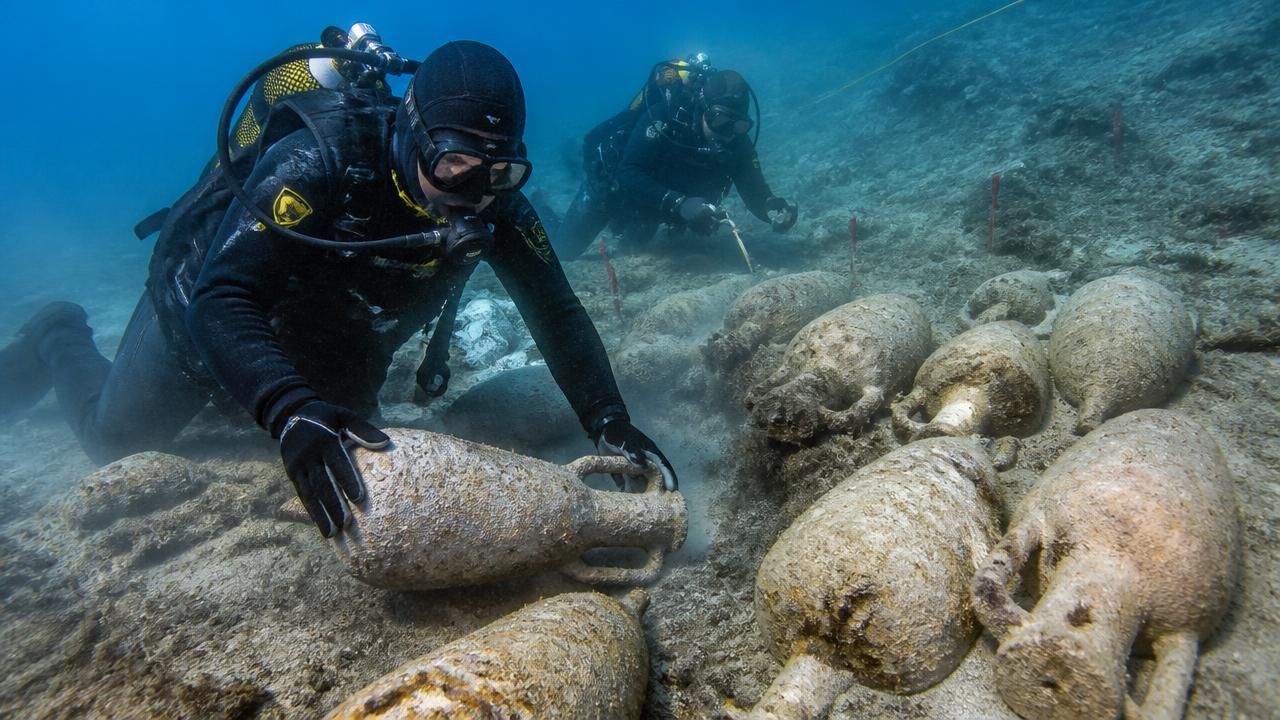
Off the coast of Sicily, divers and police have uncovered the remnants of a Roman ship that sank more than two millennia ago, laden with dozens of amphorae. The discovery, announced this week, has been hailed as one of the most significant maritime finds in the central Mediterranean in years. But beyond the piles of ancient pottery, scientists have revealed an even deeper secret: the ship's hull was coated with a waterproofing mixture whose trapped pollen tells a story of cross-Adriatic trade and repair routes.
The wreck, resting on the seabed near the Sicilian port of Palermo, was first spotted by police divers during a routine patrol. Video footage released by Italian authorities shows rows of intact clay amphorae protruding from the sand, their shapes instantly recognizable to archaeologists as transport jars used for wine, oil, and fish sauce. The vessel is believed to date to the 2nd or 3rd century BC, making it roughly 2,100 to 2,200 years old—a key period of Roman expansion in the Mediterranean.
Amphorae and the Cargo of a Merchant Ship
Amphorae are the signature relics of ancient maritime commerce. The discovery of so many intact examples is rare, as most wrecks are scattered by currents or disturbed by fishing nets. Police video shows the jars stacked in layers, some still sealed with their original stoppers. It is likely the ship was a merchant vessel, perhaps 20-30 meters long, following a route between the Italian mainland and the western Mediterranean colonies.
“This is not just a pile of old pots—it’s a time capsule. The way the cargo is preserved, the way the hull sits on the seabed, it gives us a frozen moment in Roman history,” said Dr. Elda Russo, a marine archaeologist not involved in the recovery.
The Hidden Repairs: Pine Tar and Beeswax
While the amphorae drew the immediate attention, a scientific study published in the journal Archaeological and Anthropological Sciences has analyzed the ship's waterproofing coating in unprecedented detail. Researchers took samples from the hull and found it was coated with pine tar—a thick, sticky substance long known to have been used by ancient shipbuilders. But in one section of the hull, they detected a surprising mixture: pine tar combined with beeswax.
Beeswax in ship pitch is not unknown in antiquity, but this is one of the earliest maritime examples from the Roman period. The mixture would have made the sealant more pliable and water-resistant, especially in areas subject to flex and stress. Scientists believe the beeswax was added during a repair, not during original construction, indicating that ancient sailors carried out ongoing maintenance while at sea or in distant ports.
Pollen as a Geographic Fingerprint
The most remarkable aspect of the new research is how the team used pollen grains trapped within the tar to map the ship's movements. Pollen is notoriously durable and becomes embedded in resinous substances. By comparing the pollen assemblages with regional vegetation patterns, the scientists could pinpoint where the original coating was applied and where each repair took place.
The analysis revealed that the wood and tar originated from the Adriatic region—likely the eastern coast of Italy or the Dalmatian coast. One repair, containing a distinctive mix of pine and beech pollen, pointed to a stop along the northern Adriatic, near modern-day Croatia. Another repair, with a higher concentration of olive and evergreen oak pollen, suggested a southern Adriatic port, perhaps around modern Albania or Greece's Ionian islands.
“The pollen is a geographic fingerprint. It tells us that this ship did not simply sail from one point to another; she was repeatedly patched up in different ports across the Adriatic,” explained lead researcher Dr. Marco Bello. “This is direct evidence of the complex repair networks that sustained ancient trade.”
Trade Routes and the Adriatic Connection
The ship's final resting place off Sicily, far from the Adriatic, suggests that after repairs it continued west, perhaps carrying a cargo of Dalmatian wine or Apulian olive oil to the busy ports of Carthage or Rome. The vessel may have been caught in a storm near the Sicilian coast, or perhaps it struck a reef while approaching Palermo. That it carried amphorae from different regions reinforces the picture of a mixed cargo, picked up at multiple stops—a hallmark of Roman cabotage and long-distance trade.
Historians have long known that the Romans used pine tar as a sealant; Pliny the Elder described its use. But the new study enriches that picture by showing that repairs were not just emergency fixes—they were planned, using locally available materials. The addition of beeswax, for instance, likely came from a port where beekeeping was common, and where the tar itself was of a slightly different consistency.
Differing Perspectives: Artifacts vs. Chemistry
Media coverage of the discovery has branched along two lines. Outlets like MSN and the Italian police focused on the immediate, visceral thrill of the amphorae—golden jars still stacked as they were 2,000 years ago. The video footage went viral, drawing attention to the work of the police dive unit and the protection of underwater heritage. Meanwhile, science-focused publications, such as Science Daily and Discover Magazine, delved into the chemical analysis, highlighting how modern forensics are rewriting maritime archaeology.
Both perspectives are essential. The amphorae give the wreck its emotional weight; the pollen and tar give it scientific meaning. Together, they paint a fuller portrait of a Roman ship not as an isolated artifact, but as a living machine that was maintained, repaired, and reused over years of service.
What Comes Next?
Italian authorities plan to stabilize the wreck site and, if possible, raise a selection of amphorae for display at the regional museum in Palermo. The hull itself will likely remain in situ, protected by a metal cage, as is now common practice to preserve the delicate wood. Meanwhile, the research team intends to analyze more samples from the wreck, hoping to find traces of the ship's cargo—such as grape pollen or fish remains—that could confirm what the amphorae contained.
The discovery underscores a simple truth: the ancient Romans were far more resourceful than we often give them credit for. Their ships were not fragile toys to be dashed on rocks; they were complex machines, with sailors who understood the properties of pitch and wax, who knew which ports had the best tar, and who kept their vessels afloat for decades. The Sicilian wreck is not just a tomb—it is a workshop, a logbook, and a testament to the resilience of ancient seafaring.
As Dr. Russo put it, “Every time we look at a wreck, we think we know the story. Then a new technique comes along, and we realize we were only reading the first line.”