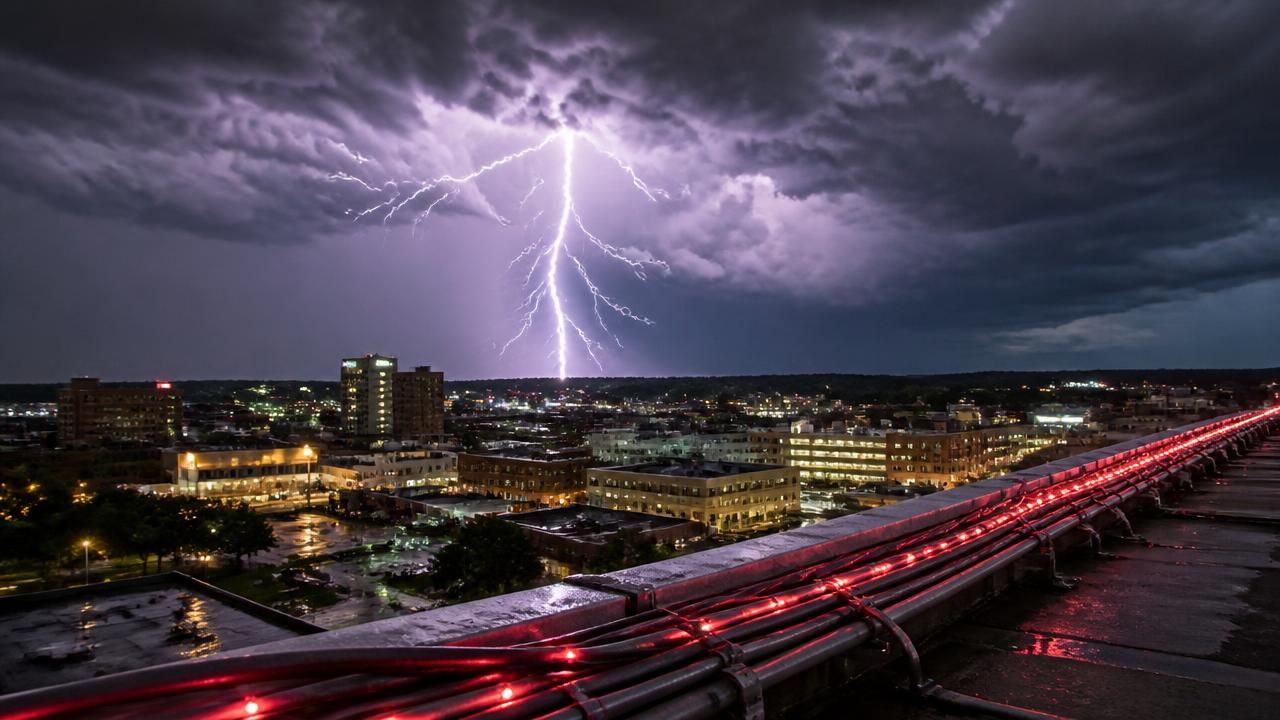
Imagine using the rumble of a summer thunderstorm to see underground. Scientists at Penn State University have done exactly that, converting lightning's acoustic shock waves—known as "thunderquakes"—into seismic probes that image the Earth's shallow subsurface. By detecting these tiny rumbles through existing fiber-optic telecommunications cables, the team has opened a new chapter in urban seismology, a technique that could transform how we map the ground beneath our cities.
"There's a potential option that sits between waiting for an earthquake and triggering your own seismic event: thunderstorms. Some of the energy carried by thunder enters the Earth's upper crust, triggering what are termed 'thunderquakes.'"
From Storm to Seismic Source
Most of what we know about Earth's interior comes from observing seismic waves. These waves travel at different speeds depending on the rock they pass through—its density, water content, fractures, and whether it is solid or partially molten. Traditionally, scientists rely on natural earthquakes to generate these waves, or they deliberately set off explosives to create controlled pulses. In a new study, published in npj Climate and Atmospheric Science, the Penn State team demonstrates a third option: thunderstorms.
When lightning strikes, it heats the air to tens of thousands of degrees, creating a rapid expansion that produces thunder. Some of that acoustic energy couples into the ground, generating seismic waves. By analyzing these "thunderquakes," the researchers hoped to map the shallow subsurface. But there was a catch: the signals are extremely complex, made up of a chaotic mix of waves from a moving, line-shaped source. "The seismic signals are extremely complex, making it difficult to extract clear signals from them," the team explained.
Fiber-Optic Cables Become Ears
To overcome that challenge, the researchers used distributed acoustic sensing (DAS), a technique that turns ordinary telecommunication fiber-optic cables into dense arrays of seismic sensors. A laser sends pulses down the cable, and imperfections in the glass reflect light back. Vibrations from seismic waves cause minuscule stretching or compression of the cable, altering the reflected light. By analyzing these changes, scientists can measure the passage of seismic waves at every point along the cable.
The team tested the method on the Penn State campus, using a 5-kilometer (3-mile) underground cable. Over several months, they recorded thunderquakes from nearby storms. After developing a new model to untangle the complicated signal patterns, they successfully reconstructed a 3D image of the subsurface beneath the campus, revealing layers of sedimentary rock and buried structures. "This shows that urban environments, where fiber-optic cables are already abundant, can become large-scale seismic observatories without the need for expensive instrumentation," said the researchers.
A Growing Toolbox for the Planet and Beyond
The new findings are part of a broader wave of innovation using fiber-optic sensing. Just this year, other teams have shown that DAS can detect earthquake magnitude in seconds, turn seafloor cables into tsunami early-warning systems, and locate volcanic earthquake swarms. In another example, Caltech researchers used fiber-optic sensing to monitor groundwater fluctuations, helping with water management in drought-prone regions. Even the Moon is a target: scientists are testing the concept of deploying fiber-optic sensors to image the lunar interior.
Here are some of the most promising applications now emerging:
- Earthquake early warning: Seafloor fiber-optic cables can detect P-waves and estimate rupture size before destructive S-waves arrive.
- Volcano monitoring: DAS arrays track small seismic events and magma movement, giving more time to predict eruptions.
- Water resource management: Cables can sense changes in groundwater storage by measuring strain caused by aquifer compaction.
- Urban infrastructure: Cities can map underground utilities, soil conditions, and even track traffic-induced vibrations.
- Lunar exploration: NASA-funded studies are exploring fiber-optic sensors for future missions to the Moon and beyond.
Challenges and the Road Ahead
While the storm-based method is promising, it has limits. Thunderquakes are weaker than most natural earthquakes, so they only probe the shallowest few hundred meters of the crust. The complex, non-point-source nature of thunder requires sophisticated modeling, and weather dependence means occasional downtime. Still, the fact that storms are frequent in many parts of the world—and fiber-optic cables run below most cities—makes this an attractive, low-cost complement to existing seismic tools.
"This work demonstrates that everyday disturbances, like thunder, can be used for scientific discovery," the authors noted. "As we refine the technique, we may be able to monitor changes beneath our feet in real time—from groundwater depletion to the integrity of levees and bridges."
With more research, the combination of thunder and fiber optics could turn every storm into a scientific instrument, making the invisible structures that support our cities and planet just a little bit clearer.