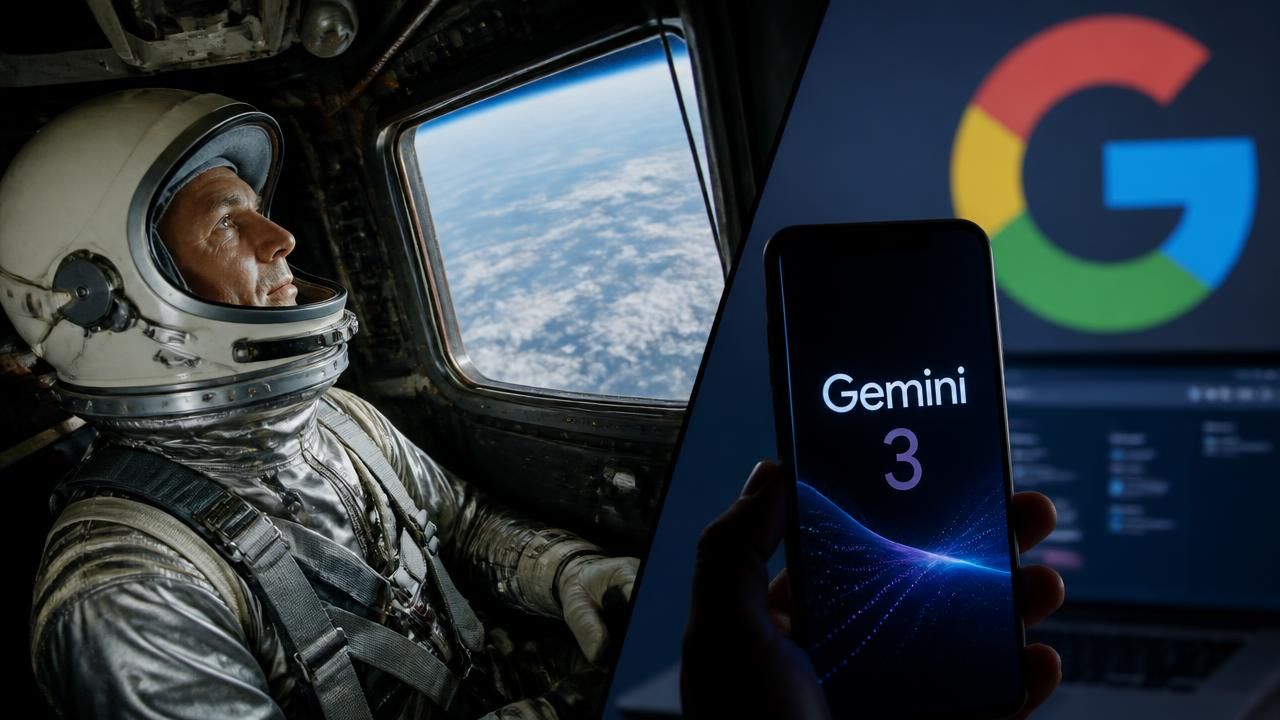
In the pantheon of iconic names, few carry the weight of Gemini. For space enthusiasts, it conjures the pioneering NASA program that taught astronauts to navigate the void. For technologists, it now evokes Google's cutting-edge artificial intelligence models. This week, both worlds are in the spotlight: NASA revisits the visual acuity experiments of the original Gemini missions, while Google unveils Gemini 3, the latest iteration of its AI system. Together, these stories reveal a shared thread—the relentless quest to see, understand, and interpret the world from ever-greater vantage points.
Astronauts Who Saw Too Much
In May 1963, astronaut L. Gordon Cooper Jr. orbited Earth aboard the Mercury-Atlas 9 spacecraft, snapping 29 color photographs from his Faith 7 capsule. As he glided 100 miles above the planet, Cooper reported an extraordinary sight: vehicles motoring along dirt roads, trains belching smoke, and the rooftops of houses. His claims were met with skepticism. Vision experts of the era argued that even astronauts with perfect 20/20 vision could not resolve objects smaller than 150 feet across from orbital altitudes. Cooper, however, possessed exceptional 20/12 vision—and he was not alone. Other Mercury astronauts also insisted they could see fine details on the Earth's surface.
The debate over human visual limits became a formal experiment during the Gemini V mission in August 1965. Cooper, joined by astronaut Charles "Pete" Conrad Jr., participated in a series of visual acuity tests designed to determine exactly what the human eye could discern from orbit. The results helped scientists understand the capabilities and limitations of human vision in space, influencing the design of future spacecraft windows and observation protocols.
"Cooper's reports were dismissed as fantasy, but they sparked a rigorous scientific inquiry into the remarkable resolving power of the human eye," noted a NASA historian. "The Gemini experiments turned anecdote into data."
The findings had profound implications: humans could serve as effective remote sensors from orbit, a capability that would later inform satellite imaging and Earth observation strategies.
Google's Gemini: A New Kind of Sight
Fast-forward six decades. Google has adopted the Gemini name for its family of AI models, and the latest announcements signal a leap in machine perception. This week, Google introduced Gemini 3, described as a new era of intelligence. Building on the foundations of Gemini 2.5—which was already hailed as Google's most intelligent model—Gemini 3 adds upgraded smarts, new capabilities, and a deeper integration with the Gemini app and Gemini Live assistant.
One of the headline features is Agentic Vision, a capability that allows the AI to understand and act upon visual information in real time. This goes beyond simple image recognition; Gemini 3 can interpret scenes, reason about spatial relationships, and even guide users through physical tasks. The model's multimodal capabilities—processing text, images, audio, and video—were showcased in seven examples released by Google Developers, demonstrating everything from identifying plant species to explaining complex machinery.
Gemini Live and the App Ecosystem
Google also unveiled updates to Gemini Live, making the assistant more helpful, natural, and visually aware. The new version connects with more Google apps, enabling users to point their camera at anything—a restaurant menu, a broken bicycle, a travel landmark—and receive contextual, actionable responses. This vision of seamless human-AI interaction echoes the awe of Cooper peering out of his capsule: seeing the world clearly and understanding it instantly.
Two Geminis, One Quest
The parallel is striking. NASA's Gemini program was named for the constellation, symbolizing the twin goals of mastering spaceflight and understanding human performance. Google's Gemini AI is also a twin of sorts: it pairs raw computational power with human-like perception, bridging the gap between data and meaning.
Both efforts push the boundaries of "sight." The Gemini astronauts proved that human eyes could discern detail from the edge of space; Gemini AI aims to give machines an equally remarkable ability to parse the visual world. In a way, the AI models are fulfilling the vision of those early astronauts—creating a synthesized perspective that can see what we see, and more.
Perspectives and Implications
Coverage of Google's announcements, from sources like the Google Developers Blog and the official Google Blog, emphasizes the technological leap represented by Gemini 3 and its predecessors. Analysts note that agentic vision could revolutionize industries such as navigation, education, and assistive technology. Meanwhile, NASA's historical retrospective reminds us that understanding visual perception is not just about engineering—it's about the fundamental nature of how we interact with our environment.
Critics, however, caution that AI perception is not the same as human understanding. While Gemini 3 can identify patterns and suggest actions, it lacks the contextual awareness born from lived experience. The NASA experiments, by contrast, measured a uniquely human capability—one that evolved over millennia on Earth and now extends into space.
As Google continues to refine its Gemini models, and as NASA looks back at its pioneering work, the name “Gemini” stands as a beacon of exploration. Whether from a capsule orbiting 100 miles high or from a smartphone camera processed by billions of parameters, the goal is the same: to see clearly, interpret accurately, and act wisely.
What Lies Ahead
The latest Gemini 3 AI model is expected to roll out across Google's ecosystem in the coming months, bringing agentic vision to millions of users. For scientists, the historical Gemini data remains a touchstone for understanding human perception in extreme environments. Together, these parallel stories remind us that every new horizon—whether in space or in silicon—begins with a simple act: looking and asking, "What is that?"