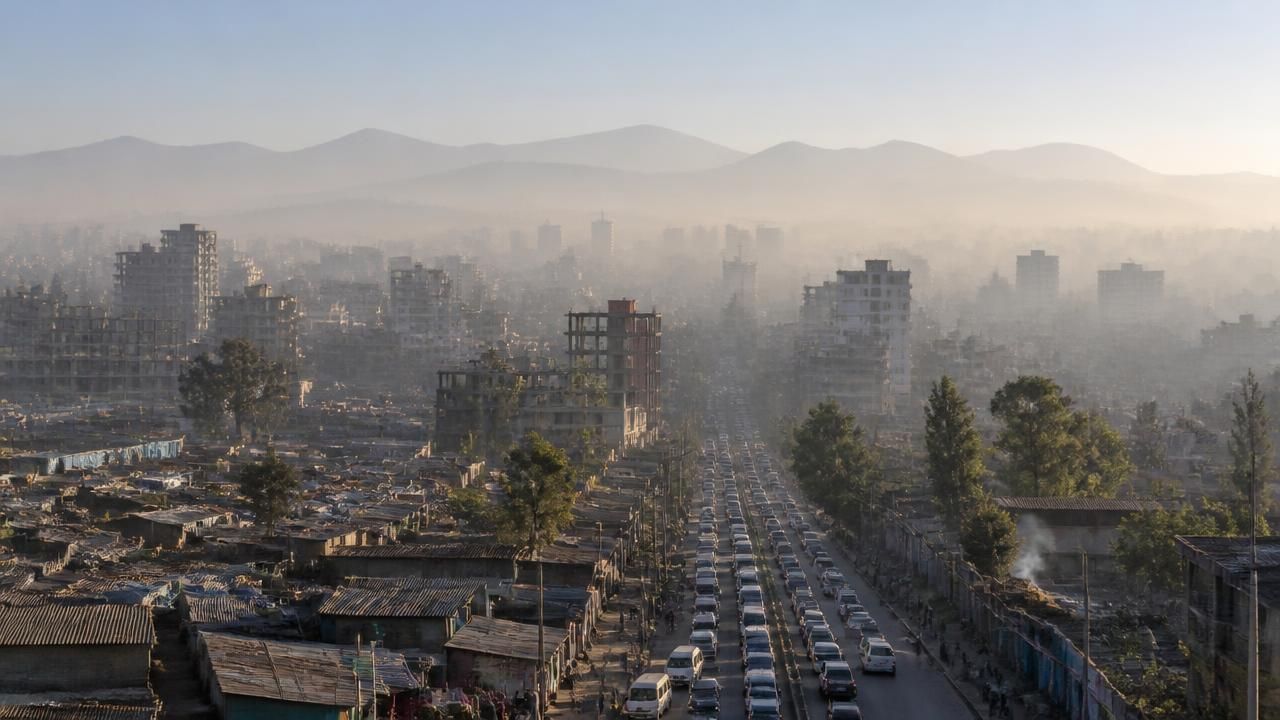
Addis Ababa, Ethiopia — For the first time, a NASA-led air quality monitoring network has captured a detailed, multi-year picture of the particulate pollution blanketing Ethiopia's capital. The findings, published in the journal ES&T: Air, reveal that residents of Addis Ababa are exposed to levels of fine particulate matter (PM2.5) more than three times the U.S. Environmental Protection Agency's annual safety standard, with black carbon — a potent climate-warming pollutant and respiratory hazard — reaching concentrations up to nine times higher than in major U.S. cities.
A Pioneering Measurement Campaign
Between 2022 and 2025, scientists deployed ten ground-based air sensors across Addis Ababa as part of NASA's Multi-Angle Imager for Aerosols (MAIA) mission. Unlike satellite observations, these sensors provide continuous, real-time measurements at street level, capturing the ebb and flow of pollution across different neighborhoods and times of day. The project focuses on PM2.5 — tiny airborne particles 2.5 micrometers or smaller in diameter, which can penetrate deep into the lungs and bloodstream.
"To our knowledge, this is the first long-term, multisite study of continuous PM2.5 and black carbon measurements in Ethiopia," said Sina Hasheminassab, MAIA's deputy principal investigator at NASA's Jet Propulsion Laboratory. "Many rapidly growing cities have limited long-term monitoring, so these measurements provide an important baseline for understanding how pollution changes across space and time."
Key Findings
According to the paper, the three-year average PM2.5 concentration was 30 micrograms per cubic meter (µg/m³). That is more than triple the EPA's current annual standard of 9 µg/m³, which was tightened in 2024. Black carbon, a component of PM2.5 produced by incomplete combustion, was measured at levels four to nine times higher than in three U.S. metropolitan areas also monitored by MAIA.
- Three-year average PM2.5 concentration: 30 µg/m³
- EPA annual PM2.5 standard: 9 µg/m³
- Black carbon levels: 4-9 times higher than in three U.S. metro areas
- 10 monitoring sites operated from 2022 to 2025
What Drives Addis Ababa's Pollution?
The high-resolution data reveal distinct pollution patterns tied to human activity. Concentrations spike during morning and evening rush hours, linked to emissions from millions of cars, motorcycles, and three-wheeled taxis — many of which are aging diesel vehicles. Seasonal increases occur during dry months and around holiday celebrations, when firework displays and biomass burning for cooking and heating add to the atmospheric burden. Open waste burning, a common practice in many developing cities, also contributes to the soot load.
Rush Hour and Seasonal Spikes
Rapid urbanization has exacerbated the problem. Addis Ababa's population has grown from about 2.7 million in 2007 to more than 5 million today, with vehicle ownership surging as the economy expands. The city's infrastructure, including road networks and public transit, has struggled to keep pace, leading to congestion and a reliance on highly polluting modes of transport.
Health and Climate Implications
The health stakes are immense. The 2025 State of Global Air Report, cited in the study, estimates that exposure to PM2.5 is associated with roughly 4.9 million premature deaths worldwide each year. Stroke, heart disease, lung cancer, and respiratory infections are all linked to the pollutant. Black carbon, in particular, has been classified as a likely carcinogen and has been shown to damage respiratory and cardiovascular systems even at low concentrations.
Beyond health, black carbon contributes to climate change by absorbing sunlight and accelerating glacial melting in high-altitude regions like the Ethiopian Highlands and Kilimanjaro. Reducing its emissions offers a double benefit: cleaner air and slower global warming.
Ethiopia Takes Bold Policy Action
In a landmark move, Ethiopia in 2024 became the first nation in the world to ban the import of internal combustion engine vehicles. The policy, which applies to both new and used cars, aims to transition the country toward electric mobility. Addis Ababa has also begun adding bike lanes and charging stations for electric vehicles, signaling a commitment to reimagining urban transportation.
These measures make the MAIA data all the more timely. The monitoring provides a baseline for tracking how air quality responds to policy interventions, such as the vehicle import ban and the expansion of public transit. "As Addis Ababa continues to grow and evolve, these measurements will be critical for assessing the effectiveness of air quality policies," the authors note in the paper.
A Global Lesson
The study is not just an Ethiopian story. Many rapidly growing cities in Africa, Asia, and Latin America face similar challenges, yet lack the monitoring infrastructure needed to guide policy. NASA's MAIA mission demonstrates how relatively low-cost ground sensors, combined with satellite and airborne data, can offer a comprehensive view of pollution even in remote regions.
"The techniques and insights from this study are directly applicable to underserved cities worldwide," the paper concludes. "By understanding what is in the air we breathe, we can take targeted actions to improve public health and environmental justice."
The MAIA team plans to extend its measurements in Addis Ababa and expand to other African cities, providing a growing body of evidence for local and national decision-makers. For now, the message is clear: the air over Addis Ababa is a public health emergency, but one that can be addressed with data, policy, and political will.