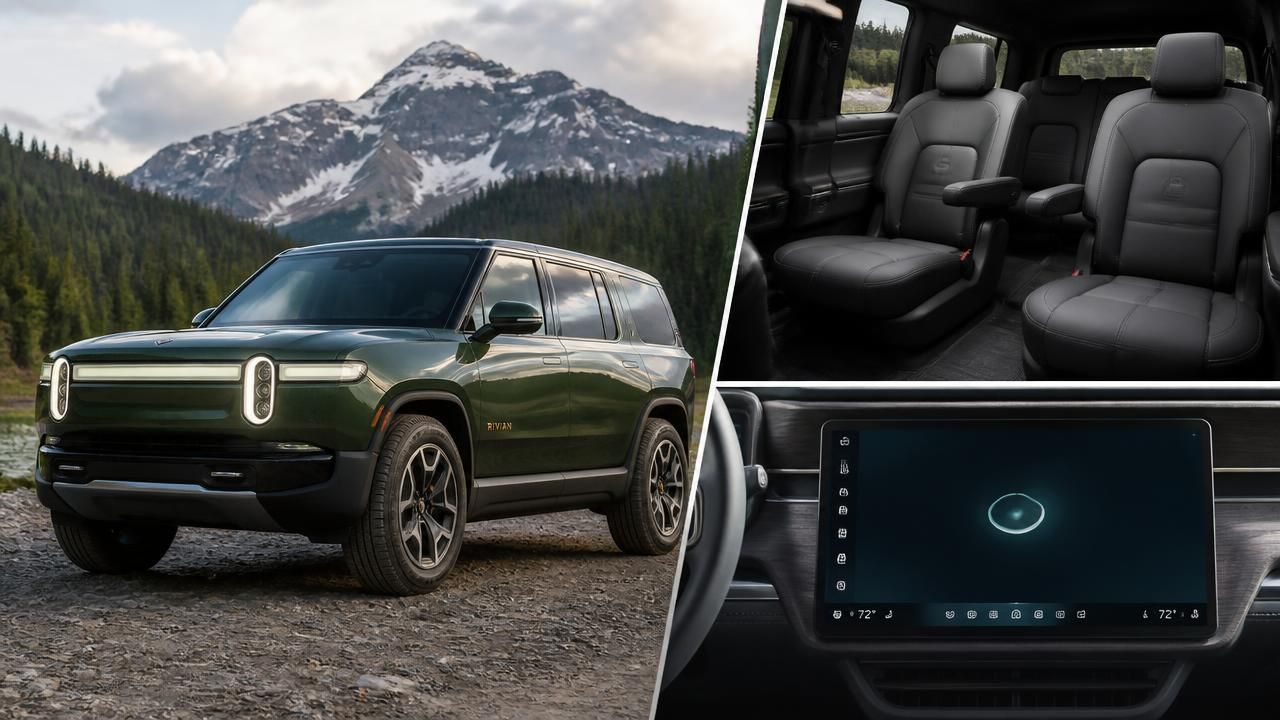
Rivian is making headlines on multiple fronts this week, from finally addressing a long-standing R1S owner complaint to doubling down on an in-house AI assistant powered by Google Gemini — and even taking aim at Tesla in the autonomous driving arena. But one thing the company remains steadfastly against is integrating Apple CarPlay or Android Auto into its vehicles, a stance that has divided owners and sparked countless workarounds.
Captain's Chairs Finally Arrive for the R1S
For years, owners of the three-row R1S SUV have been vocal about a missing option: second-row captain's chairs. As The Verge reports, the lack of standalone seats in the middle row made accessing the third row a chore, especially for parents juggling child seats. Some were so frustrated they considered ripping out the bench and installing aftermarket chairs. Now, Rivian is finally answering those calls with an official captain's chair option, giving R1S owners the accessible pathway they've begged for.
"For years, Rivian owners have lamented the absence of captain's chairs in the R1S, noting that the three-row SUV would be much improved with standalone seats instead of a bench in the second row." — The Verge
Rivian Assistant: A Gemini-Powered Voice AI
Meanwhile, Rivian is pushing forward with its own voice assistant, recently showcased in a hands-on video review of software update 2026.15. The feature, reportedly developed in partnership with Google Gemini, promises to be a conversational, context-aware companion — far beyond simple voice commands. RivianTrackr reports that the assistant can handle tasks like adjusting climate, navigating, and even answering questions about the vehicle's status, all with a natural language interface that leverages Google's cutting-edge AI models.
This move signals Rivian's intent to build a deeply integrated digital ecosystem, one that doesn't rely on smartphone mirroring. According to a source speaking to Digital Trends, Rivian believes that CarPlay and Android Auto are already outdated concepts. The company argues that as vehicles gain their own powerful AI assistants, the need to project a phone's interface onto the dashboard will fade away.
Why CarPlay Is 'Obsolete'
Rivian's dismissal of CarPlay isn't just about control; it's about vision. The company sees a future where the car is a smart agent in its own right, capable of understanding driver intent and proactively assisting. In that world, a smartphone mirroring system is a clunky, disconnected solution. Instead, Rivian's Gemini-powered assistant aims to offer a seamless, car-native experience that learns and adapts.
Notably, this philosophy contrasts with recent reports that Tesla might actually be considering adding Apple CarPlay to its vehicles — a surprising shift for a company that, like Rivian, has traditionally rejected phone integration. If Tesla caves, it would highlight a growing divide in the industry: some automakers embracing the convenience of smartphone ecosystems, while others like Rivian double down on proprietary AI.
For Rivian owners who miss CarPlay or Android Auto, there is a workaround, as detailed in a recent MSN guide: using the built-in web browser and Bluetooth to approximate some functions. But it's a far cry from native integration, and Rivian seems content to bet that its AI assistant will eventually win over skeptics.
Autonomous Driving: Second-Mover Advantage
Beyond the infotainment battle, Rivian is also making strides in autonomous driving. Autoevolution notes that the company is aggressively going after Tesla, leveraging what analysts call a 'second-mover advantage.' By studying Tesla's decade of Autopilot data and missteps, Rivian can implement a safer, more refined self-driving system from the ground up. The hardware is already in place, and software updates are steadily expanding driver-assist features.
Combined with the new AI assistant, Rivian is positioning itself as a tech-forward automaker that doesn't just build electric vehicles — it builds intelligent machines. The captain's chairs may be a simple comfort upgrade, but they signal that Rivian listens to its community. And the Gemini partnership signals it's serious about leading in automotive AI.
What This Means for the EV Market
Rivian's multipronged strategy reflects a broader industry shift. As EVs become increasingly software-defined, the battle is no longer just about range and charging speed, but about the digital experience. By refusing to cede the dashboard to Apple or Google, Rivian is staking a claim to its own ecosystem — a risky bet, but one that could pay off if its AI assistant proves as capable as promised.
For now, R1S families will enjoy easier third-row access, and tech enthusiasts can marvel at a voice assistant that actually feels like an assistant. But the biggest story may be the philosophical divergence from Tesla: Rivian is determined to do what Tesla won't — offer a truly open alternative to phone mirroring, while simultaneously chasing Musk's crown in autonomy. The coming year will test whether that vision resonates with consumers.
As the EV landscape evolves, one thing is certain: Rivian is not afraid to go its own way.