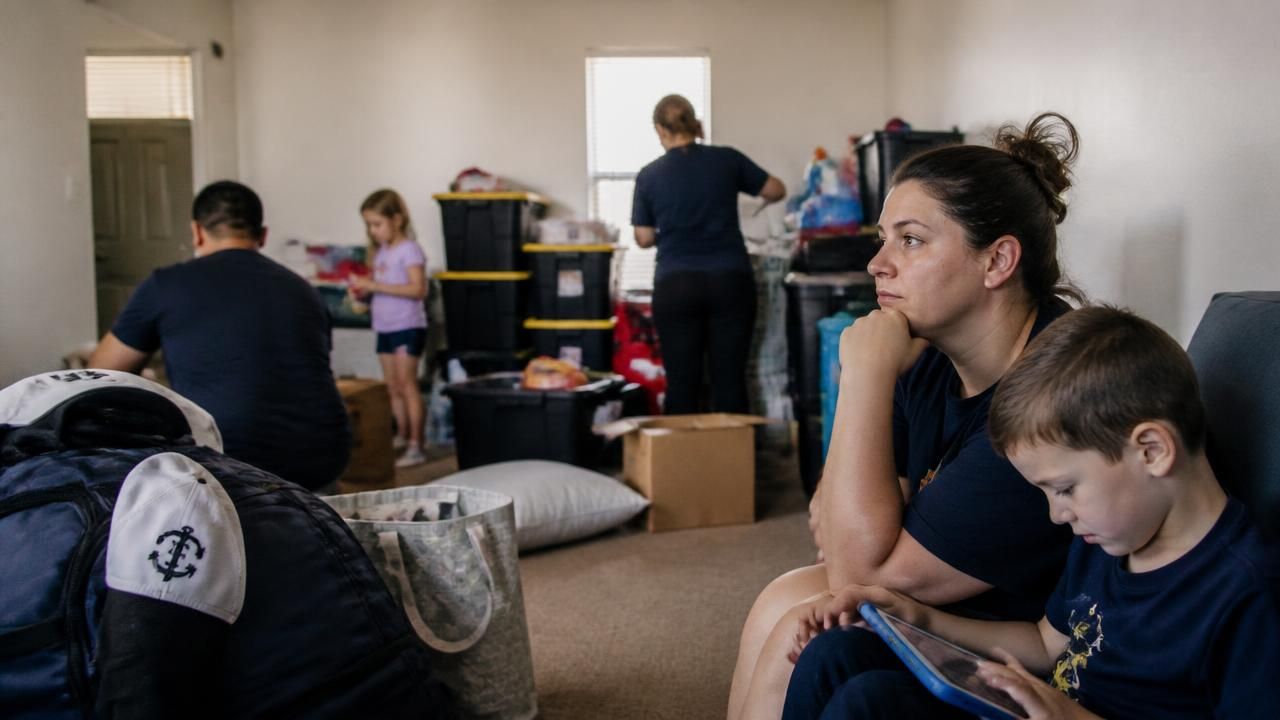
For hundreds of U.S. Navy sailors and their families, life has ground to a halt. They sit in cramped temporary housing in the United States and Europe, their belongings still in storage near bases in Bahrain, Qatar, and other Middle Eastern posts they were evacuated from months ago. The military told them it was a precautionary measure—a response to escalating regional tensions. But what was billed as a short-term relocation has stretched into an indefinite limbo, and no one can say when—or if—they will return.
The evacuation, which began in late summer and continued into the fall, affected thousands of personnel and dependents stationed at installations across the Gulf region. It followed a series of escalating incidents, including drone and missile attacks on U.S. forces in Iraq and Syria, and warnings from intelligence agencies that American bases could be targeted. The Pentagon moved quickly to draw down non-essential personnel, but the operational need for sailors remained, leaving gaping holes in both military readiness and family stability.
Lives Put on Pause
For many, the hardest part is the silence. "We were told we'd be here for 60 days, maybe 90, while they adjusted force protection conditions," explained one sailor's spouse, who asked to remain anonymous to avoid jeopardizing the family's situation. "That was five months ago. Now we can't even get a straight answer about whether our housing will be extended." The uncertainty has forced families to make painful choices: some have pulled children out of schools, others have quit jobs or placed careers on indefinite hold. "Every day I check my email, expecting orders, and every day there's nothing," said a petty officer based in Bahrain before the evacuation. "My family is in limbo, and I'm physically here but mentally there."
The Human Toll
Military family support organizations report a surge in requests for counseling and financial assistance. "This is a uniquely stressful situation because the timeline is completely opaque," said Kathleen Moakler, a former deputy assistant secretary of defense for family readiness. "In a standard deployment, you have a start and an end date. Here, families have no endpoint to anchor their expectations. That ambiguity can be more corrosive than temporary hardship."
Children have been particularly affected. At a base in Norfolk, Virginia, where many evacuees were processed, community groups have set up after-school programs. But counselors say the repeated disruptions take a toll. "I've seen kids who've changed schools twice in one semester," said one volunteer coordinator. "They stop asking questions because they've learned the answers don't help."
"We're not asking for a permanent assignment or a cushy shore duty. We just want to know if we're going back or if we need to move on. It's the not knowing that's killing us." — A Navy spouse, on condition of anonymity
Military's Response: Operational Security vs. Family Needs
Pentagon officials say they are working on a plan but are constrained by the volatile security environment. "We are continuously assessing the threat level in the region," said Navy spokesperson Commander Erica Whitaker in an emailed statement. "The safety of our service members and their families remains our top priority, and we will make determinations based on the best available intelligence."
That answer, repeated in various forms, has done little to satisfy those waiting. Congressional staffers say they have received numerous inquiries from affected families, but the Department of Defense has offered no firm dates. "It's a force protection call, and those are inherently classified," a House Armed Services Committee aide noted. "But there has to be a better way to communicate with families who are being asked to absorb so much uncertainty."
Retired Rear Admiral John Kirby, now a military analyst, argues the military is caught between conflicting imperatives. "You don't want to telegraph your operational plans to adversaries, especially in a region where the threat picture shifts by the hour," he said. "But you also have a moral obligation to treat families as stakeholders in the mission. The current approach, while well-intentioned, risks eroding trust in the institution."
Historical Precedents
This is not the first time the U.S. military has executed a mass evacuation from the Middle East. In 2020, after Iran launched ballistic missiles at Al-Asad Air Base in Iraq, the Pentagon temporarily withdrew hundreds of personnel and dependents from several bases, though most returned within weeks. More recently, the 2021 withdrawal from Afghanistan saw a larger, more chaotic evacuation, but that involved a permanent closing of a footprint.
The current situation differs because the bases remain active. "We're not closing anything," explained former Pentagon official David Berteau of the Defense Acquisition University. "We're in a state of suspended animation, hoping the security picture improves. That's uncharted territory for a large-scale operation."
The Strategic Implications
The prolonged absence of families also affects morale and retention, which are already strained after years of high-tempo operations. "Service members have to wonder: if my family isn't safe enough to live there, why am I ordered to stay?" said Berteau. "That's not an unreasonable question, and the Pentagon needs to address it frankly."
Meanwhile, the naval mission continues. Ships still deploy from overcrowded facilities; administrative duties have been consolidated; and some combat units have been moved to other bases in the region. The strain shows, but sailors say they are committed to the mission. "We're professionals. We'll do our jobs," one chief petty officer said. "But the constant uncertainty about our families makes it ten times harder."
What Happens Next?
Military officials point to three possible outcomes: a return to the Middle East once tensions subside; a permanent reassignment to other bases in the U.S., Europe, or the Pacific; or a partial return with a smaller footprint. Each option carries different timelines and implications.
- Return: Depends on diplomacy with Iran and other actors, plus the stability of longstanding U.S. alliances in the Gulf. Could occur within months if de-escalation holds.
- Reassignment: Would require the Navy to rebalance its global force posture, impacting other missions and families. Likely if the threat is judged to be long-term.
- Partial return: A compromise, keeping some families abroad while others stay behind—but that could create two tiers of service, risking morale.
For now, sailors and their families are left to navigate a system that moves on its own clock. "I've been in for 15 years, and I've learned to expect the unexpected," said the petty officer based in Bahrain. "But this is different. This isn't a deployment or a tasking. It's just a void. And you can't plan a life around a void."
The Pentagon says it will provide an update "in the coming weeks." Those words, once a comfort, now ring hollow to those who have heard them before. As one spouse put it, "We've become experts in waiting. But even experts run out of patience."