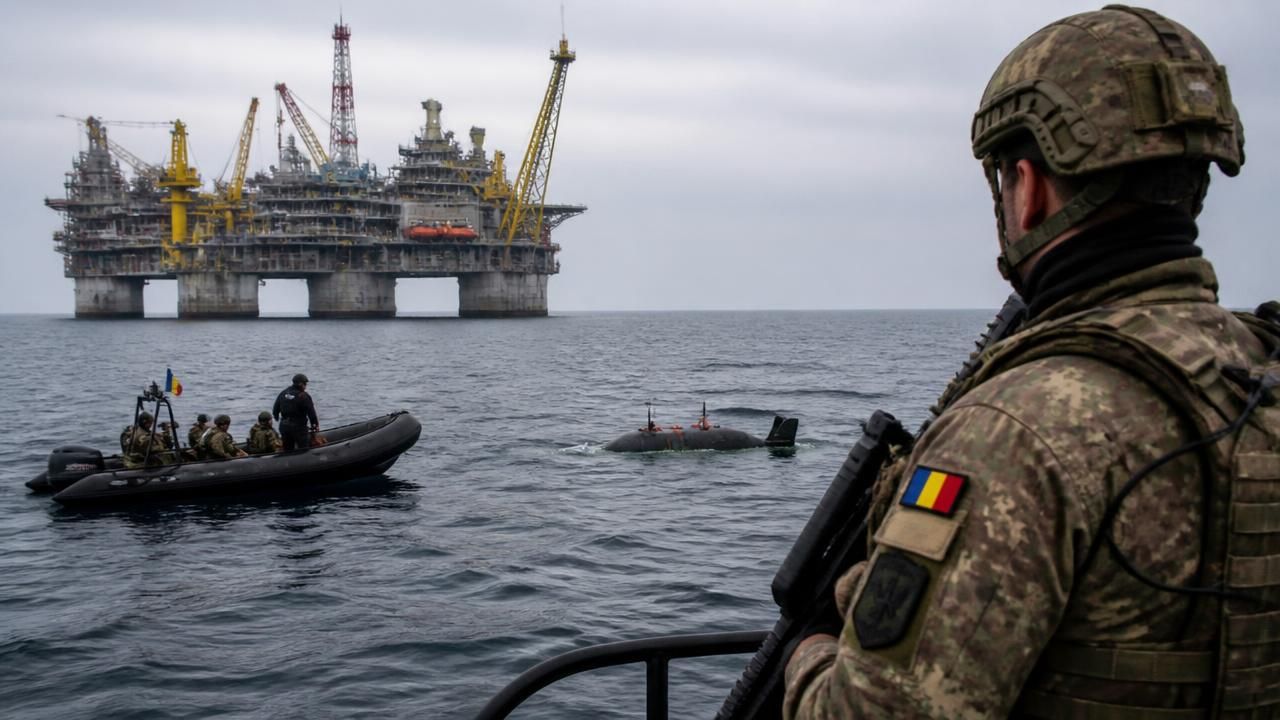
On August 11, Romanian army divers used explosives to destroy two Russian-made drones found drifting in the Black Sea near Romania's largest natural gas project, the Neptun Deep offshore development. Defense Minister Radu Miruță shared a video on Facebook showing one of the drones being blown up in the water by explosive ordnance disposal divers, according to Reuters and other outlets. The drones, identified as Gerbera-type systems of Russian design, were first spotted by a ship working in the vicinity of the project. A Romanian Coast Guard ship responded with army soldiers aboard, finding the drones and other debris. Miruță also revealed that Romania had reached out to “Ukrainian partners who confirmed that the systems do not belong to them.”
The incident underscores a growing threat to offshore energy installations as conflict in the Black Sea region intensifies. The Neptun Deep project, once complete, will make Romania the largest natural gas producer in the European Union, making it a strategic asset—and a potential target. While the drones found were unarmed and appeared to be surveillance or decoy systems, their presence near the gas field raises alarms about the security of critical energy infrastructure.
Offshore Energy Under Siege
The discovery near Romania is just one example of how drones are becoming a persistent menace to offshore platforms, pipelines, and undersea cables. Analysts point to a series of incidents in recent months, including Ukrainian drone strikes on Russian oil facilities and Russian hybrid operations aimed at European energy links. According to Upstream, Ukraine has resumed its assault on Russia's oil exports with new Black Sea attacks, targeting terminals and infrastructure vital to Moscow's economy. In one notable attack, Russia's largest oil terminal was engulfed in flames after a drone strike, demonstrating the vulnerability of such facilities to aerial threats.
Meanwhile, Russia has accused Ukraine of “energy terrorism” over an alleged strike on the TurkStream pipeline, a crucial conduit for Russian gas to Europe. France 24 reported the accusation, which Kyiv has denied. These tit-for-tat allegations highlight the increasingly blurred lines between military and civilian energy targets, with both sides using drones to disrupt supply chains and economic lifelines.
Red Sea and the Global Context
The threat is not confined to the Black Sea. In the Red Sea, Houthi attacks have disrupted vital shipping routes, forcing vessels to reroute and raising insurance costs. As noted by the Universidad de Navarra, these attacks underscore the fragility of global maritime chokepoints and the importance of protecting critical infrastructure far from traditional battlefields. The parallels between the Red Sea and Black Sea situations are striking: non-state actors and states alike are exploiting vulnerabilities in energy transportation networks to exert geopolitical pressure.
“The security of Europe's critical undersea infrastructure depends on coordination and collaboration among states, industry, and NATO,” said a report from the Centre for European Reform. “Russia has been mapping and probing these networks for years, and the response must be equally systematic.”
Hybrid Threats and the Need for Coordination
The presence of Russian drones near Romania's gas field is part of a broader pattern of hybrid warfare. The Centre for European Reform (CER) has warned that Russia is conducting operations against Europe's critical infrastructure, including undersea cables and energy installations, using methods that fall below the threshold of open conflict. These operations include surveillance, sabotage, and disinformation, all designed to test European unity and resolve.
Experts argue that protecting these assets requires a whole-of-society approach. NATO has increased its presence in the Baltic and Black Seas, but more needs to be done to coordinate intelligence sharing, invest in underwater surveillance, and harden physical defenses. As a RAND Corporation analysis noted, “Protecting Europe's critical undersea infrastructure depends on coordination and collaboration” among governments, military forces, and private operators. The challenge is that much of this infrastructure is privately owned, and responsibility for its security is often fragmented.
The Romanian Response and NATO Implications
Romania's handling of the drone discovery—quickly dispatching military divers to neutralize the threat—demonstrates a readiness to protect its energy investments. The Romanian Defense Ministry's statement that Ukraine confirmed the drones were not theirs suggests that Russia is the likely origin, though Moscow has not commented. This incident may prompt NATO to bolster its monitoring of drone activity in the region, especially around critical energy projects.
The broader implications are significant. Europe is increasingly dependent on offshore energy sources as it seeks to reduce reliance on Russian gas. Yet, the very infrastructure that provides this energy is now at risk from small, inexpensive drones that can be launched from ships or coastlines. Defending against this threat requires advanced detection systems, kinetic countermeasures, and international legal frameworks to hold offenders accountable.
What's at Stake
The Neptun Deep project represents a major investment for Romania and the EU. When fully operational, it is expected to produce around 10 billion cubic meters of gas annually, enough to meet Romania's entire domestic demand and more. This gas is seen as a bridge fuel to help Europe transition away from coal and Russian imports. Any disruption to its development or operation would have major economic and geopolitical consequences.
But the stakes go beyond Romania. The Black Sea is a key transit corridor for energy and trade, with multiple undersea pipelines and cables crossing its waters. The latest drone incident is a reminder that this infrastructure is vulnerable not only to state-on-state attacks but also to hybrid tactics designed to create chaos and uncertainty.
As the conflict between Russia and Ukraine continues, the risk of escalation in the maritime domain remains high. Both sides have demonstrated a willingness to use drones against energy targets, and the potential for miscalculation or accidental escalation is real. International observers are calling for greater transparency and communication channels to prevent incidents from spiraling into broader conflict.
Conclusion: Securing the Energy Future
The destruction of the two Russian drones near Romania's gas field is a small skirmish in a much larger battle over energy security. It highlights the need for a comprehensive, coordinated strategy to protect critical offshore infrastructure from drones and other threats. This strategy must include military measures, such as air defense and naval patrols, as well as diplomatic efforts to establish norms against attacking civilian energy facilities.
For now, Romania has demonstrated its resolve to defend its assets. But the broader challenge remains: how to secure a vast and vulnerable underwater network that is essential to Europe's economy and security. As the Centre for European Reform noted, the response must be as systematic and sustained as the threat itself. The drones found near Neptun Deep may be gone, but the questions they raise are far from resolved.